

F. Tabassum ( Department of Community Health Sciences, Karachi Medical and Dental College, Karachi. )
L. A. Baig ( Department of Community Health Sciences, Karachi Medical and Dental College, Karachi. )
November 2002, Volume 52, Issue 11
Original Article

Abstract
Introduction: Pakistan’s exports have suffered heavy losses due to its denunciation for use of children in the industry on the premise that it destroys their childhood and desires for progress. The international community has not realized the root cause of child employment and imposed harsh economic sanctions that have harmed Pakistan’s economy leading to further deterioration of health and well being of these unprivileged children.
Objectives: To identify the reasons behind child labour and to asses the occupational, health and related problems faced by the working children.
Methods: This study was done in a section of a squatter settlement Bhutta village near the seaport called Accora with a population of 10000 (approx.). It was a cross-sectional study using a structured questionnaire with questions regarding occupation, eating habits, health, hopes and aspirations. Respondents were 150 male working children permanent residents of Bhutta Village (Accora) selected by systematic sampling.
Results: The children were between the ages of 12-14 years (mean = 13.91 yrs). The average family size of these children was 7.4 members and the average family income was Pak Rupees 2,884/month. Fifty seven percent said they get no time to rest whereas the remaining got half to one hour of rest during the day. The usual foods consumed included pulses (46%), vegetables (39%) and meat (15%). Eighty seven percent were not suffering from any disease at the time of interview. The children had an average income of Pak Rupees 615/month (range: 200-1200). Forty five percent were helpers in shops the rest were employed in other businesses. The reasons given for job included family support (89%), parent’s pressure (5%), fond of work (4%), learning skills (1%) and self support (1%). The majority (56%) was working for more than 7 hours per-day and 79% said that they do not like to work. Majority of he children wanted to study, play, be born in another family and become doctors, engineers and officers.
Conclusion: The children in this area were deprived and were trapped between work for family and the desire of living the life of a child with hopes dreams and aspiration for a better future. Making them jobless is only going to aggravate their health and financial problems and will not improve their social and economic status. A policy for supporting these children has to be worked out which caters to their need for financial support and at the same time provides them with learning opportunities (JPMA 52:507;2002).
Introduction
Child labour deprives a child of his/her rights as a human being and is therefore an offence. Today, children (under 15 years of age1) have their rights established in international law, which has been validated, by most of the countries. Child labour was one of the first and the most important issue addressed by the International community, resulting in the International Labour Organization’s (ILO) 1919 minimum age convention2.
A recent ILO survey has indicated that 20 million children (5-14 years of age) living in the developing world’s are employed in various work industries3. Mostly children are forced to work in the sense that they are taught to accept the conditions of their lives and not to challenge them. According to a recent study thousands of children in the carpet industry are “kidnapped” or lured to work or their parents force them to work for paltry sums of money they receive. In return they suffer from health related problems4,5.
Child labour is considered to be a problem mainly of the developing world6. In Pakistan, child labour has assumed an epidemic proportion. Human Rights commission of Pakistan last year estimated the number of Pakistani working children working to be around 11 to 12 million out of which 3.3 million children are on the pay roll7,8. The worldwide population of children under 14 years of age, who work full time, is thought to be over 200 million. The median age of children now entering the Pakistani work force is seven, and two years ago it was eight8. Two years from now it may be six. In lower middle class and poor families, children become laborers almost as soon as they can walk. In rural areas children are raised without health care facility, proper sanitation or education and are starved for parental affection as well, As soon as they are old enough to have an elementary understanding of their circumstances, they make their way to earn money, start sacrificing for their family and if necessary travel far from home and live with strangers8. Children are working in factories, in fields and on the streets. Most of the export industries have relocated to Pakistan because of the abundance of cheap child labour and our lax labour laws9,10.
The effect of child labor is reflected in the form that only 37 percent of Pakistants 25 million school age children complete primary school11, while the world average is 79 percent and South Asian average is 50%. If the same rate continues then by the year 2000, less than a third of Pakistani children will attend school11.
Pakistan has a unique problem as it was targeted for defying child rights and its goods were not cleared for export as they were employing children on wages6. It has been seen in studies before that preventing children from working is likely to make the problems worse for children as well as their families12,13. Hence before making any major suggestions for the policy makers and developing a health and education plan for the children more research is needed to look into the root cause of child labour and its effect on the families and communities. This study was designed to look at the occupation, financial and health related factors faced by these children and their hopes and aspirations for their future.
Methodology
It was a descriptive cross sectional study. Out of the estimated 1500 houses, 300 were selected by systematic random sampling (every fifth) for interviewing. Of these 300 houses, 250 had working children between 12-14 years of age. The children present at home (100 out of 250) during a maximum of two visits were interviewed using a close-ended questionnaire and assessed subjectively for any obvious health problem. One hundred and fifty male children who are the permanent residents of Bhutta Village (called Accora) and were employed in various jobs were interviewed after taking consent from the child and the senior member of that house present at that time.
Results
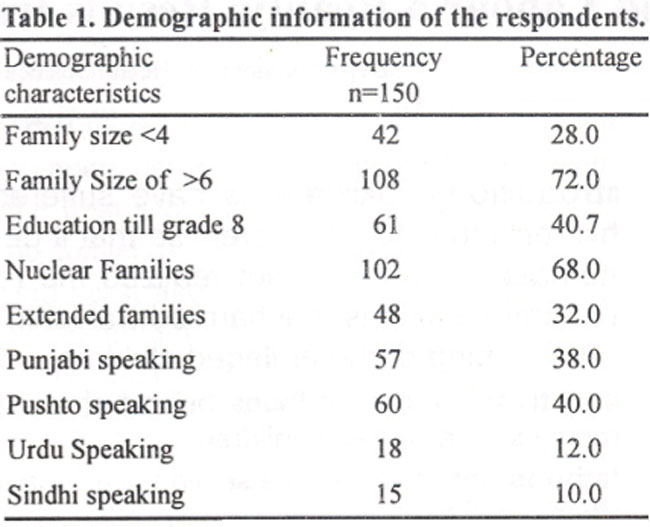
Mean age of children was 13.9 1years, the average family size was 7.4 ±2.3 and mean family income Rs, 2884 ± 1245 per month, The income of the children varied between 200/month to 1200/month with an average of Rs 614.7 ± 21.lper month. Fifty six percent children were working for more than 7 hours per day with a mean of 7 ±1.5 hours per day. The children were asked if they supported their families or made money for themselves and 89% said that they supported their families financially. Only 11% were either not sure or did not answer, The children were asked about the ingredients of their meals in the past 24 hours and the majority had eaten said pulses (46%), vegetables (39%) and meat (15%). The majority had a large family size (72%) and only 41% had studied till grade 8. The majority were living as nuclear families with only 32% extended families. The majority were migrants from NWFP (40%) and Punjab (3 8%) (Table 1).
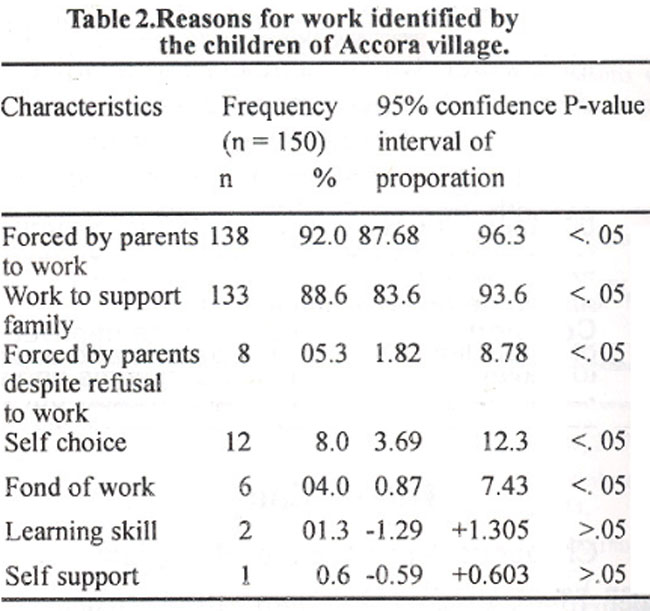
Ninety two percent of the children said that their parents forced them to work whereas 5% said that their parents forced them to work despite their refusal to work (Table 2).
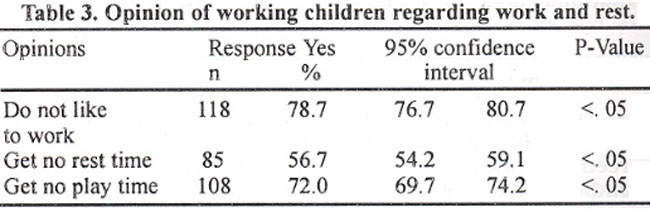
Fifty seven percent children do not get rest time during the work. Seventy nine percent said that they did not like to work, 72% had no time for play and 57% said no time to rest. The children were asked if they had an illness in the past one week. A positive answer was given by 17 (11%) said that they had some illness in the past one week whereas only 12 out of these 17 had received health care from the government dispensary (Table 3).
When asked about the present state of health 87% of children said they are presently not taking any medication for common illnesses (considered healthy).
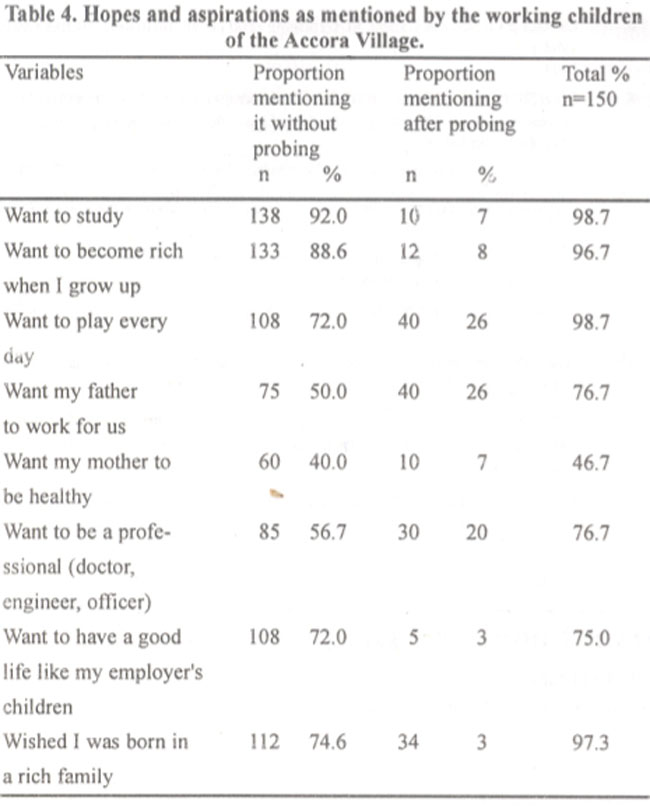
The children were asked open-ended questions regarding their future plans and any other hopes and desires that they might have. If they did not answer then they were probed by asking direct questions like, do you want to study, play, be rich, become a professional etc? The majority wanted to study (97%), become a professional (76.7%) and have a good life (75%) like their employer’s children (Table 4).
 Limitations of the study
As it was a one time study and due to resource limitations a standardized medical examination of children was not done hence the real health status could not be ascertained. Due to sensitivities of the area some of the questions regarding rights of children and social problems were not asked.
Discussion
The study revealed multiple reasons responsible for child labour including parental pressure, poverty, migration, lack of education, and unawareness of rights of children similar to the findings from previous studies5-9. Most families of these children expected them to assist in managing the house finances through income generation and at the same time expect other household chores as has been seen in previous studies14. Majority did not want to work but were forced due to family pressures. The majority were supporting their family and had lost their child hood as they hardly had any time for play and rest and hence were more prone to accidents leading to life long disabilities as seen in the studies before15. Although through this study we could not assess their health status objectively however with the discussion on past illnesses and indirect variables like their hopes and desires for being rich and like their employers children, show that these children are psychologically disturbed and not entirely healthy. The majority mentioned that they have no time for play and rest and feel pushed into working and earning for their families.
These children have lost opportunities for education and career development as they have to fulfill their family needs. A significantly large proportion mentioned that they wanted to be professionals and want their fathers to earn for the family, which is in conformity with a Pakistani study where a strong correlation between father’s income and the work status of the children was discovered16. This study reveals that these children who are supporting their families and generally seem healthy are actually disturbed and yearn for their lost childhood. The majority had hopes and feelings like any other child from a middle-income family of Pakistan but felt deprived and under-privileged.
Conclusion
Although these results are from a cross-sectional study and cannot be generalized to the whole city or all squatters but still are an eye opener for the prudent of the society. The child labour is linked to poverty, migration, lack of education and unawareness of the rights of the children by their families and the children themselves. The desires of children should be considered seriously as majority of them would not be able to fulfill their desires and probably indulge in forbidden practices. It is a time proven fact the people who are unsatisfied with their life indulge in un-healthy and illegal practices for small financial gains and do more harm to themselves and their families.
These children should be studying in school and regarding their need for money and employment a comprehensive program with income generation schemes
should be launched in such communities. Making them jobless is not going to solve the real problem instead will enhance the present dilapidated state of economics in such communities. The fear is that this state of disgnintlement can encourage negative anti-social behaviors and add more problems for the society as a whole. Hence their hopes and despair should not be taken lightly and the pnidents of the society and NGO’s working in the health sector should work together for this cause. They should also be given opportunities for educating themselves and improving their status in the society. This child labour is a reality that we have to confront and deal with highest levels of sensitivities.
References
1.Shafi M, Shafi P. Children (pledging of labour) Act 1883. In: Labour code of Pakistan. Bure. Labo. Publi., 1996; p. 25.
2.Myth and Reality. The State of the worlds children UNICEF Pakistan. 1997,p. 17.
3.Nakajima H. Bridging the gaps. The world health report. Geneva, WHO, 1997; report No. 97/10989, pp. 15-17.
4.Naidu P. Health situation in working children in the carpet industry in Mirzapur, India. Clin, Pediatr., 1997; 78:35-39.
5.Sabur G. Carpets without child labour. In: Human resource development and utilization in Pakistan. Islamabad: Pak. Offi. Germ. Friedrich-Ebert-Stiftung (FES,. 1995, pp. 9-31.
6.Director ILO. National context. In: combating child labour Islamabad. Internet Organi 1998,p.6.
7.Planning Commission(Govt Pak). Childiabour survey report Islamabad; The Institute 1997.
8.Khan SR, Syed ZA. Magnitude of educational unemployment in Pakistan and problems of waiting period. Proceedings 3rd Ann. Gen. Meet. Pak Develop. Rev., 1986; Islamabad, Pakistan, pp. 15-17.
9.Jonathan S. Child labour in Pakistan. The Atlantic Monthly, February, 1996; 277:79-92.
10.Sabur G. Why does child labour exist. In: Human resources development and utilization in Pakistan: Islamabad: Pak. Offi. Gems. Friedrich-Ebert-Stiftung(FES), 1998, pp. 225-28.
11.UNICEF (Pakistan). Highlights for Pakistan. In: The progress of the nations. Islamabad: Internet Pragni., 1998, pp. 39-58.
12.MehtaMN, Prabhu SV, MisUy HN. Child labor in Bombay. Child Abuse NegI., 1985; 9: 107-11.
13.Aftab AM. Child labour in Pakistan: a study of the Lahore area Child Welfare 1991;70: 261-67.
14.Anwar S. Improvement of working conditions and environment. In: Child labour in carpet industsy in Punjab. Islamabad: Pak.Offi. Germ. Friedrich-Ebert-Stiftung (FES) 1996; pp. 69-81.
15.Planning Commission (Govt Pak). Pakistan national programme of action for the goals for children and development in the 1990s. Islamabad, 1996.
16.Channar MS, Khichi GQK. Determinants of child labour in Bahawalpur city. JCPSP; 10): 395-98.
Journal of the Pakistan Medical Association has agreed to receive and publish manuscripts in accordance with the principles of the following committees:


