

Zubaida A. Malik ( Dept. of Pharmacology and Therapeutics, Jinnah Postgraduate Medical Centre, Karachi-35. )
April 1980, Volume 30, Issue 4
Original Article

Abstract
Various effects of harmidine hydrochloride, an alkaloid of Peganum harmalla, have been studied in rats treated with harmidine hydrochoride 12 mg/kg body weight alone and pretreated with pyridoxine. Harmidine produced shivering, ataxia, diarrhoea, reduction in motor activity, loss of postural reflex and hypothermia. Weight of animals, respiratory rate, heart rate, urinary output, oestrous cycle, leucocyte and red blood cell count, bleeding time, clotting time, haemoglobin and differential leucocyte count remained unaffected. Harmidine probably acts on the basal ganglia and brain stem reticular formation.
The animals pretreated with pyridoxine did not show shivering, ataxia, reduction in motor activity, loss of postural reflex and hypothermia, indicating that harmidine probably acts by inhibiting the activity of pyridoxine in the brain. Thus protecting 5-hydroxytryptamine and norepinephrine of the brain from destruction by mono aminu-ry oxidase which needs pyridoxine as coenzyme for its activity (JPMA 30:88, 1980).
Introduction
Peganum harmalla known as Harmalla locally grows abundantly in Sind and Punjab. Powdered seeds and their extracts have been used in indigenous medicine for various purposes (Nandkarni, 1945). Native American Indians used to take the seeds and extracts of various parts of the plant during feasts to produce hallucination and euphoria (Robson and Stacy, 1962.)
In 1841 Goebal (cited by Siddiqui, 1962) in Germany isolated an alkaloid harmaline from the seeds of Peganum harmalla. Another alkaloid named harmine was isolated by Fritsche in 1847 (cited by Gunn, 1912) from the seeds of the same plant. Gunn in 1912 investigated the pharmacological actions of these alkaloids and reported that the harmaline and harmine produced tremors and clonic convulsions in rats, mice, guinea pigs and monkeys. Chen and Chen in 1939 (cited by Gershon and Lang, 1962) observed that monkeys treated with harmine showed unsteady gait, arching of back and stiffening of legs. Udenfriend and Weissbach (1958) and Pletscher and Gey (1959) studied the effects of harmine and harmaline in vitro on liver and in vivo on rat\'s brain. They reported that these alkaloids were responsible for inhibition of mono-amino-oxidase (M.A.O.). Turner et al (1955) used harmine in non-psychotic men and observed anxiety, tremors, restlessness and aggressive acts without hallucinations in these subjects. Poirier et al (1966) reported that harmine and harmaline produced shivering and tremors in rats due to protective actions of these alkaloids through inhibition of M.A.O.
Siddiqui (1962) isolated a new alkaloid "har-midine" from the seeds of Peganum harmalla. He also reported that harmaline is actually a mixture of the two alkaloids (harmidine 85% and harmine 15%). Therapeutic index of harmidine was found to be four times higher than that of harmine (Qureshi, 1969 cited by Akhtar, 1971). She also reported that with the alkaloid harmidine and harmine there was 84% and 95% reduction in motor activity of mice. These observations and results of previous work done on harmaline and harmine created an interest to investigate the pharmacological effects of harmidine in rats.
Material and Methods
Albino rats weighing 250-300 grams and of 2-3 months of age, reared in the Animal House of Jinnah Postgraduate Medical Centre, Karachi, at 27°C, were divided into four groups of 10 rats each. First group was treated with harmidine 12 mg/kg body weight intraperitoneal-Iy. Second group (control) was given normal saline (0 9%) 2 ml/kg body weight intraperiton-eally. Third group was treated with pyridoxine 1 mg/kg body weight intraperitoneally. Fourth group was treated with harmidine hydrochloride 12 mg/kg body weight, one hour after the administration of pyridoxine. Pyridoxine group was included because it acts as a coenzyme of M.A.O. The animals were observed for the pharmacological effects of the drugs at 15 minutes, 30 minutes, one hour, two hours and 24 hours intervals after the administration of the drugs.
Results are presented in tables I, II and III.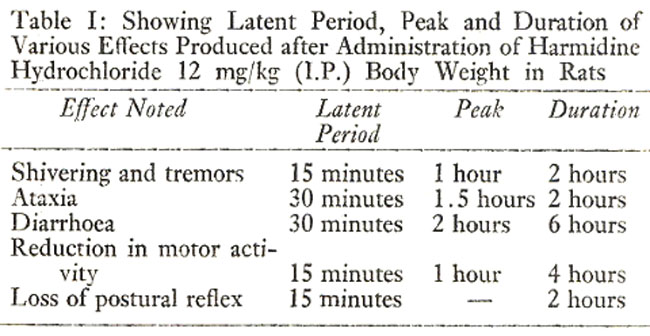
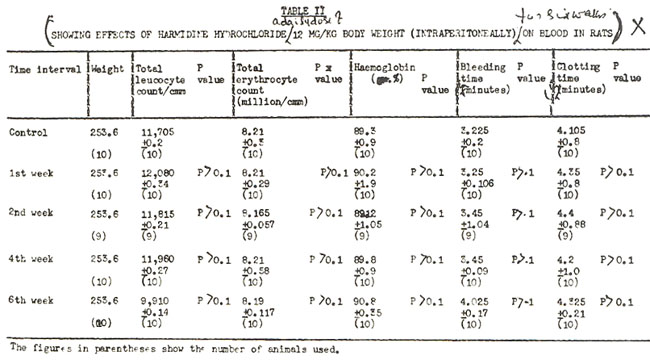
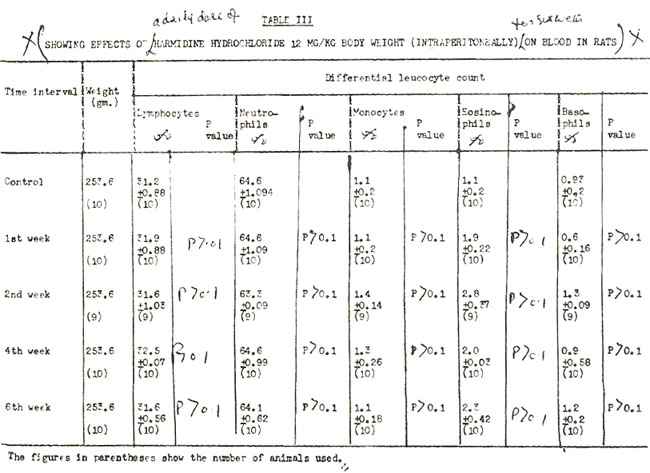
The 4th group treated with pyridoxine and Harmidine hydrochloride did not produce such visible and noticeable effects as shivering, ataxia, reduction in motor activity and loss of postural reflex. Such effects of harmidine were significantly antagonized by pyridoxine.
Estrous cycle in female virgin rats remained unaffected during and after the administration of a daily dose of harmidine hydrochloride 12 mg/kg body weight for about six weeks. The weight of the animals remained stable. Skin and hair were also unaffected.
Discussion
Harmidine hydrochloride 12 mg/kg body weight in rats has produced shivering, ataxia, diarrhoea, reduction in motor activity and loss of postural reflex. These effects are probably due to increased concentration of 5-hydroxy-tryptamine (5-HT) and norepinephrine (NE) in certain parts of the brain. Qureshi and Akhtar (1972) has demonstrated a significant increase in concentration of 5-HT and NE in the hypothalamus of rats treated with harmidine and have suggested that increase in the biogenic Amines is probably due to inhibition of M.A.O., activity by harmidine. The above mentioned effects except diarrhoea were found to be absent in the animals pretreated with pyridoxine (4th group). Pyridoxine, a coenzyme, is essential for the activity of mono-amino oxidase (M.A.O.). Harmidine probably inhibited the activity of pyridoxine in the brain, thus decreasing or abolishing the destructive action of mono-amino-oxidase on 5-HT and NE of the brain. Udenfriend and Weissbach (1958) and Pletscher and Gey (1959) reported that harmaline and harmine were responsible for inhibition of M.A.O. in vitro on liver and in vivo on rat\'s brain respectively. Siddiqui (1962) reported that harmidine is a mixture of harmaline (85%) and harmine (15%).
Presence of diarrhoea was probably due to a local increase in the concentration of free 5-HT in the alimentary canal, again due to the local inhibitory effect of M.A.O. activity on 5-HT metabolism.
The decrease in the motor activity was not due to tranquilization but presence of spastic paralysis of the hind limbs oberved in the animals treated with harmidine (group 1). The reduction in motor activity was absent in the animals pre-treated with pyridoxine (group 4) and the animals did not show any sign of tranquility and spastic paralysis.
Stability of weight after the administration of the alkaloid (12 mg/kg body weight, intra-peritoneally) over a period of about six weeks shows that it does not interfere with the nutrition and metabolism of the animals. Absence of changes in the oestrous cycle indicates that the hormonal effects on the vagina is not affected. Nothing can be said about the effect of the alkaloid on the uterine muscles of such animals at present. In vitro experiments, harmidine has inhibited the effects of 5-HT on the isolated rat uterus preparation (Qureshi et al., 1970 cited by Akhtar, 1971).
In rabbits treated with harmidine hydrochloride 12 mg/kg of body weight (intraperi-toneally) desynchronization of electroencephalogram (EEG) was observed upto 24 hours (Babar, 1971). It is evident from the results of the present studies that harmidine has its effects on multiple sites in the brain with multiple actions. The main site of action is most probably the brain stem reticular formation and basal ganglia. Keeping in view the effects of the alkaloid, produced in the above mentioned studies it can be said that harmidine may prove an effective antidepressant drug. Absence of its effects on respiration, heart rate, weight, total leucocytes and erythrocytes count, haemoglobin, bleeding time, clotting time, differential leucocyte count and urine output reflect that the alkaloid may also be quite harmless. But further studies on cardiovascular system, genital tract and central nervous system are required before the final suggestion.
Acknowledgements
Thanks are due to Dr. Salimuz Zamman Siddiqui for providing the drug for the present work. Thanks are also due to Mr. Shamim Ahmad and Mr. Iftikhar Ahmad Malik, for technical help.
References
1. Akhtar, M.S. and Malik, Z.A. (1974) Pharmacological screening of harmidine hydrochloride. Pakistan T. Agri. Sci., 11:9.
2. Akhtar, M.S. Study of norepinephrine and 5-bydroxytry-ptamine content of hypothalami of rats treated with harmidine hydrochloride. Karachi, JPMC, Department of Pharmacology, 1971.
3. Babar, M.K. A study of effects of harmidine on central nervous system of experimental animals. Karachi, JPMC, Department of Pharmacology, 1971.
4. Gunn, J.A. (1912) Pharmacological actions of harmine. Trans. Roy. Soc. Edinburgh, 48:83.
5. Nandaarni, A.K. Indian materia medica. Vol. 1, 3rd ed. Bombay, Popular Book Depot, 1954, pp. 927-9.
6. Pletscher, A. and Gey, K.F. (1959) Pharmacological effects produced on the CNS by short acting amine oxidase inhibitors of harmala alkaloid. Helv. Physiol. Pharmacol. Acta, 17:202.
7. Poirier, L.T., Sourkes, T.L. and Bouvier, G. (1966) Sttital amines, experimental tremor and the effect of harmaline in the morkey. Brain, 89:37.
8. Robson, J.M. and Stacey, R.S. Recent advance in pharmacology. 3rd ed. Boston, Little, Brown, 1962.
9. Siddiqui, S. (1962) A reinvestigation of the alkaloidal constituents of Peganum harmala. Pakistan J. Sc.. Ind. Res., 5:207-211.
10. Turner, W.M.J., Merlis, S. and Carl, A. (1955) Concerning theories of indoles of schizophrenigenesis. Am. J. Psychiat. 112:466.
11. Udenfriend, S. and Weissbach, H. (1958) Turnover of 5-hydroxytryptamine (serotonin) in tissue. Proc. Soc. Exp. Biol. Med., 97:748.
Journal of the Pakistan Medical Association has agreed to receive and publish manuscripts in accordance with the principles of the following committees:


