

Ghazala Haq ( Department of Microbiology, Basic Medical Sciences Institute, Jinnah Postgraduate Medical Centre, Karachi. )
Pirzada M.A. Siddiqui ( Department of Microbiology, University of Karachi. )
May 1983, Volume 33, Issue 5
Original Article

Abstract
Twenty-six cases suspected of bacterial endocarditis were studied. Main infecting organisms were staphylococcus and streptococci. Bateraemia was intermittent and first and third culture gave maximum positive results (JPMA 33 : 108,1983).
Introduction
In most forms of bacteremia blood stream invasion is intermittent in nature, because the microorganisms are cleared rapidly from the circulation by reticuloendotheial system by intra and extra vascular polymorphonuclear leucocytes and macrophages. These mechanisms operate both in acute intermittent and continuous bacteremia (Werner et al., 1967).
The present study was conducted to determine whether the bacteremia in bacterial endocarditis is continuous or intermittent.
Material and Methods
Three 10 ml or less venous blood samples, preferably before antibiotic therapy were collected from each patient at an interval of at least 2 hours over a period of 24 - 48 hours. Blood was inoculated into blood culture bottles containing base broth at patients bed side and incubated at 37°C. The culture were kept for 3 weeks before discarding.
Culture bottles were examined in the morning and afternocin of the day of incubation and in the morning of each day thereafter for turbidity.
Subcultures were made on the 1st, 4th and 7th day of incubation on the respective media, incubation was done for 24 to 48 hours at 37°C before discarding. One set was incubated aerobically and another anaerobically.
Results
Two organisms were mainly isolated i.e., streptococci and staphylococci as shown in Table 1.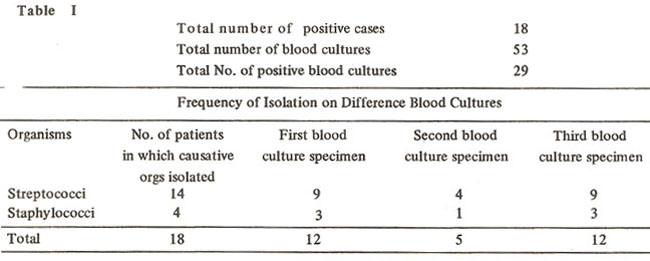
Maximum positive results were obtained in 1st and -third cultures while the second blood culture gave the lowest yield i.e., 9.43% (Table II).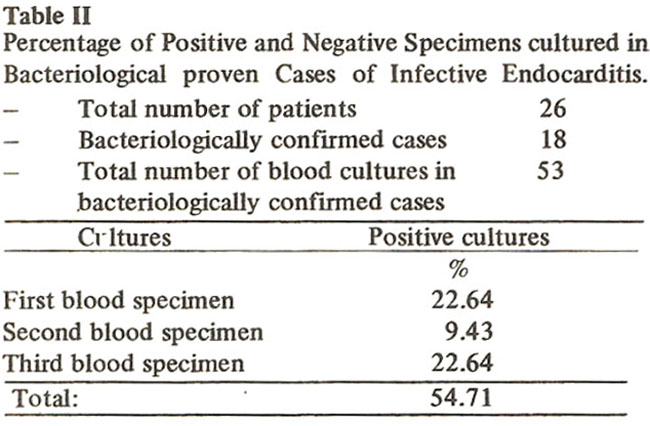
Discussion
There are divergent opinions concerning the consistency of bacteremia in bacterial endocarditis. It may be continuous (Kelson and White, 1945; Barritt and Gillespie, 1960; OlCeefe and Gorbach, 1978; Werner et aL, 1967) or intermittent (Newman et aL, 1954; Belli and Waisburn, 1956).
In this study the bacteremia was intermittent in nature. The results (Table. I) show that the first culture was positive in 22.64% of the cases followed by third blood culture which was also positive in the same number of cases, the second blood culture was positive in only 9.43% of of the cases.
This suggests that niiltiple cultures should be taken in bacterial endocarditis. However, the actual time at which the blood culture is taken is not crucial (Hurst, 1978). Even if a blood culture gives negative results, further attempts should be made, because negative results may be due to intermittent nature of bacteremia.
References
1. Barritt,D.W., and Gillespie, W.A. (1960) Sub acute bacterial endocarditis. Brit. Med. J.d : 1235.
2. Beth, J.. and Waisburn, B.A. (1956) -The number of blood cultures necessary to diagnose most cases of bacterial endocarditis. Am. J. Med. Sci.,232 : 284.
3. Hurst, J.W., The heart, 4th Edition. McGraw Hill Book Company, 1978 pp. 333.
4. Kelson, S.R., and White, P.D. (1945): Notes on 250 cases of subacute bacterial (Streptococcal) endocarditis studied and treatment between 1927 and 1939. Ann. Intern. Med.,22 : 40.
5. Newman, W, Torres, J.M., and Guek, J.R.; (1954) Bacterial endocarditis: an analysis of fifty-two cases. Amer. J. Med.,16 : 535.
6. O’Keefe, J.P., and Gorbach, S.L.(1978 Laboratory diagnosis of infective endocarditis Rahimtoola, Grune and Spratton, 1978 ,307.
7. Werner, A.S., Cobbs, C.G., Kays, D., and Hook, E.W. (1967) Studies on the bactermia of bacterial endocarditis. JPMA., 262 :199.
Journal of the Pakistan Medical Association has agreed to receive and publish manuscripts in accordance with the principles of the following committees:


