

Zaibunnisa Sheikh ( Department of Neurology, Dow Medical College & Civil Hospital, Karachi. )
Akhter Ahmed ( Department of Neurology, Dow Medical College & Civil Hospital, Karachi. )
May 1983, Volume 33, Issue 5
Original Article

Abstract
Test of digit retention was carried out to investigate if the usually accepted norm of 7 forward digit retention holds true in our population. The highest mean score of 8.85 was obtained by executives. Professionals scored a mean of 8.08 followed by students (7.81). Housewives, skilled workers and unskilled workers scored less than the accepted norm of 7 digit forward retention.
A strong influence of vocational and socio-cultural background in ability to score in this test is shown in this study and it must be considered when passing judgement on the patient’s mental abilities in clinical assessment (JPMA 33 105, 1983)
Introduction
Digit retention is a test of retentiveness and has been used by psychologists for many kind of psychological tests (Hillgard, 1971) and by neurologists during the neurological examination. It is easy to administer, easy to score and specific as to the type of ability it measures. Low scores are frequently associated with attention defects and individuals with these defects have the phenomena often referred to as ‘lack of mental control.’
Intelligence also has a deep concern with digit retention. A bright intelligent person will achieve good scores and take less time than the person who is dull. Therefore in some intelligence tests, digit retention is included as a verbal test (Weschler, 1969).
It has been suspected that most of our population who had not been exposed to formal schooling beyoned the primary level would not be able to retain 7 digits. The purpose of the study therefore was to establish normative data in Pakistani population and the effect of education and occupation on this mental function.
Material and Methods
Five hundred and seventy nine subjects studied included relatives of patients attending the Department of Neurology, students of a school in Karachi, their parents and the students of Dow Medical College, Karachi. The Professionals were young engineering and medical graduates. They were divided into seven occupational groups nimely, professionals, executives, urban housewives, rural housewives, skilled workers, unskilled workers and students. Except for students all subjects were from 20 to 50 years of age. The students were in 8th class or higher.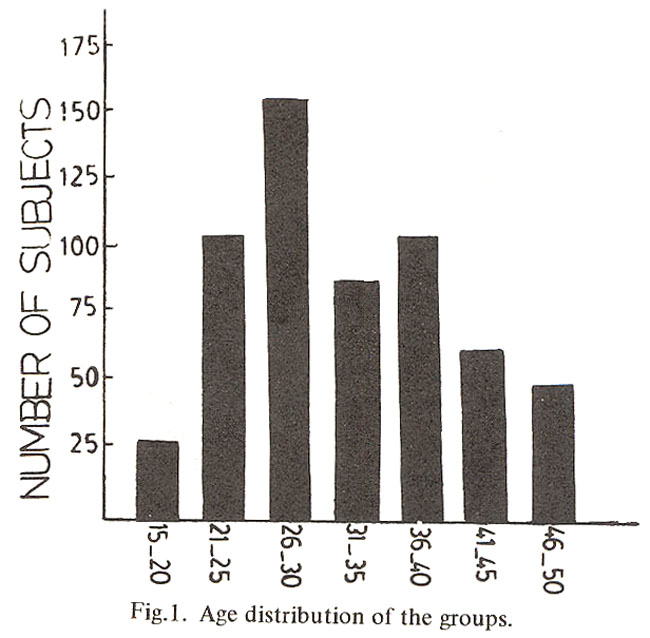
Fig.1 shows age distribution of the groups.
subjects were first given sets of rand9m digits from 1 to 9, starting with two digits and on successful completion advancing slowly to 15 digits. The factors recorded as routine informations included the age, sex, occupation, place of residence, racial background, parental education, impressions about mothers and fathers, alertness where applicable, father’s occupation and family income.
Results
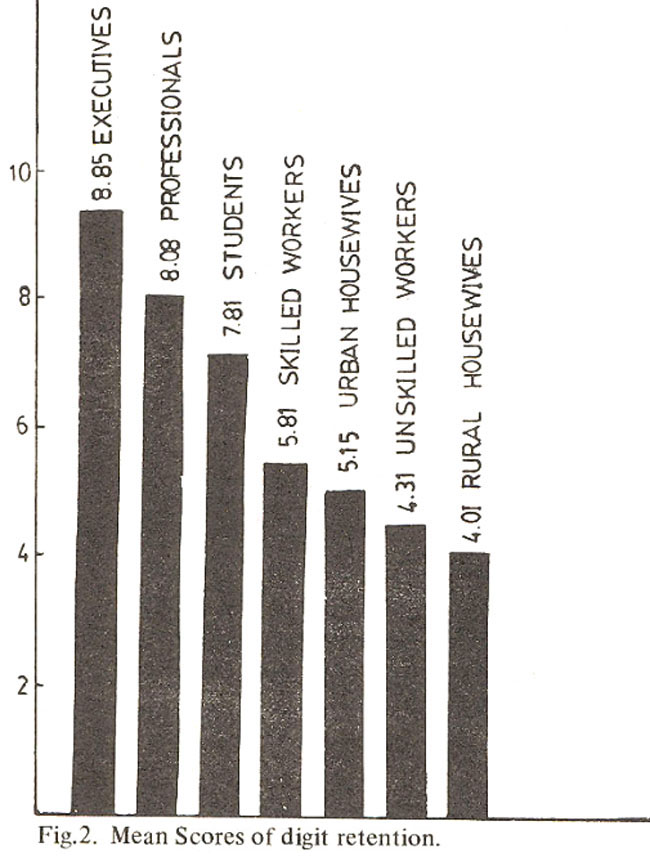
Fig. 2 shows the mean scores in different categories. The highest score is of executives 8.85 and the lowest of rural housewives is 4.01. Details of pattern of digit retention in various groups tested is shown in Fig. 3.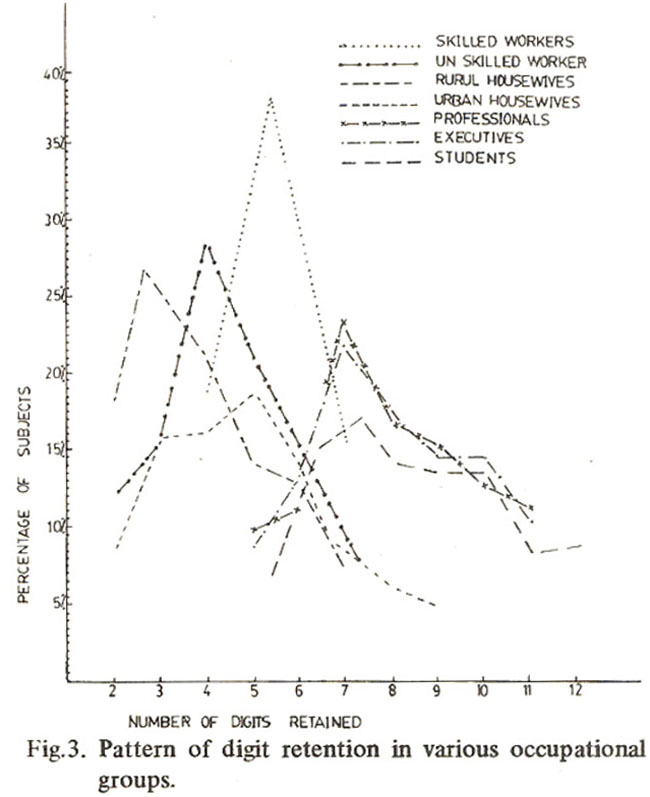
The rural housewives show a peak at 3 digits. The largest percentage of rural housewives (26.72%) could retain 3 digits forward retention with some scatter towards higher scores. The unskilled workers show a peak at 4 digits (28.9%) followed by 5 digits (21.2 1%). The skilled workers show up better with peak at 5 digits (37.7%) followed by a good proportion at 6 digits (28.3%). There is a rapid fall on either side
The urban housewives also show a peak at 5 digits (18.86%) but there is a greater scatter towards lower and higher scores, a close percentage completing 4 digits (16.03%) and 3 digits (15.01%), 8.5% were able to retain only two digits. On the other side 14.15% retained 6 digits, 6.5% eight digits and 5% retained 9 digits..
8 and 9 digits retention and higher scores were found mainly in executives, professionals, students and a few urban housewives.
There is no group that peaks at 6 digits but in all groups a significant percentage could retain 6 digits. The lower scores were seen in rural housewives, unskilled workers, skilled workers and urban housewives.
A higher proportion of professionals, including doctors, engineers and lawyers retained more than 6 digits. Almost a quarter of them (23.6%) retained 7 digits, falling rapidly towards the higher scores.
Very close to the professionals, executives also show a rapid fall towards highest digit levels. although in higher scores they are slightly below the professionals at all levels.
The students group peaks at 7 digits, about 17% being able to do 7 digits but there is hardly a fall off to 6 digits (14.85%), 8 digits (14.18%) and 9 digits (13.5%) levels, 13.5% of them could retain 10 digits. Even more significantly, about 8 % retained 11 digits and another 9 % 12 digits. The student group also show greatest scatter.
Discussion
The accepted norm of 7 forward digit retention does not hold good for most of our population. The rural housewives peaks at the lowest scores of 3 digits. Many of these women did not know their age or the age of their children. The category with second lowest digit retention is of unskilled workers, followed by skilled workers and urban housewives, both peaking at 5 digits, followed by students, executives and professionals, all peaking at 7 digits. The executives show the best average in digit retention followed closely by professionals. The students showed a very even spread through 8,9,10,11 and 12 digits.
It is interesting to speculate about the scores of students who were able to retain upto 12 digits. Their proportion in the category of 4 (3.37%) and 5 digits retention is very smill. This is the only group which could retain 12 digits. It is possible that this mental function is better in younger individuals and a loss of peak performance occurs with advancing age (as is observed in competitive sports).
Digit retention scores were similar in skilled workers, professionals and executives. Skilled workers obtained higher scores than unskilled workers. For skilled workers, their training and skill probably helps them retain more digits. The cause and effects can be debated.
The comparison between the rural and urban housewives is of some interest. In urban life besides education, housewives are exposed to communication media and like newspapers, radio and television and community discussions and they have greater social activities. These activities probably make them more alert mentally resulting in increased digit retention. On the contrary, in rural areas the housewives have less education and limited environment. There are less social activities and fewer compulsions towards reading and writing.
The wide difference in scores of various groups makes it inevitable that the occupational and socio-cultural background of a person must be taken into consideration before iudging a patient by digit retention scores.
References
1. Hilgrad,E.R. Introduction to Psychology. Published by Harcourt Brace, Javenovich, Inc. 1971.
2. Weschler, D. Manual of Weschler Adult, Intelligence scale. published by Psychological corporation, N.Y., USA., 1969.
Journal of the Pakistan Medical Association has agreed to receive and publish manuscripts in accordance with the principles of the following committees:


