

Shahbaz Aman ( Dept. of Pathology, Allama Iqbal Medical College, Lahore. )
Rubina Akhtar ( Dept. of Pathology, Allama Iqbal Medical College, Lahore. )
January 1986, Volume 36, Issue 1
Original Article

Abstract
Of 210 children 164 (78%) had diarrhoea due to E.coli infection. The common enteropathogenic serotypes in 71 cases were 0111: K58 (36.6%) and 0125:K70 (25.4%).
Enteropathogenic strains of E.coli were sensitive to Ampicillin (84.5%), Amoxil (73.2%) and Ampiclox (54.9%) (JPMA 36: 14, 1986).
INTRODUCTION
Diarrhoea is a common disease of infants and children under the age of two years. It is caused by infectious agents like E.coli, Salmonella, Proteus, Shigella, Pseudomonas, Staph aureus, Paxacolon, Yersina and Campylobacter jejuni. Among these E.coli particularly its pathogenic serotype is still considered a major cause of disease. The enteropathogenic serotypes of E.coli include 026, 0142, 055, 0111, 0112, 0114, 0119, 0124, 0127 and 0158. This study was undertaken to determine the frequency of diarrhoea due to enteropathogenic E.coli in children admitted in Services Hospital, Lahore.
MATERIAL AND METHODS
Two hundred and ten stool samples were received from infants under the age of two years suffering from diarrhoea. These were from in patient and outpatient departments of Services Hospital, Lahore. Specimens from outpatients were received in sterilized polythene bags. Stool cultures were done immediately or within two hours on Mac Conkey 5.5. agar and E.M.B. agar plates. After incubation at 37°C for 24 hours, pink colonies were subcultured on nutrient agar slants and nutrient broth. After incubation the slants were kept in refrigerator for serotyping and from the broth biochemical tests using system No :1 (Eiken chemical) and Enterotubes (Roche) and morphological indentification were done. One hundred of 164 E.coli strains were serotyped using antisera of Bact. E.coli (Difco Laboratories) as follows:
(I) Set A Poly A 0 26: K 60, 0 55: K59,
0111: K 58,0 127: K63.
086a: K 61, 0119: K 69
(II) Set B Poly B 0124: K 72, 0 125: K70, 0126: K 71,0 128: K 67.
(III) Set BPo1Yc 0l8a,0 lSc:K77,
020a,020c:K6l
021a,020b:K84
028: K 73, 044: K 74
0112a, ll2c: K 66.
Different tests performed were presumptive screening test, presumptive serogrouping and tube technique for 0 antigen. Each test was performed according to the instruction supplied by Difco Laboratories (1976) 1.
Presumptive Screening Tests: All the samples cultured on blood agar Plates over night were subjected to presumptive screening test. Of 100 samples only 71 showed complete agglutination.
Presumptive Serogrouping: All 71 Screened E. coli strains showed the presence of capsule on slide agglutination using different of antisera.
Titration for 0 Antigen: As observed with tube agglutination method all the strains were positive with different 0 antisera. In vitro sensitivity was also performed.
RESULTS
Of 210 stool samples, 164 (78%) were positive for E. coli. Seventy one of 100 strains serotyped were enteropathogenic.
The percentage distribution of various subtypes is shown in Table I.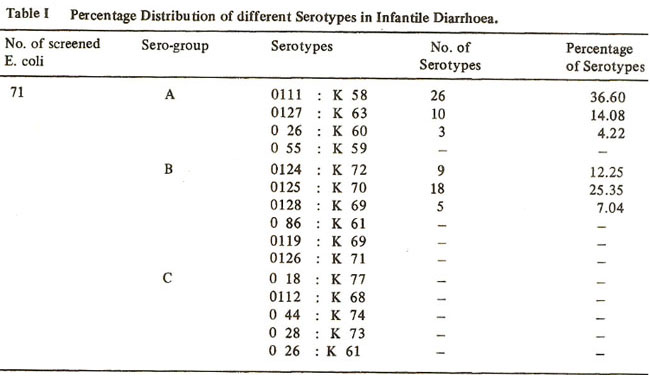
The common serotypes were O1 1 1:K58, 0125 :K70 and 0127: K63.
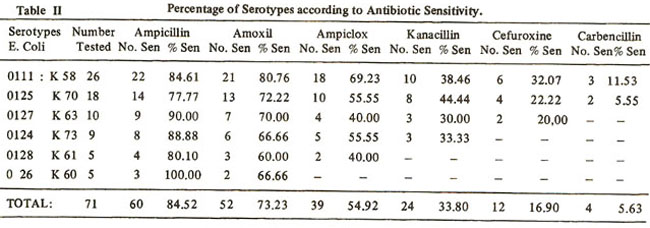
Table II shows the sensitivity pattern of these strains to various antibiotics were ampidillin, amoxil and ampiclox.
DISCUSSION
Infantile diarrhoea is caused by various organisms but the present study was restricted to pathogenic E.coli Serotypes. Out of the 100 cases studied 71 showed the presence of pathogenic E. coli.
Enteropathogenic strains were more frequently isolated in this study (7 1%) than those reported by Khan et al.2 from Rawalpindi/Islamabad (58.4%) and Tauseef et al.3 from Peshawar (28.23%). Pattern of serotypes was also similar to other reports from Pakistan but serotypes 055:B5, 0112:Bl1, 086: B7,Olll : B5,026: B6 and 0119 : B14 reported in other series2-6 could not be isolated in the present study due to lack of availability of antisera.
The variations in the frequency of Enteropathogenic E. coli as a cause of infantile diarrhoea in various groups may be due to dif ferences in the environments and hygienic standards.
ACKNOWLEDGEMENT
The authors are grateful to Prof. A.H. Nagi, Professor of Pathology, King Edward Medical College, for his guidance through out the course of this study and Mr. Sher Mohamrnad for his assistance in laboratory work.
REFERENCES
1. DIFCO Serological identification of Escherichia coli Difco Laboratories. Detroit. Michigan, 1976.
2. Khan, A.M.S., Gilani, S. and Ghafoor, A. Bacteriological studies of gastroenteritis. Pakistan J. Health, 1970; 19:41.
3. Tauseef, Z., Azim, S., Roghani, M.T. and Ahmad, A. Pathogenesis infantile gastroenteritis and value of antibiotic treatment in this disease. Pakistan J. Med. Res., 15: 39.
4. Epidemiology; gastroenteritis in children. Br. Med. J., 1970;2:58.
5. Love, W.C., Gorden, A.H. and Gross, F.J. Esche richia Coil gastroenteritis. Lancet, 1972; 2: 355.
6. Criuckshank, R., Duguid, J.P., Marmion, B.P. and Swain, R.H.A. Medical microbiology, the practice of medical microbiology. 12th ed. Edinburgh, Churchill Livingstone, 1975, v. 2.
Journal of the Pakistan Medical Association has agreed to receive and publish manuscripts in accordance with the principles of the following committees:


