

Khursheed Hashmi ( Department of Microbiology, Basic Medical Sciences Institute, Jinnah Postgraduate Medical Centre, Karachi. )
Amtul Hafiz ( Department of Microbiology, Basic Medical Sciences Institute, Jinnah Postgraduate Medical Centre, Karachi. )
January 1986, Volume 36, Issue 1
Original Article

Abstract
Antibacterial activity of the extract of roots of Berberis as/at/ca was tested in white mice against pneumococcal infection. A dose of 6 mg given intraperitonealy at 6 hour interval over a period of 24 hours, protected 57% of the in fected mice from pneumococcal infection and subsequent death. Ampicillin in a total dose of 2 mg over a period of 24 hours protected 100% of the infected mice from pneumococcal infection and death (JPMA 36:5, 1986).
INTRODUCTION
The plants of the genus Berberis have long been used in medicine in the treatment of many diseases. In Pakistan many species of Berberis are found in hilly areas like Chitral, Gilgit, Kurram, Swat, Murree and Ziarat. 1
Almost all parts of the plant, mainly the fruit, stem wood and roots have been used with encouraging results in the treatment of diseases of eye, ear and face e.g. conjunctivitis, otitis, pimples, boils and in oriental sore2. Earlier studies from this laboratory3 showed that Rasaut, an extract of Berberis aristata possesses antileishmanial activity. It was therefore, planned to look for antibacterial activity of these plants on representative species of gram positive and gram negative bacteria.
In vitro antibacterial activity of Berberis aristata and Berberis asiatica has been reported in another publication. It was found that the extract of the roots of Berberis asiatica was bactericidal for streptococcus pneumoniae.
The present study reports the in vivo activity of this extract against experimental pneumococcal infection in mice.
MATERAL AND METHODS
The roots of Berberis asiatica obtained from Harndard Laboratories, Karachi were weighed, ground in pestle and mortar and soaked in 50% alcohol for 72 hours with three changes of the solvent. The extract thus obtained was dried over water bath at 40°C, weighed and a solution of 2Omg/ml was prepared in 50% ethanol. White mice of 8-10 weeks age and weighing 25 grams were obtained from the animal house of JPMC, Karachi. Culture of Streptococcus pneumoniae obtained from N.I.H., Islamabad, was confirmed in the Lab. Graded concentrations of 8 hours broth culture at 37°C were administered intraperitonealy to the mice. The minimum number of organisms contained in 0.001 ml of the culture was obtained as minimum lethal dose (MLD) which killed mice within 28 hours.
In order to obtain the minimum tolerable dose of the extract which could be used to test its efficacy against pneumococcal infection in mice, graded concentrations (ranging from 2-4mg) of the extract were given intraperitonealy to groups of 6 mice each according to the following scheme. The LD 50 of the extract was found to be 2.5 mg.
The effect of root extract against pneumococcal infection was determined according to the method of Dubos4. First the effect of a single dose of the extract and that of Ampicillin was tested. Multiple dose effect of the extract and that of ampicillin was then determined in another batch of mice.
RESULTS
Results of a single injection of 2 mg of root extract (B. asiatica)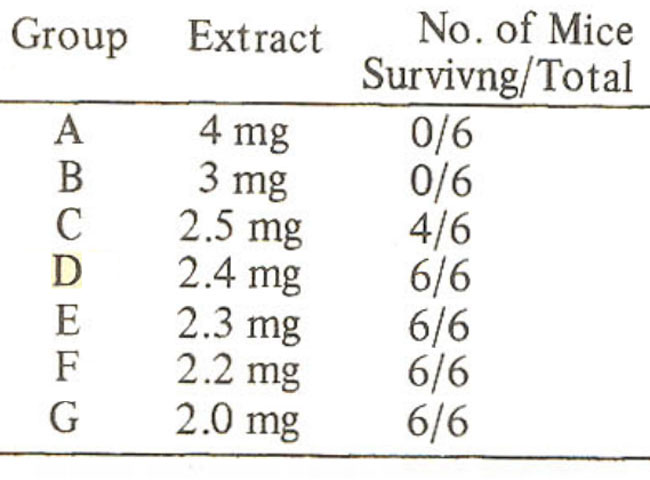
against pneumococcal infection in mice are given in table 1.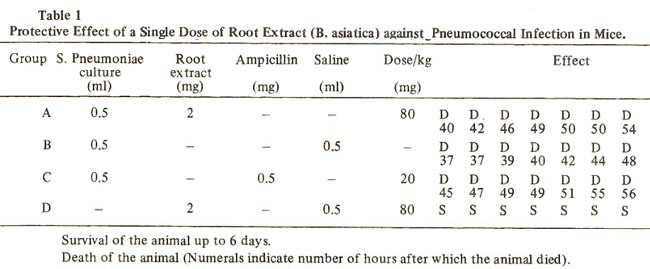
All the animals of group A which received the infective dose (0.001 ml in 0.5 ml saline) of the culture and a single injection of 2 mg of root extract died within 45-54 hours. All the group B animals receiving only the infective dose of culture died within 37-48 hours. All the group C animals which received a single injection of 0.5 mg of ampicillin in addition to the infective dose of the culture died within 45-56 hours, while all the control animals which received 2 mg of root extract only survived beyond the experimental period, i.e., 6 days.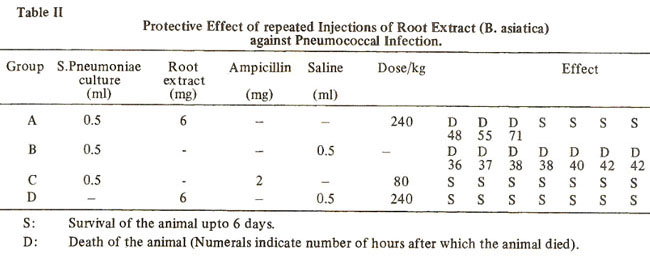
Table II shows the results of the experiment with repeated doses of root extract and that of ampicillin against experimental pneumococcal infection. Three out of seven animals of group A receiving a total dose of 6 mg (240 mg/kg) of root extract in 4 divided doses over a period of 24 hours died within 48-7 1 hours, whereas the remaining four survived beyond the experimental period of six days. All animals in group C receiving a total dose of 2 mg (80 mg/kg) of ampicillin in four divided doses over 24 hours also survived for at least 6 days. All animals of group B receiving ohly the infective dose of the culture died within 36-42 hours. All animals of group D receiving only 6 mg (240 mg/kg) of the root extract in divided doses survived beyond the experimental period.
DISCUSSION
A single intraperitoneal injection of 2 mg of the root extract of B. asiatica given just after the administration of the infective dose of the culture of Streptococcus pneumoniae did not protect mice from pneumococcal infection and subsequent death, although the dose was well tolerated by group D animals. Similarly a single dose of 0.5 mg of ampicillin did not protect mice from pneumococcal infection and subsequent death. However, the fact that the animals in group A died later than those of group B indicated the possibility that the extract might protect mice from pneumococcal infection if the dose was increased or treatment prolonged.
The treatment was, therefore, prolonged by repeating the injection of root extract at 6 hours interval. A total dose of 6 mg (240 mg/kg) over a period of 24 hours protected four out of seven mice from an infection of Streptococcus pneumoniae. Ampicillin in four divided doses of 0.5 mg each (80 mg/kg) protected all the mice from pneumococcal infection and death. A total dose of 6 mg of root extract given in 4 equally divided doses over a period of 24 hours was well tolerated (group D animals). These results indicate that the root extract of B. asiatica possesses Streptococcus antibacterial activity against pneumoniae in vivo as well.
REFERENCES
1. Nasir, E. and Ali, S.l. Flora of West Pakistan. Karachi, Fakhir Printing Press, 1972, P. 179.
2. Nadkarni, K.M. Indian materia medica. 3rd ed. Bombay, Popular Book Depot, 1954.
3. Rajpar, G.M. Clinical study on cutaneous leishmaniasis and experimental study on susceptibility of Leishmania tropica to the extracts of indigenous plants of berberidiaceae family. Karachi, JPMCDeptt. of Microbiology, 1983 (M. Phil Thesis).
4. Dubos, R.J. Studies an .a bactericidal agent extracted from a soil bacillus. II. Protective effect of the bactericidal agent against experimental pneumococcal infection in mice. J. Exp. Med., 1939;70 :11.
Journal of the Pakistan Medical Association has agreed to receive and publish manuscripts in accordance with the principles of the following committees:


