

S. Humayun Shah ( Dept. of Pathology, Ayub Medical Couege, Abbottabad. )
M.A. Khaliq ( Dept. of Pathology, Ayub Medical Couege, Abbottabad. )
F. Subhani ( Dept of Zoology, Government Postgraduate College, Abbottabad. )
January 1986, Volume 36, Issue 1
Original Article

Abstract
Of 6874 faecal Samples from 3 hospitals in Hazara Division 12.9% were found to have helminthic infestation. This incidence was lower than othereDivisions (40.6%) of N.W.F.P. Anky lostoma infestation is also less frequent in Abbottabad (1.2%) than in Haripur (7%) and Mansehra (6%). (JPMA 36:11,1986).
INTRODUCTION
Parasitic infestations represent one of the greatest drains of human energy and is a dangerous health hazard. According to a world wide survey 460 million persons throughout the world were affected with hookworms, out of which 200 million were in India1.
The knowledge of helminthic infestation in N.W.F.P. is scanty particularly in Hazara Division. The reason for this obscurity may be due to inadequate sampling in this division.
Hazara is the biggest division of N.W.F.P., but population-wise it is third having population of 3 million out of a total of 11 million for the whole province. Population is scattered, as most of the area is hilly. Agriculture land is minimum in Abbottabad but relatively more in Haripur and Mansehra. Heavy rains is the only natural way of cleaning the dirty streets of the cities and towns. Most of the population gets its drinking water from springs and in a few areas from rivers. Most of the people in rural areas go out to the open fields to respond to the call of nature. This pattern of living is likely to influence the prevalence of parasitic infestation. Reports on the frequency of parasitic infestations are available from other citiet2-7 of Pakistan but no such survey has so far been published from Hazara Division.
Keeping this in view, 6874 faecal samples were collected from three hospitals of Hazara Division during 1983-84. An analysis of collected data infestation in this area revealed some interesting facts regarding helminthic infestation in this area.
MATERIAL AND METHODS
All faecal samples received for examination in the laboratories of District Headquarter Hospital, Abbottabad, Tehsil Headquarter Hospital, Haripur and Bach Christian Hospital Qalandarabad (District Mansehra) were checked for helnilnths.
Stools were examined by saline and iodine methods in D.H.Q. Hospital, Abbottabad. Saline concentration method was also used where considered necessary. Initially macroscopic examination of collected stools specimen was carried out to determine its consistency and the presence of mucus and blood. A printed proforma was filled for each individual listing his particulars, clinical history and physical examination.
RESULTS
Out of the total cases examined, 19.0% from Haripur, 14.6% from Mansehia and 11.2% from Abbottabad were found positive for helminthic ova (Table I).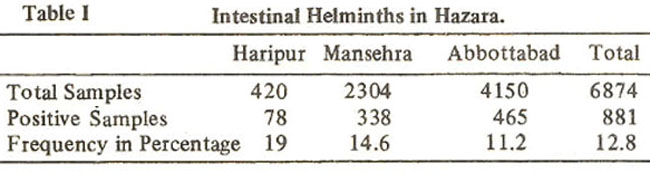
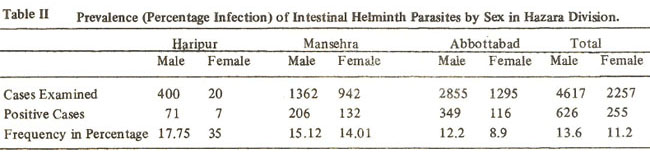
Table II shows the prevalence of intestinal helminths according to sex in Haripur, Mansehra and Abbottabad. Overall frequency in males was 13.6% and in females 11.2%.
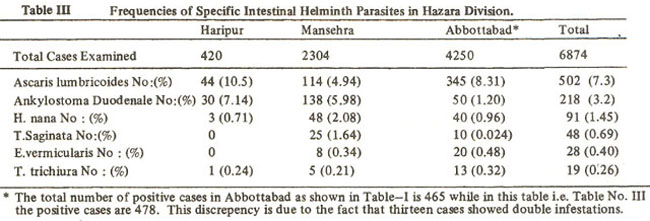
Table III shows frequencies of specific intestinal helminths in Haripur, Mansehra and Table I Abbottabad. The highest frequency was observed for Ascaris Lumbricoides (7.3%), and the lowest for Trichuria (0.26%). In Haripur highest incidence was observed for A. lumbricoides (10.5) while it was the lowest for T. saginata and E.vermicularis (zero). In Mansehra the highest and lowest incidence was observed for A. duodenale (5.98%) and T. trichiura (0.2 1%) respectively. In Abbottabad, A. lumbricoides was found to be more prevalent (8.31%) while the least prevalent helminth in this area was T.saginata (0.24). In 13 cases infestation with more than one helminth was noted and Ascaris lumbricoides infestation was accompanied by other helminths. In 5 cases A.lumbricoides infestation was accompanied by Ankylostoma infestation, and in remaining 8 cases by H.nana infestation.
DISCUSSION
The present study was carried out in Hazara Division so as to know about the prevalence of intestinal hehninths among the inhabitants of this division. The frequency of A.lumbricoides, T.trichiura, A.duodenale, H.nana and H.saginata was found to be lower in Abbottabad than in Mansehra, because the people of Abbottabad are relatively more educated and have piped water and latrine facilities. As Hazara Division is a hilly area, hills are the only natural way to help the drainage of the dirty water from the streets.
Frequency of A.lumbricoides infestation is higher in Haripur (10.5%). and Abbottabad (8.3 1%) as compared to that of Mansehra (4.98%). A duodenale (hook worm) infestation is low in Abbottabad (1.2%) as compared to that of Haripur (7.14%) and Mansehra (5.98%), while there is no marked difference in the frequency of Trichuris infestation in the three towns/areas. No case ofT. Saginata or E.vermicularis infestation was reported from Haripur.
In Mansehra and Abbottabad there is little difference between helminthic infestation among the two sexes while in Haripur there is a marked difference and males have higher infestation than females.
In a Peshawar study6, a frequency of 48.6% of helminthic infestation was reported of which 40% were Ancyclostoma. A still higher frequency of Taenia infestation has been reported from Dadar (District Mansehra).
Partially cooked beef might be responsible for infestation with T.saginata. Moreover unhygienic habitats of these people living in rural areas is obviously a contributory factor. The current survey will help in effective treatment of the community and to eliminate favourable epidemiological factors responsible for the spread of intestinal helminths among the communities of Hazara Division. In order to safeguard the health of the people, the local authorities should pay attention towards improving the existing sanitary conditions so as to minimize the favourable epidemiological and environmental factors responsible for spreading of parasitic infestation. This problem could be partially solved by educating the masses and making them aware of the hazards of helminthic diseases.
ACKNOWLEDGEMENT
Thanks are due to Mr. R. Stent, Administrator, Bach Christian Hospital, Qalandarabad, Dr. Iqbal Lodhi, M.O.I. Tehsil Headquarter Hospital, Haripur, Dr. Wali Mohamniad, Senior Registrar Paediatric Ward, D.H.Q. Hospital, Abbottabad and Mr. Sajjad Ahmad, Statistical Officer, P.M.R.C. Abbottabad, for their kind cooperation throughout the research. The assistance of S. Nash Shah and Mr. Usman-Zahir (3rd year Medical Students) in collecting stool samples from their respective hospitals is also gratefully acknowledged.
REFERENCES
1. Hanlon, 3.3. and Picket, G.E. Public health admmistration and practice. 7th ed. St. Louies, Mosby, l9’79;p. 61.
2. Ansari, M.A.R. and Nash, A.S. Intestinal protozoa and helminths detected by rapid method against Borstal Jail Prisoners, Lahore. Proc. 8th Pakistan Sci. Conf., l965;p.49.
3. Pal, R.A. and Rana, S.!. Incidence of intestinal helminth parasites of man in the twin cities of Rawalpindi-Islamabad. JPMA., 1983; 33: 33.
4. Saleem, A. Incidence of helminthiasis and dysenteries in Karachi.JPMA., 1961; 9: 175.
5. Faxooki, M.S. An investigation on human intestinal parasitism in some areas of West Pakistan. Pakistan J. Med. Res., 1964; 3: 113.
6. Siddiqui, M.N. and Bano, L. Observations on parasitic infections in school children of Peshawar. PakistanJ. Zool.,1979; 11:113.
Journal of the Pakistan Medical Association has agreed to receive and publish manuscripts in accordance with the principles of the following committees:


