

Abid Parvez ( PMRC Research Centre, Punjab Medical College, Faisalabad. )
Naseer Ahmad Chaudhry ( PMRC Research Centre, Punjab Medical College, Faisalabad. )
Fateh M. Chaudhry ( PMRC Research Centre, Punjab Medical College, Faisalabad. )
Muhammad Ashfaq ( Department of Statisties, University of Agriculture, Faisalabad. )
November 1989, Volume 39, Issue 11
Original Article

INTRODUCTION
Quackery an ancient Practice1-3 is an outcome of shortage and inaccessibility of qualified medical practitioners in this country. It is a threat to scientific medical practice and hazardous to the population. Inspite of this, people still resort to various non scientific, sometimes crippling and even-life threatening ways, for their ailments. The present study was conducted to know the attitudes of people towards different modes of treatment and the reasons thereof in Tehsil Faisalabad. Faisalabad is the third largest city of Pakistan with an urban population of 1.12 million and rural population of 0.93 million4. Its industrial, commercial and agricultural set up is representative of the Punjab Province.
MATERIAL, METHOD AND RESULTS
This study included all urban and rural house holds in Tehsil Faisalabad. The urban area was divided into enumeration blocks which were further divided into three strata according to socioeconomic levels. In rural area each village was considered a separate block. Forty five urban blocks and 35 villages were randomly included in the sample by applying two stage stratified random sample technique. Twenty households from each block/village were selected, thus the total number of households was 1600. Information regarding socio demographic parameters, attitude of people towards different modes of treatment and theft possible reasons were recorded by the Field Surveyors on the prepared proforma. Modes of treatment preferred were classified into three groups. The households in Group 1 preferred Government hospital/dispensary treatment, in group 2 private hospitals + Specialists + general practitioners and in group 3 proforma was for homeopaths, hakims, quacks, faith healers (Peers) and self medication.
RESULTS
Of 1600 households surveyed, 900 were urban and 700 rural, covering a population of 11,395(6614 urban, 4781 rural) persons. The average household size for urban and rural areas was 7.3 and 6.8 and male to female ratio 1.12:1 and 122:1 respectively. The urban (545%) population, preferred MBBS doctors, Specialists and Private hospitals and the rural population preferred homeopaths, hakims and faith healers (Table I).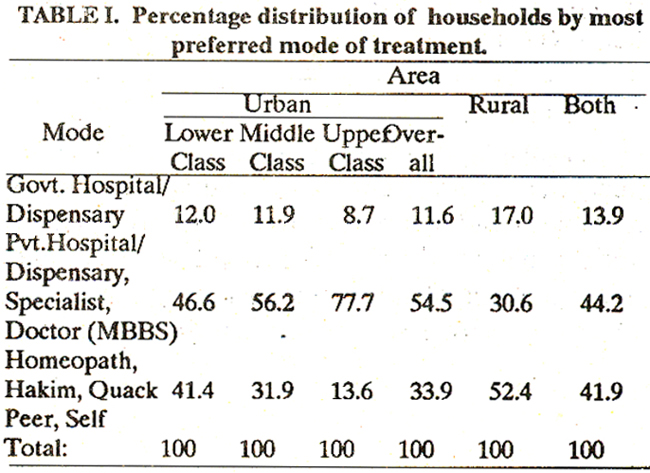
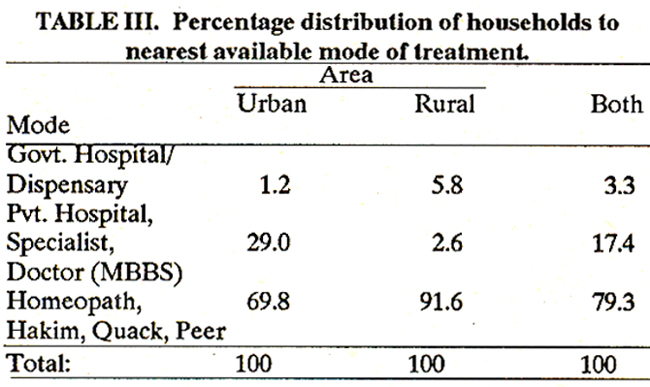
The overall preference for group 2 mode of treatment was for proper diagnosis and rapid relief and group 3 for easy availability, lower cost, sympathetic attitude (Table II) and the easy access (Table III).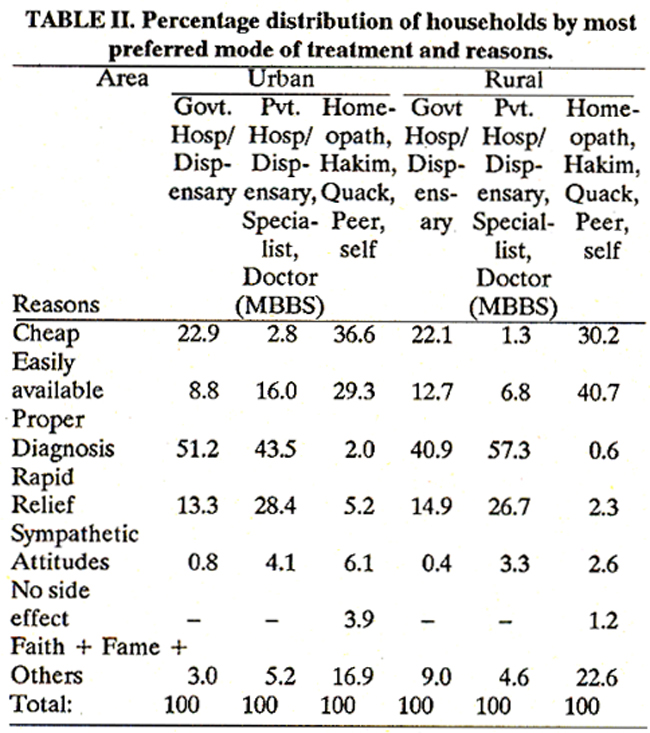
DISCUSSION
The standard of health care in a country depends on the available medical facilities and the manpower. In Pakistan there was 1 doctor for 4,000 and 1 hospital bed for 2,000 persons in 19776,7. Although the figures have improved in 1986 but they / are still not as good as other Countries5-7 (Table IV).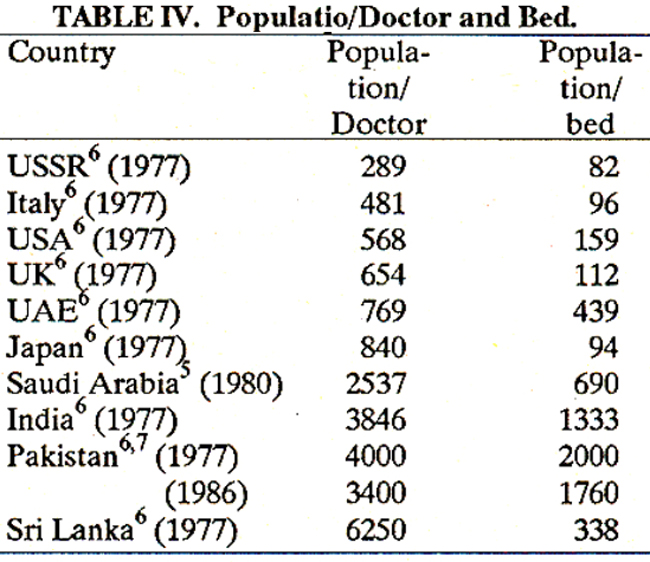
Non-availability of government hospitals and dispensaries in rural areas, lack of diagnostic facilities, medicines and manpower in few that are available and the high cost have made group 1 and 2modes of treatment out of reach for an average Pakistani. They, therefore, resort to unscientific and at times hazardous modes of easily available, low cost treatment of group 3 as is shown in this study. Taking this study as a base line a comprehensive survey of government health facilities and an attempt to improve the health manpower and hospitals may bring some change in the health status of people of this country.
REFERENCES
1. Lyons, AS. and Pettrucelli, R.J. Medicine, and illustrated histosy. New York, Hany N. Abrams, 1978, p. 67, 72,196,301.
2. Saffron, M. Medicine, an illustrated history, by Lyons A.S. and B.. J. Pettrucelli. New York, Hariy N. Abrams, 1978, p 485, 489.
3. Brieger, G.H. Christopher’s text book of surgery, 12th ed London, Saunders, 1981.
4. 1981 District Census Report of Faisalabad. District Census Report No. 49. Islamabad, Population Census Organisation, Government of Pakistan, 1984, p. 22.
5. Makkah Region Comprehensive Development Plans, Final Report; Saudi Arabia, Ministry of Municipal & Rural Affairs, Kingdom of Saudi Arabia, 1984, p.62.
6. The world almanac and book of facts, 1983. New York, Newspaper Enterprises Association, 1983, p500.
7. Economic Survey 1985-86. lslamabad, Economic Advisors Wing, Ministry of Finance, Government of Pakistan, 1986, p.12.
Journal of the Pakistan Medical Association has agreed to receive and publish manuscripts in accordance with the principles of the following committees:


