

S. Haroon Ahmed ( Department of Psychiatry, Jinnah Postgraduate Medical Centre, Karachi. )
Shifa Naeem ( Psychosocial Centre, Hilal-e-Ahmer House, cifton, Karachi. )
Farida Zainulabdin ( Psychosocial Centre, Hilal-e-Ahmer House, cifton, Karachi. )
February 1991, Volume 41, Issue 2
Original Article

ABSTRACT
Alexithymia is a new term which usually means “no words for mood “and used to describe a disorder where patients have difficulty in expressing feelings in words. Such patients therefore express emotions in somatic terms. We have selected headache as a symptom to test the term Alexithymia. A group of thirty patients with the complaint of persistent headache of more than 6 months duration, without any organic pathology or neurological disease entity was taken. This study concludes that Alexithymic traits are not necessarily more prominent in those having psychophysiological symptoms specially tension headache. It also shows that we should not accept any new concept evolved in Wool without testing it in our own conditions (JPMA 41: 40, 1991).
INTRODUCTION
Alexithymia literally means no words for mood and is used to describe a group of patients who have impoverished fantasy lives and difficulty in expressing their feelings in words1. They dream rarely and tend to focus on physical symptoms and trivial environmental details. They rarely cry and exhibit an operative style of thinking which is concrete, inert and stimulus-bound (Table-I).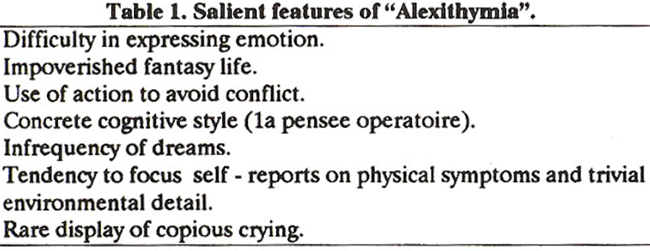
Although this cluster of alexithymic traits may appear in various patient groups, most reports link them with psychosomatic symptoms. 2,3 The present study is an attempt to measure alexithymic traits in a group of patients with psychosomatic symptoms and compare them with a control group. Our hypothesis was that alexithymic traits would be more prominent among patients presenting with somatic symptoms.
METHOD
The symptom chosen for this study was ‘Tension Headache.’ Although this condition was not considered to be one of the classical psychosomatic illnesses it is now categorized with “psychological factors tiffecting physical conditions” in D.S.M III, 4 alongwith other psychosomatic conditions and given the code of 316.00. International classification of disease of WHO (ICD-9) 5 includes it in ‘psychalgia’under code 307.8 where headache is of “mental origin and a more precise medical or psychiatric diagnosis cannot be made”. The sample of patients and controls was taken from the out-patients walk-in clinic of the department of psychiatry at Jinnah Postgraduate Medical Centre, Karachi. This is attached to a teaching state hospital and caters to people from the lower socio-economic stratum. Thirty patients between the ages of 16-45 years were taken with the complaint of persistent headache of more than 6 months duration,. without any organic pathology orb naurological disease entity e.g migraine. These patients were given urdu version of ‘M.M.P.I. 6 Alexithymia Scale, which consists of 21 statements to be marked true or false by the subject, A score of 13 and above was taken as alexithymia, 7 or less as nonalexithymia, and between 8-12 as borderline. A control sample of 30 persons from similar socioeconomic, sex and age group without headache was also taken and rated on the M.M.P.I. Alexitbymia Scale.
RESULTS
The average age of the experimental group, which we will call the “headache group” was 34 years, while that of the control group was 28 years. There were 5 males and 25 females in the headache group and 7 males and 23 females in the control group (Table II).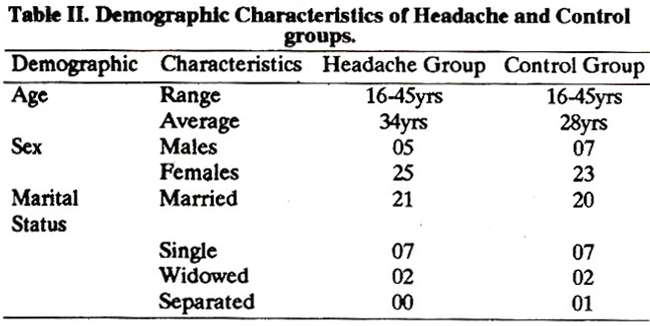
Ten out of thirty (33%) from the headache group were found to be alexithymic as compared to eleven (37%) in the control group. Fourteen patients (47%) from the headache group turned out to be borderline alexithymic as compared to seventeen (58%) from the control group. Six (20%) subjects were nonalexithymic from the headache group as compared to only two (7%) from the control group (Table III).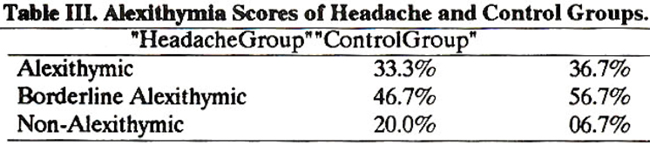
DISCUSSION
In our series 33.3% patients with ‘headache’36.7% controls were alexithymic. Similarly, there was a higher percentage (56.7%) of borderline alexithymics among the control group as compared to the “Headache” group (46.7%). This study, therefore, concludes that alexithymic traits are not necessarily more prominent in people having psycho-physiological symptoms specially tension headache. There could be more than one explanation for such a result. It is likely that the traits we were trying to elicit are present in most people belonging to the lower socioeconomic strata i.e. under-privileged. Several cognitive characteristics have been found among the under privileged, most of whom are similar to alexithymic traits e.g. they are physical and visual, rather than aural, externally oriented rather than introspective, and use words in relation to action rather than being word bound. 8 As we had taken our samples (both the headache and the control groups) from the lower socioeconomic stratum both the groups are showing alexithymic traits, regardless of the fact whether they had psychosomatic symptoms or not. This study also shows that we should not accept any new concept evolved and introduced in the west without testing it in our own conditions.
REFERENCE
1. Taylor, G. J. Alexithymia; Concept, measurement, and implications for treatment. Am. 1. Psychiatry, 1984; 141: 725.
2. Kesser, I. M.A reviewof the alexithymic concept. Psychosom. Med., 1981; 43: 531.
3. Nemiah, J. C. and Sifnoes, P. E. Affect and fantasy in patients with psychosomatic disorders, in modern trends in psychosomatic medicine by D. W. Hill. London, Butterworth, 1970; V.3, P. 26.
4. American Psychiatric Association. Diagnostic and statistical manual mental disorders. 3rd ed. Washington, A.P.A., 1980, P. 55.
5. World Health Organization Mental disorders; glossaiy and guide to their classification in accordance with the ninth revision of the International Classification of Diseases, Geneva, W.H.O. 1987, p.303.
6. Mirza, L. Translation and standardization of M.M.P.J. for Pakistan in handbook of cross-national MMPI research. Edited by James N. Butcher and Paolo Pancheri. Minneapolis, University of Minnesota Press 1976, p. 33.
7. Kleiger, J. H. and Kinsman, R. A. The development of an MMPI alexithymia scale. Psychother. Psychosom., 1980; 34: 17.
8. Sadock, B. J., Kaplan, H; I., Freedman, A. M., and Sussman, N. Psychiatiy and the Urban Setting, in comprehensive textbook of psychiatiy. Edited by Freedman, A. M., Kaplan, H. I., and Sadock, B. J., 2nd ed. Baltimore, Williams and Wilkins, 1975, p. 2498.
Journal of the Pakistan Medical Association has agreed to receive and publish manuscripts in accordance with the principles of the following committees:


