

Rakhshanda Baqai ( Pakistan Medical Research Council, Research Centre, Jinnah Postgraduate Medical Centre, Karachi. )
Sarwar J. Zuberi ( Pakistan Medical Research Council, Research Center, Jinnah Postgraduate Medical Centre, Karachi. )
February 1991, Volume 41, Issue 2
Original Article

ABSTRACT
Four hundred and fifty eight water samples collected from domestic tanks and taps and community taps were analysed for bacterial contamination. Faecal pollution was more in domestic tanks and taps in Mehmoodabad, Korangi and least in water collected from community taps of Liaquatabad, Korangi and Mehmoodabad. Bacteria isolated were mostly e.coli, Enterobacter sp, Klebsiella sp. and A. faecalis, while other organisms (except Pseudomonas) were found In lower numbers. Salmonella para typhi and para typhi B, Shigella dysenteriae and Aeremonas sp. were found In Clifton area. Parasite (Fluke) was isolated from one water sample only (JPMA 41: 33, 1991).
INTRODUCTION
Hepatitis (A,E)1,2 and diarrhoeal disease3-5 widely prevalent in Karachi, may be due to consumption of polluted water. Pollution can occur at source, in pipes carrying water from the source to domestic water supply and in domestic tanks. The degree of contamination may vary in different areas depending upon the hygienic and living standards of the population4 . This study was done on domestic water supply to determine whether water consumed by Karachi population is potable.
MATERIAL AND METHOD
Four hundred and fifty eight water samples (211 each from domestic tanks and taps, and 36 from community taps) were collected from different areas of Karachi (Table 1).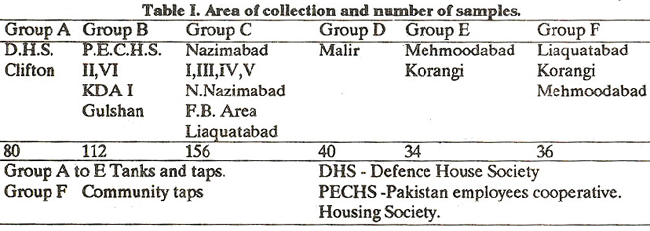
Chlorinated water samples were collected once from each source, and specimens were analysed for faecal contamination by membrane filter technique6. A measured volume (100 ml) of water was passed through the membrane, the test carried out in duplicate. Each membrane was transferred to MacConkey’s agar. The plates were incubated at 37°C and 44°C for 24 to 48 hours. Colony counts between 10-80 were considered significant. Bacterial growth was identified by colony morphology, gram’s staining and biochemical reactions on API 20-E kit. Out of 458 water samples, parasites were looked for in 248 specimens. A similar volume of water was passed through another membrane filter. The membrane was washed with 2 ml sterile saline in a petri dish. The saline solution was centrifuged and the sediment was examined under low and high power objective.
RESULTS
Water samples collected from different areas of Karachi were divided into 6 groups. Contamination in tanks was similar in groups A to D. Higher contamination was found in group E, both in tanks and taps while least contamination was found in community taps (Table II).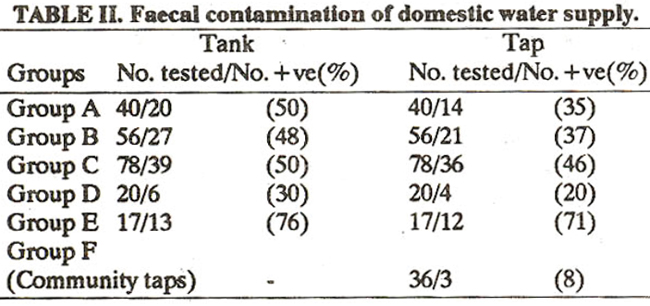
Faecal contamination was found in all areas (Table III).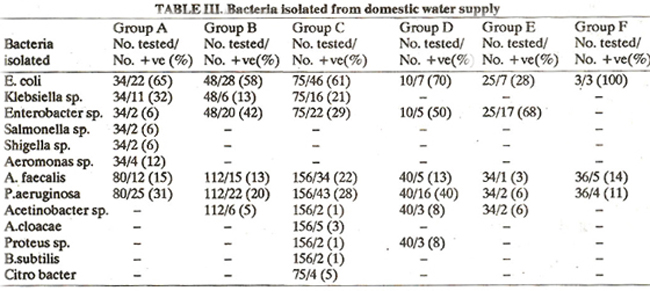
Among the bacterial isolates E.coli (both at 37°C & 44°C) were mainly isolated followed by Enterobacter sp and Kiebsiella sp. Other pathogenic bacteria were found in lower numbers, while Shigella dysenteriae, Salmonella para A and B and Aeromonas sp. were found in few water samples from underground tanks in Clifton. Pseudomonas was isolated in moderate numbers in all the groups. Direct mjcroscopy for parasites indicated only one positive sample (Fluke) from an underground tank.
DISCUSSION
Faecal pollution of domestic water supply may introduce a variety of intestinal pathogens and result in microbial disease in the community. These organisms may cause diseases that vary from mild gastroenteritis to severe and sometimes fatal dysentry, cholera or typhoid. The source of water and the type of supply has a bearing on contamination and diarrhoeal disease. This study indicates that unhygienic polluted water is being consumed by a large proportion of Karachi population. In other cities of Pakistan faecal contamination was found in domestic water in congested areas and also in water obtained from natural sources8-12, as water supplies might be contaminated from faeces being passed or washed into rivers, streams or being allowed to seep into wells. Parasitic infestation is probably not through water in Karachi city as only one parasite (Fluke) was detected. A coliform limit is not adequate to ensure the absence of pathogenic intestinal protozoa in treated water supplies due to extreme chlorine resistance of the pathogens13. In order to ascertain potable water supply extra care must be taken right from the source of supply to the consumers’tanks and taps. Quality of construction of underground tanks should be improved to avoid cracks and seepage from outside. Water and sewage pipe lines should be laid far apart so that mixing does not occur when cracks develop or seepage occurs. Regular cleaning of tanks and.. checking contamination by a simple test tfran occasionally by a more complicated test or series of tests is necessary as contamination is often intermittent. Addition of alum or sulphur in tanks, and above all, simply boiling of water which is used for drinking purposes is necessary to make water safe for human consumption.
REFERENCES
1. Qureshi, M. S., Ahmed, M., Rashid, H., Mushtaq, S. and Ahmed, S. A. Hepatitis Non A - Non B report of a water-borne outbreak. JPMA., 1988; 38: 203.
2. Zuckerman, A. J. Hepatitis. A virus. Br. Med. J., 1990; 300: 1475.
3. Esrey, S. A., Reachem, K G. and Hughes, J. M. Intervention for the control of diarrhoea! disease, among young children; improving watersupplies and excreta disposal facilities. Bull. WHO., 1985; 63:757.
4. Muttamare, S. and Krishnaswamy, M. Diarrhoeal diseases related to sanitation and water supply. Southeast Asian J. Trop. Med. Public Health, 1982; 13: 348.
5. Baqai, K Water contamination and its related disease (Editorial). JPMA., 1988; 38: 90.
6. World Health Organization. Guidelines for drinking-water quality. Health criteria and other supporting information. Geneva, WHO., 1984; vol.2, p.3.
7. Cutting, W.A.M. and Hawkins, P. The role of water in relation to diarrhoeal disease. J. Trop. Med. Hyg., 1982; 85: 31.
8. Waheed, T. and Kausar, T. Quality of drinking water in Lahore. Pakistan J. Med. Res., 1987; 26: 162.
9. Sami, Z. and Rehman, G. Detection and enumeration of faecal coliform and other organisms in drinking water. (A comparison of two technique). JPMA., 1985; 35: 329.
10. Sami, Z., Khan, M. A. and Ghafoor, A. Bacteriological analysis of drinking water. JPMA., 1988; 38: 92.
11. Akhtar,T. and Salarzai, and Zahoorullah. Quality of drinking water in N.W.F.P. Pakistan J. Med. Res., 1986; 25: 74.
12. Khaliq, M.A., Khan, S.P. and Khan, J.A. Bacteriological study of drinking water in district Abbottabad. Pakistan J. Med. Res., 1986; 25:97.
13. Craun, G.E Waterborne giardiasisin the United States; a Review. Am. J. Pub. Hlth., 1979; 69: 817.
Journal of the Pakistan Medical Association has agreed to receive and publish manuscripts in accordance with the principles of the following committees:


