

Kamran Aziz ( Department of Biochemistry, Allama Iqbal Medical College, Lahore. )
Riaz Javed Raja ( Department of Pathology, King Edward Medical College, Lahore. )
Shah Mohammed Marri ( Department of Pathology, Postgraduate Medical Institute, Lahore. )
October 1992, Volume 42, Issue 10
Original Article

Ramazan fasting, one of the pillars of Islam, extends from dawn until sunset. In high northern latitudes, depending on month oftheyear, period of fasting can be longer. During this period individuals abstain from eating, drinking, oral medication, intravenous fluids and nutrients. The calorie gap during fasting is usually bridged by taking extra milk, sweets, fried snacks and dates. The physiological and biochemical effects of fasting are mild and reversible1. This paper describes the effect of Ramazan fasting on serum lipids profile in healthy adult males.
SUBJECTS, METHODS AND RESULTS
Twenty-five healthy, non-obese, non-smoker adult male volunteers who observed fast during the whole month of Ramazan were included in the study. Their ages ranged between 30-45 years. Blood samples were collected aseptically by venipuncture from all subjects before Ramazan fasting and then every week for 4 weeks just before Iftar (breaking fast) time and one sample after Ramazan. Sera were analyzed for triacylglycerols2, cholesterol3, HDL-C4 and VLDL5. Serum triacylglycerols and cholesterol levels decreased significantly in first (R1) and third (10) weeks of Ramazan. However, post-Ramazan levels (Rp) reverted back to prefasting levels (Table I).
Sustained increase of the protective factor (HDL-C) alongwith decreasing risk factor (LDL-C) during last week of Ramazan (Table II)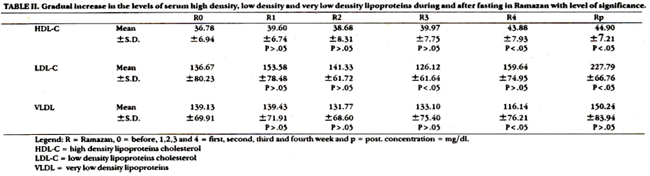
are also reflected in decreasing ratio, i.e., total- cholesterol/HDL-cholesterol and LDL cholesterol/HDL-cholesterol (Table III).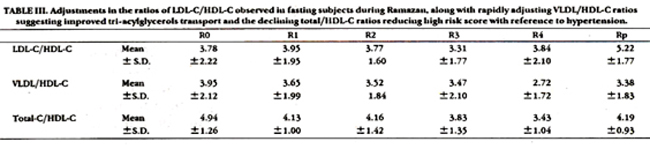
COMMENTS
Slight increase in cholesterol level was observed in 36 healthy, fasting male volunteers during Ramazan6. In another study increased cholesterol was in the LDL and VLDL fractions7. Triglycerides were increased with an increase in VLDL-TG while APO CII and APO III were significantly decreased7. Raised lipid levels in Ramazan may also be due to large evening meal or increased intake of sweets and fats1. Contrary to these findings cholesterol, LDL and VLDL concentrations declined during fasting, cholesterol specially showed a significant lowering during the fourth week whereas HDL cholesterol levels regttered an increase in this study. The VLDL/HDL-C, LDL-C/HDL-C and total-C/HDL-C ratios also changed during fasting and were found to be related to the reduced cholesterol levels. Thus a positive relationship was observed between fasting in Ramazan and lowering of the serum cholesterol levels with subsequent reduction in LDL-C and rise in HDL-C. Variation in lipid levels observed in different series may be related to dietary changes, working pattern and the duration of fasting in various countries.
REFERENCES
1. Sulimar , R.A. Ramadan fasting: Medical aspects in health and disease. Ann. saudi Med., 1991;11:637-41.
2. Tri ler. P. Enzymic colourimetric estimation of triglycerides by glycerol phoaphatasephenol oxidsse method. Ann. Clin. Biochem., 1969;6:24-27.
3. Roeschlsu, P., Bernt, B. and Oruber, W. Enzymic determination of total cholesterol by cholesterol esterase-per-oxidase method. 3. cnn. Chem. Biochem., 1974;12:403.
4. Burstein, M. and Scholnick, H.R. Lipoprotein-polyamin-metal interactions. Adv. Lipid Res., 1973;2:67-108.
5. Moide, A., Kswai, T. and Kubots, A. Analysis of serum lipoproteins by precipitationwith heparin and calcium ions. Jpn. J. Clin. Pathol., 1975;21:82-91. Special issue.
6. El-Hszmi, MAP., Al-Faleh, F.Z. and Al-Mofleh, I.A. Effect of Ramadan fasting on value of haematological and biochemical parameters. Saudi Med. J., 1987;8:171-76.
7. Shoukry, M.l. Effect of fasting in Rsmsdsn on plasma lipoproteins and apoproteins. Saudi Med.J., 1986;7:561-65.
Journal of the Pakistan Medical Association has agreed to receive and publish manuscripts in accordance with the principles of the following committees:


