

Sadia Malik ( Department of Psychology, University of Sargodha, Sargodha, Pakistan. )
Aneeqa Kaiser ( Department of Psychology, University of Sargodha, Sargodha, Pakistan. )
July 2016, Volume 66, Issue 7
Original Article

Abstract
Objective: To investigate the impact of emotional maltreatment on self-esteem among adolescents, and to see if gender makes a difference in this context.
Methods: The cross-sectional study was conducted from January to April 2014, and comprised adolescents in the age range of 14 to 18 years who were selected using purposive sampling from various government and private schools and colleges of Sargodha, Punjab. The questionnaire on seven dimensions of emotional maltreatment at home and Rosenberg self-esteem scale were used.
Results: There were 400 subjects; 200(50%) boys and as many girls. The overall mean age was 16.14±1.36 years (range: 14-18 years). Correlation coefficient indicated significant negative relationship between emotional maltreatment and self-esteem (degrading r= -0.33, p<0.01; exploitation r= -0.30, p< 0.01; isolating r=-0.36, p<0.01; ignoring r= -0.32, p<0.01; rejecting r=-0.43, p< 0.01; and terrorizing r= -0.35, p<0.01) among students. Emotional maltreatment strongly predicted negative self-esteem (isolating?= -0.12, p<0.05; and rejecting ?= -0.30, p< 0.001) among adolescents. Findings indicated significant gender differences in degrading component of emotional maltreatment and self-esteem.
Conclusion: Emotional maltreatment strongly predicted negative self-esteem among adolescents. Gender was a significant factor in the domain of degrading.
Keywords: Emotional maltreatment, Rejecting, Isolating, Self-esteem. (JPMA 66: 795; 2016)
Introduction
Adolescence is a phase of speedy growth and changes. During this developmental phase adolescents face various mental health problems as well as pressures and environmental factors.1 Adolescence starts at the age of 12 and ends at the age of 18 years.2 It is considered that adolescence is a time when one\\\'s struggle for exploring reasons for one\\\'s own behaviour dominates all other things3 and hasty alteration during this phase can have an effect on self-esteem, changing responsibility, and multifaceted relations.4 Researchers have tried to work out the connection between adolescent\\\'s maltreatment and harmful behavioural and emotional maturity in adolescence.5
Children and adolescents\\\' exposure to aggression refers to the experience of physical abuse, sexual abuse, emotional abuse and domestic violence.6 Emotional abuse/maltreatment is a problematic behaviour that is stressful for individuals of all socioeconomic sectors, ages and genders.7 The emotional maltreatment that adolescents have to face at home may appear in diverse types and various conditions. Though there is no sufficient consensus on absolute categorisation, acknowledged factors in literature include rejecting, degrading, terrorising, isolating, corrupting/exploiting, denying and ignoring.8 Psychological maltreatment (PM), also recognised as emotional abuse and neglect, is widespread around the world.9-11 Abuse is defined as a behaviour that causes harm, and neglect also has harmful consequences. More over, neglect symbolises the malfunctioning of parental responsibilities like provision of care and safety.12
Additionally, it is divided into four main types: physical abuse, physical neglect, emotional abuse and emotional neglect. Sometimes sexual abuse is considered physical abuse, but it has its distinctive features that discriminate it from other types of maltreatment. It has been found that emotional abuse is the type of abuse which is most common.13 Researchers concluded that children who experience emotional abuse have the most horrible effects and it is a significant predictor of later maladjustment.14 Self-esteem is considered a vital part of an individual\\\'s social and cognitive growth.15 Self-esteem is the level that persons think that they are able, important, successful and admirable.16
An adolescent\\\'s weak emotional relationship with parents and other caregivers can influence his social life.17 Numerous authors found significant positive correlation between adolescents \\\'implicit\\\' self-esteem and their parents\\\' \\\'emotional warmth and understanding\\\' and their mothers\\\' favouritism. This suggests positive parenting styles could enhance adolescents\\\' implicit self-esteem. They further revealed that negative parenting styles affected the consistency of adolescents\\\' covert and overt self-esteem.18
Another research demonstrated that adolescent girls who had high parental security feelings had low emotional autonomy and high level of self-esteem.19 It was also noted that perceived rejection from parents was the strongest risk factor associated with low self-esteem in adolescents20 Researchers found that fathers\\\' involvement had opposite correlation with depression, aggression, negative self-esteem, lack of self-competence, emotional insensitivity and unenthusiastic world-view in adolescents of Pakistan.21 It is also evident that parental rejection is negatively associated with self-esteem in adolescents.22 In another study, family atmosphere and parental insulting and hostile behaviour were found to be associated with poor self-concept and low self-esteem.23
Researchers have always been paying attention on investigating the troubles and problems of adolescence because it is a significant era of life and they experience so much trouble that it might cause some psychological issues. The present study was planned to examine the relationship between emotional maltreatment and self-esteem among adolescents, and to explore the role of gender in this equation.
Subjects and Methods
The cross-sectional study was conducted from January to April 2014, and comprised adolescents in the age range of 14 to 18 years who were selected using purposive sampling from various government and private schools and colleges of Sargodha, Punjab.
For data collection, after informed written consent was obtained from all subjects, the Questionnaire on Seven Dimensions of Emotional Maltreatment at Home (QSDEMH)8 was used to measure emotional maltreatment. Its seven dimensions are degrading. exploiting, corrupting, isolating, ignoring. rejecting and terrorising. Each section consists of seven items on a four-point Likert rating scale of \\\'very often\\\' (4); \\\'often\\\' (3); \\\'sometimes\\\' (2); and \\\'never\\\' (1). The higher the score, the more psychologically maltreated is the participant at home.
The Rosenberg self-esteem (RSE)16 scale was used to measure self-esteem. It is a global measure to assess positive and negative feelings about self. All 10 items are answered using a 4-point Likert scale format ranging from \\\'strongly agree\\\' to \\\'strongly disagree\\\'.
SPSS 20 was used to analyse data. Pearson product moment correlation, regression analysis and independent sample t-test were also used.
Result
There were 400 subjects; 200(50%) boys and as many girls. The overall mean age was 16.14±1.36 years (range: 14-18 years).
Reliability coefficients ranged from 0.57to 0.85, indicating that scales had sufficient internal consistency. Pearson correlation revealed that emotional maltreatment factors degrading, exploiting, isolating, ignoring, rejecting and terrorising were significantly negatively correlated with self-esteem (Table-1)
Multiple regression analysis revealed the impact of isolating and rejecting on self-esteem and the overall model was found significant (F96, 395]= 16.25; p<0.001) suggesting that isolating and rejecting predicted self-esteem and accounted for 18% variance in the outcome variable of self-esteem (R2=0.18). Among these predictor variables, isolating was a significant negative predictor of self-esteem (b = -0.124; t = -1.92; p<0.05). Rejecting was a significant negative predictor of self-esteem (b = -3.02; t = -3.76; p<0.001) (Table-2) 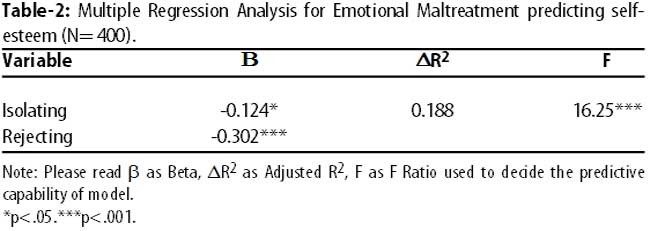
Significant gender differences were noted in degrading and self-esteem, while no significant differences were found in other components of emotional maltreatment (Table-3)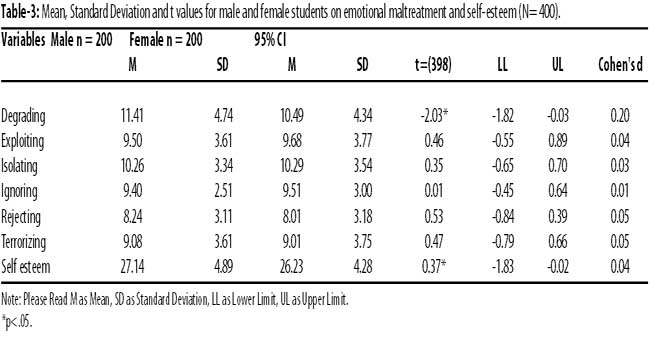
Discussion
The present study was an endeavour to explore the relationship between emotional maltreatment and self-esteem. Results indicated positive relationship between emotional maltreatment and self-esteem. It was hypothesised that emotional maltreatment would be a negative predictor for self-esteem among adolescents. Findings approved the hypothesis. These findings appear to be similar with a previous study which explored that emotional abuse appear to be strongly linked with low self-assessment almost certainly because children have a propensity to internalise parental statement as part of the criteria for self-observation.13 Similarly, a study reported that parental rejection is a significant predictor of negative self-esteem in adolescents.24 It showed that parents in Pakistani families don\\\'t have concern about the mental and emotional requirements of their child and it is more challenging for the child. They are uninformed of the consequences, they use insulting and rude verbal communication that hurts their child; adverse behaviour of parent may cause lower level of self-esteem in their child.25 Along the same line, researchers found that father\\\'s rejection had significant negative relationship with self-esteem among adolescents.26
The results are also confirmed by another study that concluded perceived rejection from parents was the strongest risk factor associated with low self-esteem in adolescents.27 Similarly, it was observed that emotional and behavioural problems are considered to have a negative relationship with self-esteem of the children and adolescents.25
The second hypothesis of the present study was that there would be significant gender difference in emotional maltreatment and self-esteem. Findings indicated that boys had slightly higher self-esteem and experienced degrading more than females. So, this hypothesis was accepted. Previous research showed that adolescent girls who had high parental security feelings had high level of self-esteem.26 Current results in this context are inconsistent with previous research.26 This study will be helpful for parents, educationist and clinicians to understand the adolescent\\\'s issues.
Conclusion
Emotional maltreatment strongly predicted negative self-esteem among adolescents. Significant gender differences in the degrading component of emotional maltreatment and self were also found.
Acknowledgement
We are grateful to administrative staff and students who helped us in data collection for the study which was part of M.Phil thesis of Aneeqa Kaiser entitled \\\'Predictors and Consequences of State Resilience Among Adolescents of Sargodha Region: Role of Life Orientation\\\'.
Disclosure: None.
Conflict of interest: None.
Funding source: None.
References
1. Steinberg L, Morris AS. Adolescent development. Ann Rev Psychol 2001; 52: 83-110.
2. Erickson HE. Childhood and Society. New York: Norton and Company; 1950.
3. Steinberg L. Adolescence. 6thed. Boston: McGraw-Hill, Inc; 2002
4. Block J, Richard RW. A longitudinal study of consistency and change in self-esteem from early adolescence to early adulthood. Child Development 1993; 64: 3909-23.
5. Ireland TO, Smith CA, Thornberry TP. Developmental issues in the impact of child maltreatment on later delinquency and drug use. Criminology 2002; 40: 359-99.
6. Walsh CA, MacMillan HL, Trocme N, Jamieson E, Boyle MH. Measurement of victimization in adolescence: development and validation of the childhood experiences of violence questionnaire. Child Abuse Neglect 2008; 32: 1037-57.
7. Jolly O, Aluede O, Ojugo, AI. A psychological postulation for the understanding classroom emotional abuse. Eur J Educ Stud 2009; 1: 125-31.
8. American Humane Association. Emotional abuse [online] 2010 [cited 2014 Mar 12] Available from: URLhttp://americanhumane.org.
9. Gesinde AM. Dimensions of emotional maltreatment of school adolescent at homes: Implication for counseling practice. A paper presented at 11th International Conference of Kenyan Professional Association.2010.
10. Binggeli NJ, Hart SN, Brassard MR. Psychological maltreatment of children: The APSAC study guides 4. Thousand Oaks, CA: Sage Publications; 2001.
11. Kaysen D, Scher C, Mastnak J, Resick P. Cognitive mediation of childhood maltreatment and adult depression. Behav Ther 2005; 36: 235-44.
12. Straus MA, Field CJ. Psychological Aggression by American Parents: National Data on Prevalence, Chronicity, and Severity. J Marriage Fam 2003; 65: 795-808.
13. Giovannoni JM. Parental mistreatment: Perpetrators and victims. J Marriage Fam1971; 33: 649-57.
14. Daniel F. A survey of the prevalence of child abuse and neglect as perceived by parents and guardians. Nigerian Educ Psychol 2004; 3: 56-65.
15. Simeon D, Guralnik O, Schmeidler J, Sirof, B, Knutelska M. The role of childhood interpersonal trauma in depersonalization disorder. Am J Psychiatry 2001; 158: 1027-33.
16. Berndt TJ. Friendship quality and social development. Curr Directions Psychol Sci 2002; 11: 7-10.
17. Rosenberg M. Society and the Adolescent Self-image. Princeton, NJ: Princeton University Press; 1965
18. Riggs SA. Childhood emotional abuse and the attachment system across the life cycle: what theory and research tell us. J Aggression Maltreatment Trauma 2010; 19: 5-51.
19. Sternberg KJ, Knutson JF, Lamb, ME, Baradaran LP, Nolan CM, Flanzer S. The Child Maltreatment Log: A computer-based program for describing research samples. Child Maltreatment 2004; 9: 30-48.
20. Anne MR. Attachment of female adolescents to parents and its effect on self-esteem and depression. Dissertation Abstracts International: The Sciences and Engineering 1998; 59-62
21. Robertson JF, Simons RL. Family factors, self-esteem, and adolescent depression. J Marriage Family 1989; 51: 125-38
22. Najam N, Kausar. Father acceptance-rejection, father involvement and socio emotional adjustment of adolescents in Pakistan. J Behav Sci 2012; 22: 121.
23. Riaz MN, Qasmi FN. Impact of Perceived of Parental Acceptance-Rejection on Psychological Adjustment and Self Concepts of Persons with Disabilities. J Behav Sci 2012; 22: 64-82.
24. Ounsted C, Oppenheimer R, Lindsey J. Aspects of bonding failure: The psychology and psychotherapeutic treatment of families of battered children. Developmental Med Child Neurol 1974; 16: 447-56.
25. Coopersmith S. The antecedents of self esteem. 1967; San Francisco: Freeman.
26. Navarre EL. Psychological maltreatment: The core component of child abuse. In: Brassard MR, Germain R, Hart SN. Psychological maltreatment of children and youth. N.Y: Pergamon Press; 1987.
27. Michalak J, Teismann T, Heidenreich T, Strohle G,Vocks S. Buffering low self esteem: The effect of mindful acceptance on the relationship between self-esteem and depression. Personality Individual Differences 2011; 50: 751-4.
Related Articles
Journal of the Pakistan Medical Association has agreed to receive and publish manuscripts in accordance with the principles of the following committees:


