

Abdur Rehman ( Dow University of Health Sciences, Karachi. )
Faiza Amin ( Dow Dental College, Dow University of Health Sciences, Karachi. )
Muhammad Abbas ( 3Department of Prosthodontics, Ziauddin College of Dentistry, Karachi. )
November 2014, Volume 64, Issue 11
Original Article

Abstract
Objective: To examine the effect of distilled water, artificial saliva and ethanol on the tensile strength of direct tooth-coloured restorative material.
Methods: The study was conducted at Dr. Ishrat ul Ebad Khan Institute of Oral Health Sciences, Dow University of Health Sciences (DUHS), Karachi, from April 2011 to September 2012. The testing was performed at the Pakistan Council of Scientific and Industrial Research (PCSIR) laboratories. Two composite resins Filtek Z250 and Spectrum TPH were tested. Specimens (13mmx3mmx2mm) of each material were prepared in the stainless steel mould according to the manufacturers' instructions and distributed into 3 equal groups: one immersed in distilled water, the other in artificial saliva, and the last one in ethanol for 24 hours. Tensile strength was determined after 24 hours in universal Instron Testing Machine.
Results: There were 72 specimens in all; 36(50%) each for Filtek Z250 and Spectrum TPH. The three sub-groups in each case had 12(33.3%) specimens. For the Filtek Z250, there was no statistically significant difference between immersion in distilled water and artificial saliva, but the ethanol group presented lower tensile strength (p<0.05). For the Spectrum TPH, samples immersed in ethanol and artificial saliva presented lower tensile strength compared to distilled water (p<0.05).
Conclusion: The tested composite resins were affected by the immersion media and adversely affected the mechanical properties of composite resins.
Keywords: Composite resins, Tensile strength, Artificial saliva, Distilled water, Ethanol. (JPMA 64: 1250; 2014).
Introduction
Dental composites generally consist of inorganic fillers, coupling agent and resin matrixes. Due to their rapid polymerisation, aesthetic appearance and strength, dental composites are becoming more and more popular as dental restorative material. However, dental composites have water sorption in wet oral environment, and some negative effect occurs along with this sorption, such as release of some substances (impurities of monomers, degradation products, un-reacted monomers and additives), leaching of the filler ions and softening of the resin matrixes.1,2 These released substances depress the biocompatibility of dental composites by stimulating the growth of bacteria around the restoration, promote allergic reaction and lead to secondary caries.3,4 It has been proposed that long-term exposure to these constituents may damage health.5 Degradation of dental composites also gets accelerated by water sorption2 and cause harm to mechanical/physical properties such as wear resistance, flexural elastic modulus, tensile strength and flexural strength2,4,6 which occur essentially due to the following two reasons: first, bond between filler particles and silane break down hydrolytically, resulting in the debonding of the filler-resin matrix; second, water acts as a plasticiser which results in the softening of dental resins. However, moderate water sorption has a positive side effect relieving some of the internal stresses created during polymerisation shrinkage7,8 compensating polymerisation shrinkage9 and improving marginal sealing.10
Mechanical properties of the resin-based composites (RBCs) decreases by water because it degrades the silane interface of the composite resins.11 The extent to which degrade seems to be different for each material, mechanical and physical properties of dental polymer networks may be adversely altered by the effects of component elution and solvent uptake.12 Clinical data indicates that hygroscopic and hydrolytic effects are not the most common reasons for the failure of composite restorations. The principal reason for the replacement of restorations of composite and amalgam, as diagnosed clinically, are secondary caries. Therefore, long-term stability of RBCs within the wet oral environment is a matter of concern.13 According to a study14 lower plasticising effect will be exerted by water and ethanol when the composites are composed of finer filler particles, that results in shorter filler spacing slowing down the diffusion of plasticising agents.
Many studies have been conducted previously on the behaviour of resin composites in wet atmosphere like ethanol,15 food-simulating liquids16 and sodium hydroxide.17 Artificial saliva is used as a simulation of real saliva and there is very scarce data on the behaviour of the composites in artificial saliva. However, researchers18 have observed that composite resins leached lesser ions on being exposed to water than artificial saliva, creating doubts on the clinical relevance of the use of water as the storage medium.
The degradation of composites in water expressed by a decrease of the mechanical properties could not be proved in many other studies.19,20 This topic seems to be a controversial issue among researchers. Therefore, the current study was planned to determine the tensile strength of composite resins after being immersed in distilled water, ethanol and artificial saliva.
Materials and Method
The study was conducted at Dr. Ishrat ul Ebad Khan Institute of Oral Health Sciences, Dow University of Health Sciences (DUHS), Karachi, from April 2011 to September 2012. The testing was performed at the Pakistan Council of Scientific and Industrial Research (PCSIR) laboratories. Two composite resins Filtek Z250 and Spectrum TPH were tested (Table-1).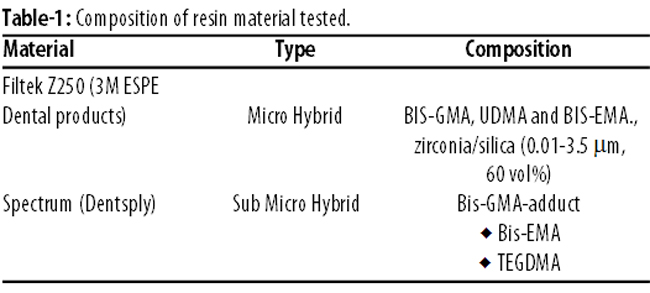
Filtek Z250 (3M ESPE Dental products) was based on aromatic and aliphatic dimethacrylates. The second composite was spectrum from Dentsply based on dimethacrylates
Specimens were prepared using specially-designed stainless steel mould in order to produce hour-glass shape composite slabs (Figure-1).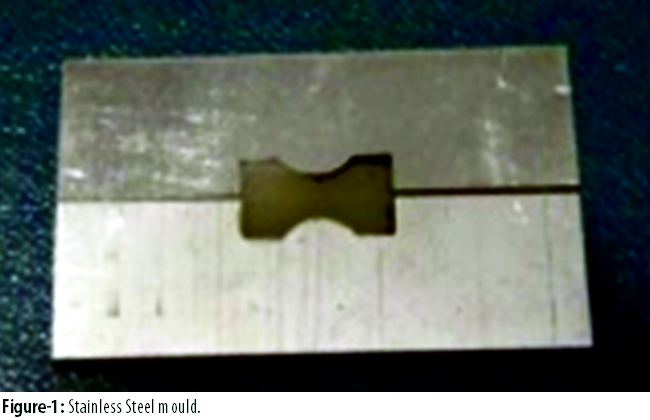
They were 13mm in diameter and 2mm in thickness. The effect of distilled water, artificial saliva and ethanol on tensile strength was evaluated for the two mediums.
The mould was filled with one of the composites, which was inserted in a single increment. Another thin glass slide (thickness: 150mm) was pressed against the restorative material and any excess material was removed before polymerisation. To avoid the effects of scattering light and uncontrolled initiation of polymerisation, only one curing unit (DB-682 Deepblue Technology Co LTD) was used.
They were placed close to each other without any gap between them. This setup served to ensure controlled polymerisation over the entire length of the specimens. The intensity of each curing light was >1000 mW/cm2. After polymerisation was completed according to the polymerisation time recommended by the manufacturers (Figure-2),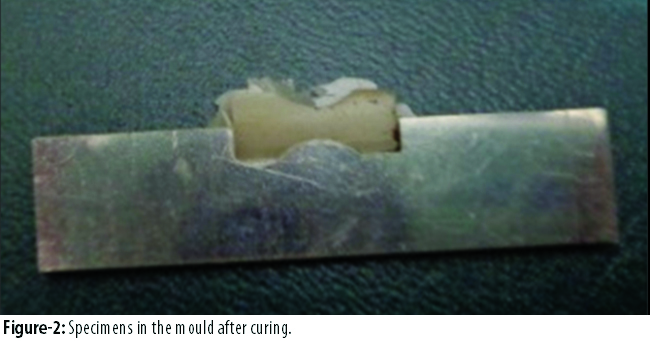
the specimens were extracted from the moulds (Figure-3)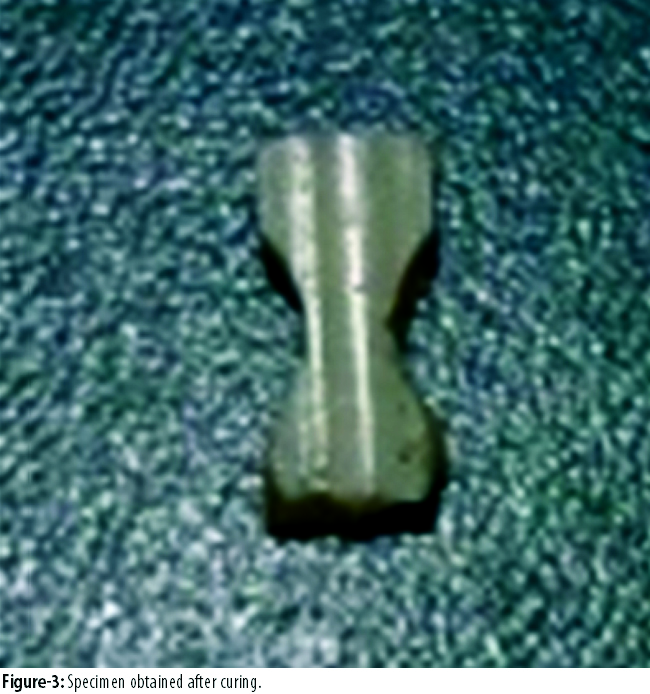
and measured using digital calipers (Mitutoyo Co., Kawasaki, Japan). Thereafter, the specimens were examined for the presence of air bubbles, and defective specimens were excluded. The specimens were then randomly divided into three test groups, each consisting of 12 specimens. Control Group 1 was immersed in distilled water, Group 2 in artificial saliva, and Group 3 in ethanol for 24 hours.
The specimens in Group 2 were immersed in 250ml of artificial saliva solution at 37°C for 24 hours. The artificial saliva solution had an electrolyte composition similar to that of human saliva. It was composed of 1g sodium carboxymethylcellulose, 4.3g xylitol, 0.1g potassium chloride, 5mg calcium chloride, 40mg potassium phosphate, 1mg potassium thiocyanate and 100g distilled de-ionised water. After the specimens were removed from the artificial saliva, the surfaces were rinsed with distilled water for 30 seconds and then they were dried.
The specimens in Group 3 were immersed in 250ml of ethanol solution (Universal trader's chemical suppliers. Pakistan) at 37°C for 24 hours.
Tests for diametral tensile strength (DTS) were performed using a universal testing machine (Instron universal testing machine model static load cell 5KN). The disk-shaped specimens were loaded until fracture at a crosshead speed of 0.5mm/min. It was being compressed between the two supporting plates of the machine, while the outside surfaces of the specimens were in contact with the plates. Tensile strength testing values were calculated in MPa. The formula used to calculate tensile strength was:
Tensile strength = Load X10 / Thickness (mm) X Width (mm)
One-way analysis of variance (ANOVA) test for multiple comparisons between means to determinate significant differences was used at the alpha level of p<0.05 for the analysis of results. To determine which mean differed significantly, post hoc tukey test was used.
Results
There were 72 specimens in all; 36(50%) each for Filtek Z250 and Spectrum TPH. The three sub-groups in each case had 12(33.3%) specimens. For the Filtek Z250, ethanol medium groups presented lower tensile strength which was statistically different (p<0.05) from distilled water and artificial saliva. However, insignificant differences were obtained between distilled water and artificial saliva (p>0.05).
For Spectrum TPH, ethanol and artificial saliva mediums presented lower tensile strength, and both were statistically different (p<0.05) from distilled water. The mean value of the specimens fabricated from Filtek Z250 were noted. When immersed in distilled water (control) the mean value of the tensile strength was 21.07±4.12MPa. However there was major decrease in the tensile strength of the specimens when immersed in ethanol. The mean value was found to be 14.26±0.38 MPa. There was a slight decrease in the tensile strength of the material when immersed in artificial saliva that is 20.20±1.52 MPa (Table-2).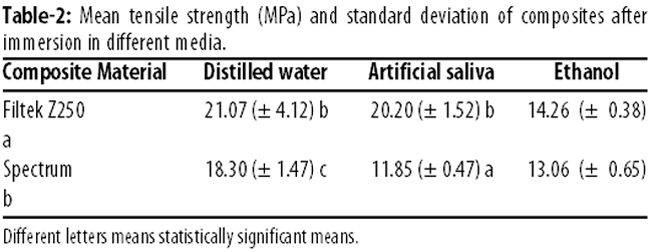
The mean values of the specimens fabricated from Spectrum TPH were aks noted. When immersed in distilled water the mean value of the tensile strength was 18.30±1.47 MPa. There was major decrease in the tensile strength of the specimens when immersed in ethanol. The mean value was found to be 13.06±0.65 MPa. There was a slight decrease in the tensile strength of the material when immersed in artificial saliva that is 11.85±0.47 MPa.
Discussion
The diametral tensile strength is a mechanical parameter providing information about the behaviour of brittle materials, such as RBCs, once exposed to tensile stresses. It is therefore a clinically relevant factor since RBCs would be expected to fail under tensile stresses during mastication because of the forces they are subjected to in functional areas. Although there are critical voices questioning the validity of DTS testing, but it is still regarded as a valuable method to analyse the mechanical properties of modern restorative resin-based materials.21
Under the experimental condition of the study, the results showed that the tensile strength of composite resins can be affected by storage in distilled water, artificial saliva and ethanol. Distilled water simulates the wet oral environment provided by saliva and water. The ethanol solution simulates certain beverages, including alcohol, vegetables, fruits, candies and syrups. Tensile strength provides an indication of a restorative' resistance to the lateral forces generated during function.22 Generally, adhesive capacity has been evaluated by in vitro testing, with shear and tensile tests being the most widely used ones.23 For this reason tensile testing was used in this study. Water uptake in polymer network is related to resin polarity and chain topology.24,25 Resin polarity influences the number of hydrogen bonding sites and the attraction between the polymer and water molecules, while chain topology determines the spatial configuration of the molecular segments and the availability of nanopores within the polymer structure.24,25 Water sorption initially caused a softening of the polymer resin component by swelling the network and reducing the frictional forces between the polymer chains.24,25 The absorbed moisture also acts as a plasticiser, lowering the glass transition temperature (Tg) of the cured resin.
Water sorption may eventually cause irreversible damage to the material by formation of microcracks through repeated sorption/desorption cycles.26 This is followed by hydrolytic degradation of the polymer with scission of the ester linkages and gradual deterioration of the infrastructure of the polymer over time.26 In the present study, Spectrum TPH showed a major decrease in the tensile strength when stored in ethanol whereas there was slight decrease in strength when stored in artificial saliva compared to distilled water. A study27 reported that the solubility of monomers in organic solvents was higher than that in water. The results were in agreement with another study.27 Indeed, the tensile strength of spectrum decreased drastically in the aqueous ethanol solution, compared to the decrease in distilled water. Organic solvents like ethanol have the potential for polymer damage. It can penetrate the resin matrix fully and promote the release of unreacted monomers.27 The partial dissolving of the resin matrix may result in the degradation of the filler-matrix interface, thereby impairing the tensile strength of the specimens. The destruction mechanism of ethanol also caused decreases in the tensile strength of Filtek Z250 in the current study. This similarity of results between two materials was because of the same type of inorganic fillers present in them. According to our study, Filtek Z250 showed a marked decrease in tensile strength when immersed in ethanol whereas there was slight decrease in the strength when immersed in artificial saliva although this decrease was statistically insignificant compared to the distilled water. A study28 found that the measured DTS values were not affected greatly by storage for 4 weeks, not even after storage in more aggressive solutions such as ethanol. This result opposes the results of the present study and this might be due to the fact that they used nanohybrid composites in that study. Nanohybrid RBCs contain a range of different filler sizes, also large filler particles besides the eponymous nano-scale sized fillers. The varying particle sizes provide for a homogenous filler distribution within the matrix, since the small nano fillers are able to occupy the spaces between the larger particles perfectly and therefore help to generate RBCs with filler loadings that are comparable with the conventional hybrid composites. According to a study29 there was a marked reduction in the tensile strength of composite resins when immersed in water/ethanol. This reduction was attributed to degradation of filler-matrix bonds and to swelling and plasticisation of the matrix around the filler particles.30 Since the matrix shrinks during polymerisation, hoop stresses will exist around the filler particles. These hoop stresses increase the frictional forces between the filler and the matrix, thereby decreasing the filler pull-out tendency during tensile testing. However, when the composite is immersed in water, it destroys some of the filler-matrix bonds, which results in an irreversible reduction in tensile strength. Also, water causes the surrounding matrix to swell and plasticise, thus reducing the hoop stresses around the filler particles which facilitate filler pullout.30
The limitations of the current study include incomplete replication of the complex oral environment and disregard for the effects of thermocycling. While future studies may examine the in vivo effects of other immersion media, this study at least confirms the potential damage by ethanol and artificial saliva, a potentially damaging factor of which the public should be aware.
Conclusion
Filtek Z250 showed marked reduction in the tensile strength when immersed in ethanol, but there was a slight decrease in the tensile strength when immersed in artificial saliva compared to distilled water. Resin composite spectrum showed marked reduction in tensile strength when immersed in both ethanol and artificial saliva compared to distilled water.
References
1. Finer Y, Santerre JP. Influence of silanated filler content on the biodegradation of bisGMA/TEGDMA dental composite resins. J Biomed Mater Res A 2007; 81: 75-84.
2. Toledano M, Osorio R, Osorio E, Aguilera FS, Romeo A, de la Higuera B,, et al. Sorption and solubility testing of orthodontic bonding cements in different solutions. J Biomed Mater Res B Appl Biomater 2006; 76: 251-6.
3. Sideridou ID, Achilias DS. Elution study of unreacted Bis-GMA, TEGDMA, UDMA, and Bis-EMA from light-cured dental resins and resin composites using HPLC. J Biomed Mater Res B Appl Biomater 2005; 74: 617-26.
4. Sideridou I, Tserki V, Papanastasiou G. Study of water sorption, solubility and modulus of elasticity of light-cured dimethacrylate-based dental resins. Biomaterials 2003; 24: 655-65.
5. Mazzaoui SA, Burrow MF, Tyas MJ, Rooney FR, Capon RJ. Long-term quantification of the release of monomers from dental resin composites and a resin-modified glass ionomer cement. J Biomed Mater Res 2002; 63: 299-305.
6. Asaoka K, Hirano S. Diffusion coefficient of water through dental composite resin. Biomaterials 2003; 24: 975-9.
7. Toledano M, Osorio R, Osorio E, Fuentes V, Prati C, Garcia-Godoy F. Sorption and solubility of resin-based restorative dental materials. J Dent 2003; 31: 43-50.
8. Martin N, Jedynakiewicz NM, Fisher AC. Hygroscopic expansion and solubility of composite restoratives. Dent Mater 2003; 19: 77-86.
9. Sideridou I, Achilias DS, Spyroudi C, Karabela M. Water sorption characteristics of light-cured dental resins and composites based on Bis-EMA/PCDMA. Biomaterials 2004; 25: 367-76.
10. McCabe JF, Rusby S. Water absorption, dimensional change and radial pressure in resin matrix dental restorative materials. Biomaterials 2004; 25: 4001-7.
11. Söderholm KJ, Roberts MJ. Influence of water exposure on the tensile strength of composites. J Dent Res 1984; 63: 1248-54.
12. Ferracane JL. Hygroscopic and hydrolytic effects in dental polymer networks. Dent Mater 2006; 22: 211-22.
13. Deligeorgi V, Mjör IA, Wilson NH. An overview of reasons for the placement and replacement of restorations. Prim Dent Care 2001; 8: 5-11.
14. Schwartz JI, Söderholm KJ. Effects of filler size, water, and alcohol on hardness and laboratory wear of dental composites. Acta Odontol Scand 2004; 62: 102-6.
15. Roulet J. The problems associated with substituting composite resins for amalgam: a status report on posterior composites. J Dentistry 1988; 16: 101.
16. Ronald LS, John MP. Craig,s Restorative dental materials. 13th ed. St Louis: mosby publishing co, 1997.
17. Nakabayashi N. Importance of mini-dumbbell specimen to access tensile strength of restored dentine: historical background and the future perspective in dentistry. J Dentistry 2004; 32: 431-42.
18. Cobb D, Vargas M, Rundle T. Physical properties of composites cured with conventional light or argon laser. Am J Dentistry 1996; 9: 199.
19. Cesar PF, Miranda Jr WG, Braga RR. Influence of shade and storage time on the flexural strength, flexural modulus, and hardness of composites used for indirect restorations. J Prosthet Dent 2001; 86: 289-96.
20. Sideridou ID, Karabela MM, Micheliou CN, Karagiannidis PG, Logothetidis S. Physical properties of a hybrid and a nanohybrid dental light-cured resin composite. J Biomater Sci Polym Ed 2009; 20: 1831-44.
21. Lien W, Vandewalle KS. Physical properties of a new silorane-based restorative system. Dent Mater 2010; 26: 337-44.
22. Cobb D, Vargas M, Rundle T. Physical properties of composites cured with conventional light or argon laser. Am J Dentistry 1996; 9: 199.
23. Pashley DH, Sano H, Ciucchi B, Yoshiyama M, Carvalho RM. Adhesion testing of dentin bonding agents: a review. Dental Materials 1995; 11: 117-25.
24. Soles CL, Chang FT, Gidley DW, Yee AF. Contributions of the nanovoid structure to the kinetics of moisture transport in epoxy resins. J Polymer Sci 2000; 38: 776-91.
25. Soles CL, Yee AF. A discussion of the molecular mechanisms of moisture transport in epoxy resins. J Polymer Sci 2000; 38: 792-802.
26. Musto P, Ragosta G, Scarinzi G, Mascia L. Probing the molecular interactions in the diffusion of water through epoxy and epoxy-bismaleimide networks. J Polymer Sci 2002; 40: 922-38.
27. Zhang Y, Xu J. Effect of immersion in various media on the sorption, solubility, elution of unreacted monomers, and flexural properties of two model dental composite compositions. Journal of Materials Science: Materials Med 2008; 19: 2477-83.
28. Schmidt C, Ilie N. The effect of aging on the mechanical properties of nanohybridcompositesbased on newmonomerformulations. Clin Oral Investig 2013; 17: 251-7.
29. Sideridou ID, Karabela MM, Bikiaris DN. Aging studies of light cured dimethacrylate-based dental resins and a resin composite in water or ethanol/water. Dental Materials 2007; 23: 1142-9.
30. Soderholm KJ, Roberts M. Influence of water exposure on the tensile strength of composites. J Dent Res1990; 69: 1812-6.
Journal of the Pakistan Medical Association has agreed to receive and publish manuscripts in accordance with the principles of the following committees:


