

Mumtaz Begum ( Biological Production Division, National Institute of Health, Islamabad. )
March 1985, Volume 35, Issue 3
Original Article

Abstract
A total of 230 food samples were collected over a period of 18 months from different shops, vendors and canteens of Rawalpindi/Islamabad region. The sample included cooked, uncooked, frozen and non frozen (pre-packed) food. One hundred and five samples were found contaminated with different bacterial strains, which were grown at two different temperatures i.e. 35-37°C and at room temperature. The pathogenic microorganisms isolated were identified as Coliforms group, 79 (75.23%), Escherichia coli, 49 (46.66%), Staphylococcus aureus, 11(10.47%), Clostridium perfringens, 5 (4.85%)and Salmonella spp, 1 (0.9%). Other pathogens namely, Shigella, Vibrio cholerae and Vibrio parahaemolyticus were not isolated (JPMA 35: 79, 1985).
Introduction
It is an established fact that once food is subjected to the attack of microorganisms the microbial population increases within a few hours time at normal temperature, because food is an ideal culture medium for multiplication of a variety of microorganisms. The types and number of bacteria which cause spoilage, indicates the quality of food. Therefore, it is necessary to employ routine bacteriological testing for recommending effective sanitary control of such food. It is essential for every catering service to carry out the bacteriological quality control of its food routinely in order to protect health of the consumer and to assess its nutritive qualities.1
Raw foods like sea food are the vehicles of food borne diseases,2 since contaminating pathogens in it are virulent and able to survive the competition of other microbes and multiply during conditions of storage of food. The largest proportion of food-borne diseases in our country is probably caused not by commercially processed food like, jams, jellys and beverages, but by food prepared in institutions, markets and hotels. Processing of food by smoking at such places is an ineffective method to suppress the growth of pathogenic microorganisms. Spore bearing microorganisms in processed foods may survive even
cooking for shorter period or may even multiply if proper hygienic precautions are not taken. Clostridium spp. produced exo-toxins in canned or vacuum-packed foods which are not processed properly by heating and hermetically sealing. In most instances staphylococcus aureus and Salmonella Spp. are introduced by insects, skin, soil, and human carriers who are involved in processing the food. Any instance of mishandling of food under unhygienic conditions can cause risk of health to hundred of persons.
Pakistan being a developing country, its food industries are few and do not meet the international standards. Processed foods like infants formula and dry milk are imported from different countries. If proper care during handling and processing is not exercised then presence of different types of bacterial contaminants,could be of high degree in such foods. To assess the keeping quality of food and its fitness for human consumption, it becomes essential to evaluate the total bacterial counts present in cooked, uncooked, frozen and non frozen (pre-packed) foods. There are Standard Bacteriological methods for food testing.3,4
The Food and Agricultural Organisation (FAO) had drawn the attention of the Government of Pakistan in 1979 to develop a project on “Food contamination study and control in Asia”.
It is hoped that such a study woul4 help to initiate the formulation of food standards in Pakistan to ensure both safety and quality of food and food stuffs as per our national requirement.
Material and Methods
1. Material
a) Food Samples
Two hundred and thirty food samples, cooked, uncooked, frozen, non frozen, (prepacked) were purchased from 50 food shops, vendors and canteens of Rawalpindi/Islamabad region. Fifty grams of each food sample was aseptically transferred to sterilized wide mouth glass stoppered bottles which were immediately transported to the Laboratory for quantitative and qualitative bacteriological analysis.
b) Biological reagents, Cultural media.
Physiological saline (0.85% Nacl solution)
Alkaline Peptone water (Difco)
Nutrient broth (“)
Selenite-F-enrichment medium (“)
Carbohydrate fermentation media (“)
Nutrient agar (“)
MacConkey agar (Oxoid)
Brilliant green agar (“)
Desoxycholate citrate agar (“)
Thiosulphate citrate bile (“)
lalts agar
Triple sugar Iron agar (“)
Urea agar (“)
Cooked meat medium (“)
Blood agar 10% defibrinated sheep
blood plus nutrient agar
c) Diagnostic sera (Difco ):-
For identification of different species of organisms.
d) Rabbit Serum: -
Normal rabbits Serum for coagulase test.
Methods
A serial dilution of homogenized samples were prepared from 1:10 to 1:10,000 dilution. In the case of butter sample a portion of sample was put in a sterile beaker and kept in a water bath at 45 °C until butter became fluid enough for pipetting.5
Total viable bacterial counts were determined from nutrient agar plates of the serial dilutions, using a modification of the surface drop technique.6 Separate drops of each dilution with a calibrated pipette which deliver 40 drops/ ml were placed upon the agar surface of the relevant plate which were marked on the bottom into four equal parts. After the drying of drops the plates were incubated at 35-37°C, and also at room temperature (20-25°C) for 24 hours. Dilutions showing sufficient numbers of colonies were counted using a colony counter.
The colony count per ml was made by multiplying average number of colonies per dilution and also by multiplying with 40 (the No. of drops). Total number of organisms per ml = Average No. of colonies X Dilution X 40.
The colonies from the countable plates of each sample were picked up and examined microscopically by gram-staining. Typical Colonies from the plates were inoculated into triple sugar Iron agar (TSI) tubes and incubated at 37°C for 24-48 hours. After incubation, tubes showing specific reactions were noted and identification of different bacterial species were confirmed by performing serological and biochemical tests.
Selenite-F-enrichment broth was used for the isolation and identification of Salmonella and Shigella spp.7 Attempts to isolate Clostridium species (striclly anaerobes) were carried out. 8 Coagulase positive Staphylococcus aureus were isolated on blood agar and identified by coagulase test. 9 Alkaline peptone water and thiosuiphate citrate bile salts agar (TCBS) were used for the primary isolation of Vibrio cholerae and Vibrio parahaemolyticus and identified.10
Results
One hundred and five of 230 food samples collected were found contaminated with different bacterial strains, whereas one hundred and twenty five (125) food samples did not yield any bacterial growth. The ability of these bacteria to grow at different temperatures is of interest. Mean viable bacterial count/gm of food samples was higher at room temperature as compared to 35-37°C. The total bacterial count ranged from 15.726X10² to 49.407X 10⁴ per gm of food when incubated at room temperature and from 10.220X10² to 42.487Xl04 when incubated at 35-37°C (Table-I).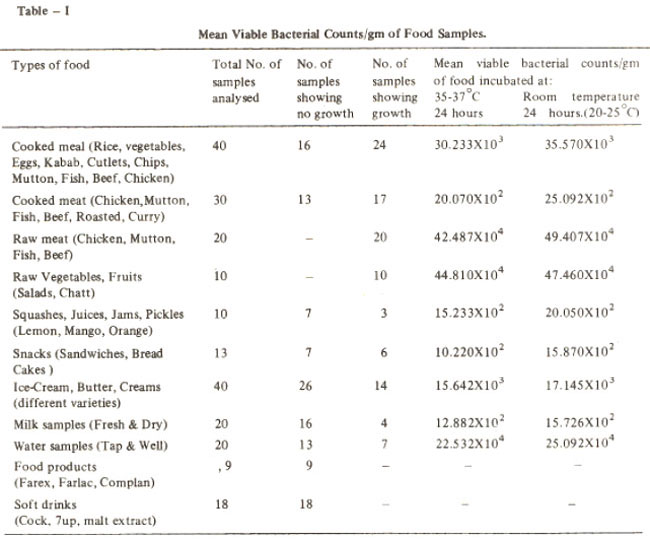
As shown in table-Il,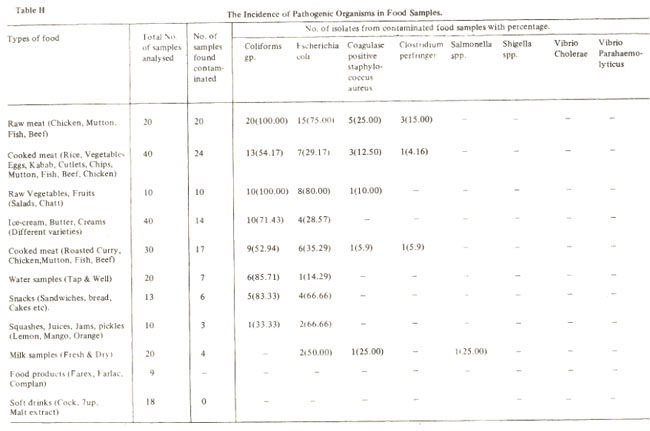
one hundred and forty five bacterial strains were isolated from contaminated food samples. On the basis of morphological,, biochemical and serological characteristics the organisms identified were, Coliform group, 79 (45.23%), Escherichia coli, 49 (46.66%), Staphylococcus aureus, 4(10.47%), Clostridium perfringens, 5 (4.85%) and Salmonella spp. 1 (0.90%) Other food poisoning bacteria namely, Shigella spp., Vibrio cholerae, Vibrio parahaemolyticus were not isolated from any of food samples tested in this study.
Discussion
Safe food is considered to be free from pathogenic microorganisms and after ingestion should not cause any illness. Safe foods may have low bacterial counts which should not hinder shelf life. Foods suspected of causing food poisofling give higher counts ranging from one million to 10 million per gm of food.11
Out of 230 food samples examined in this study only 105 (42%) samples were found contaminated with different bacterial strains. The ability of these bacteria to grow at different temperatures is of interest. Mean viable bacterial count/gm of food was higher when incubated at room temperature as compared to 35-37°C for 24 hours. These fmdings are consistent with other studies.12-13
High bacterial counts are often due to mishandling , distribution and improper storage. In a study on frozen and non frozen meat and gravy, it was observed that the bacterial counts were increased significantly in cooked meat while being sliced handled under unhygienic conditions.1,14,15
In this study, it was found that the highest incidence of Coliforms gp. (100%) in raw foods like, raw meats, raw vegetables, fruits salad and chatt as well. The highest recovery of Escherichia coli was found in raw meats (75%) and raw vegetables and fruits salad (80%). These findings, together with those obtained on Coliforms gp. suggest a possible faecal contamination an& insanitary conditions under which these raw foods were being handled. All strains of Escherichia coli in food do not cause symptoms2,16,17 only certain strains are pathogenic and may cause enteritis and urinary tract infections in man and animals.
The occurrence of outbreaks of enteritis due to coagulase positive Staphylococcus aureus has been widely recognised.18 In this study only II food samples (10.47%) were found to harbour this strain which is apparently a low incidence. This finding is in agreement with another study19 where the staphylococci counts for the marketcheese were not particularly high, but the- presence of coagulase positive Staphylococci in a food supply is undesirable, because its rapid multiplication in food becomes uncontrollable if proper handling and storage is not observed.
Clostridium perfringens as contaminant in raw foods is now considered to be one of the most important anaerobes which causes food poisoning. Spores of these organisms survive cooking and are heat activated to germinate when a suitable temperature is available to foods. Isolation of high percentage of Clostridium perfringens from foods by various workers in different parts of the world indicates ubiquitous prevalent of these organisms as food contaminants.9
The pathogenicity of Salmonella, Shigeila spp, V. Cholerae, and V. parahaemolyticus is beyond any doubt. In these infections, the infective doses are insignificant and thus their isolation pose a great public health problem. It is difficult to isolate these organisms because they are present in small numbers. It is believed that a minimum of 104 organisms of Salmonella spp.,105 organisms of Shigella spp. and V. Cholerae and 107 organisms of V. parahaemolyticus is required to cause symptoms of food-borne diseases.20 In this study, Salmonella spp. were isolated from only one sample (25.0%) of fresh milk. Shigella spp., V. Cholerae, and V. parahaemolyticus were not found from any of the food samples analysed (Table - H).
Bacterial flora identified in the present study is quite high and it was observed from the results that conditions prevailing in the country are concerned, we have acute problems and deficiencies is sanitation, processing and handling of foods. The only point lies in the fact that in all cases the foods are to be cooked to a point where most of the vegetative cells die and consumption of food could be made safe if not stored for a longer time at ambient temperature. However persons handling the food in raw state are most likely to contact the infection.
In order to establish bacteriological standards of food, it -becomes necessary to conduct a random survey of food samples obtained directly from all types of food and food products. However, safety of food should be that it is palatable, safe for health and good in appearance, taste and flavour as well as to meet the bacteriological standards.
Acknowledgement
The valuable guidance, suggestions of Maj. Gen. M.I. Burney, Executive Director and Mr. Zafar Ali, Senior Scientific Officer, National Institute of Health, Islamabad, in carrying out this research work and in preparation of manuscript respectively is gratefully acknowledged. Thanks are also to Dr. Zaka-ur-Rehman Malik, Chief, Nutrition Division, National Institute of Health in providing necessary facilities to carry out the work on this subject.
References
1. Lim, V.S. and Jegathesan, M.A. Bacteriological study of some and non frozen foods. Southeast Asian J. Trop. Med. Public Health, 1977; 8: 37.
2. Bryan, F.L. Factors that contribute to outbreaks of food disease. J. Food. Prop., 1977; 41: 816.
3. The Food Hygiene Laboratory, Central Public Health Laboratory, Colindale Avenue, London. Procedure for the bacteriological examination of cooked and uncooked frozen sea foods. 1965.
4. Association of Official Analytical Chemists. Official methods of analysis of Association of Official Analytical Chemists, 11th ed; Washington, Association of Official Analytical Chemists, 1970;p 842.
5. Jensen, J.M., Harper, C.H. Jr. and Long, H.F. Microbiological methods for butter, in: standard methods for the examination of dairy products.Hausler W.Jr, 13th ed Washington American Public Health Association, 1972; p. 146.
6. Miles, A.A. and Misra, S.S. The estimation of the bactericidal power of the blood. J. Hyg. Camb., 1938;38 :732.
7. Edwards, P.R. and Ewing, W.H. Identication of enterobacteriaceae, 2nd. ed. Minniapolis, Minn., 1962.
8. Dowell, V.R. Jr. and Hawkins, T.M. Laboratory methods in anaerobic bacteriology. CDC Laboratory manual. Atlanta, Georgia, centre for disease control, 1974; p.I.
9. Cruickshank, R., Dugaid, J.P., Marmion, B.P. and Swain, R.H.A. Medical microbiology, 12th ed. Eclinburg Churchill Livingstone, 1973, v.1.
10. Breed, R.S., Murray, E.G.D. and Smith, N.R. Bergsy’s Manual of Determinative Bacteriology. 7th ed. Baltimore, Williams and Wilkins Co, 1957.
11. Hobbs, B.C. The intensity of bacterial contamination in relation to food poisoning with special reference to Clostridium weichil. Rome, 6th Intern. Congr. Microbiol., 1953; 3:288.
12. Lim, Y.S. and Jegathesan, M. Effect of thawing on total viable bacterial counts in cooked frozen prawns. JMHLTM., 1976; 3:7.
13. Bryan, F.L. Diseases transmitted by foods contaminated by wastewater. 3. Food. Prop., 1976; 40: 816.
14. Huber, D.A., Zaborowski, H. and Rayman, M.M. Studies on the microbiological quality of precooked frozen meats. Food. Technol., 1958; 12 : 816.
15. Winter, F.H., York, G.K. and El. Nakhal, H. Quick counting method for estimating the number of viable microbes on food and processing equipment. Appl. Microbiol., 1971; 22 : 89.
16. Shooter, R.A., Cooke, E.M., Rousseau, S.A. and Breaden, A.L. Animal sources of common serotypes of Escherichia coli in the food of hospital patients, possible significance in urinary tract infection Lancet, 1970; 2 : 226.
17. Hall, L.P. Frozen food in the home: Microbiological aspects. R. Soc. Health J. 1977;94: 253.
18. Bryan, F.L. Microbiological food hazards today-based on epidemiological information. Food Technol., 1974;28 :66.
19. Donnelly, C.B., Black, L.A. and Lewis, K.H. Occurrence of coagulase positive staphylococci in cheddar cheese. AppI. Microbiol., 1964; 12 311.
20. Sakazaki, R. Halophilic vibrio infections. in. food-borne infections and intoxications. Reimann, H., London Academic press, 1969; p.115.
Journal of the Pakistan Medical Association has agreed to receive and publish manuscripts in accordance with the principles of the following committees:


