

Riaz Ahmed Pal ( Department of Biological Sciences, Quaid-i-Azam University, Islamabad. )
Abdul Aziz ( Department of Biological Sciences, Quaid-i-Azam University, Islamabad. )
March 1985, Volume 35, Issue 3
Original Article

Abstract
Four thousand persons were surveyed for malarial parasite in 10 localities around Rawalpindi Islamabad during September-November, 1982. A parasite rate of 0.35% (Rawalpindi = 0.3%, Islamabad 0.4%) was observed. Seven species of anopheline mosquitoes were identified from this area. Population of female mosquitoes was more in cattle sheds than human dwellings. Some control measures for malarial parasites have also been discussed. (JPMA 35 : 69, 1985).
Introduction
One of the most vicious diseases of man is malaria. It has played a major role in shaping history, including the decline of civilizations. Human malaria is known to have contributed to the fall of the ancient Greek and Roman empires. During World War II epidemics of malaria severely threatened both the Japanese and the Allied Forces in the Far East.1 Malaria is by no means uncommon in Pakistan and the government has launched a comprehensive campaign to eradicate it.De-Zulueta et al.2 described malaria control and long term periodicity in Pakistan by comparing the results of malaria control programme during the years 1970-77. Apart from the official reports of Directorate of Malaria Control, Ministry of Health and Social Welfare, Government of Pakistan, very few published accounts of malaria survey in different parts of the country are available.3 A survey of malarial parasites in the Rawalpindi-Islamabad area was, therefore, carried out to ascertain their endemic prevalence in this part of the country and to suggest some measures of control.
Material and Methods
During the present studies, 4,000 persons were surveyed for malarial parasite from 10 villages and localities around Rawalpindi Islamabad (Fig. 1)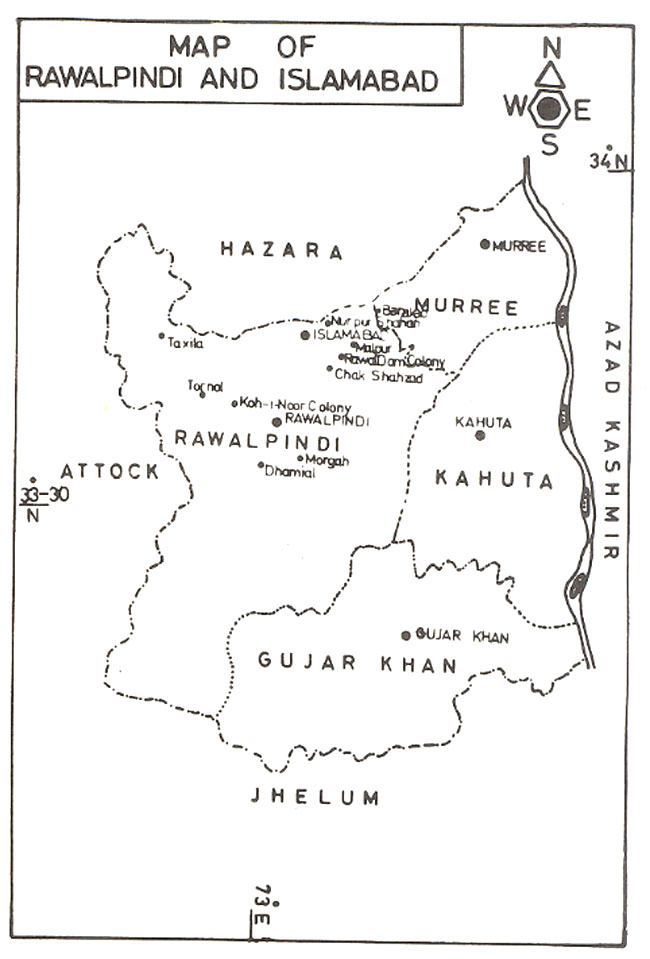
during September-November, 1982. Exactly 400 persons were sampled from each village and thick as well as thin blood smears were prepared by finger pricks with the help of a pricking needle. Methanol fixed thin blood smears and dehemoglobinised thick blood smears were stained with Giemsa stain. At first, a thick blood smear was examined under oil immersion lens for at least 10 minutes and if it was found positive then the thin blood smear was examined similarly for specific identification of the malarial parasite.
A total of 2,924 anopheline mosquitoes were collected from houses, sheds, toilets and stores during post-monsoon season i.e., September to November, 1982. Indoor collections of mosquitoes were made with the help of a mouth aspirator while outdoor collections were carried out using mosquito nets. Very few anopheline mosquitoes entered the net during evening sweepings and field collections from underside of bridges .and drainage pipes. Stomach and salivary glands of female mosquitoes were dissected out and examined for the presence of malarial parasite.
Results
Of the 4,000 individuals examined 152 had fever and 5 splenomegaly, Only 14 thick smears were positive. Ten cases of Plasmodkium vivax and two cases of P. falcipwum were identified. For the remaining two of the 14 cases identification of plasmodiuni upto specific level was not possible owing to damage of thin smears (Table ).
The overall incidence of the malarial parasites was 0.35% (Rawalpindi 0.3% and Islamabad 0.4%). No sporozoites and oocysts were observed in the stomach and salivary glands of the female mosquitoes.
As regards anopheline mosquitoes, 7 species were collected and identified as Anopheles culicifacies Giles, An. stephensi Liston, An subpictus Grassi, An. annularis Van der Wuip, An. fluviatilus James, An. puicherrimus Theobald, and An. nigerriinus Giles. The female anophelirte mosquito population was lower in bed rooms than cattle sheds. The individual mosquitoes were found resting indoors in humid dark places like toilets, stores, garages, chicken barns and animal sheds. In animal sheds these mosquitoes occur in and near the ceiling while in bedrooms these were found resting both on the ceiling and under the furniture. More females were collected from sheds and rooms with corrugated sheet roofs as compared to those with thatch roof where they are able to hide themselves and avoid trapping. Anopheline females feed during all the 24 hours of the day but peak feeding in An. culicifacies and An. Stephensi was observed during late hours of the night. Indoor collection of female population was high as compared to out-door collections.
Discussion
In March-April, 1981, malarial parasite rate was 2.22% in Islamabad4 whereas during the present studies it has been observed as 0.4% which is considerably low. Malarial parasite rate of 14.53% has been reported from Karnataka State.5
Dissection of salivary glands and stomach of anopheline female mosquitoes did not reveal any of the sporozoites and oocysts respectively. It is due to the fact that most of the mosquitoes were collected from cattle shed rather than human dwellings. In cattle sheds mosquitoes rest in lar.ge numbers. It therefore, points to the conclusion that since man-vector contact is low the parasite rate also appears low. In-door collections of female population is high as compared to that of out-door ones which is in accordance with the earlier observations6 where female An. culicifacies and An. stephensi were endophilic.
A very slight increase of malaria cases has been observed in Islamabad but it is to be pointed out that this area has not been sprayed since 1981. From the present studies it becomes apparent that there is no substantial difference in malaria cases between the suburban areas of Rawalpindi and Islamabad indicating that niosquito breeding places are uniformly distributed in this whole area. It is, therefore, proposed that there is a need to improve the drainage system so that water does not remain collected forming mosquito breeding places. Insecticides should be sprayed to kill adults as well as larvae. A concerted vigilance is also required to detect malaria cases in all the rural areas and to test the sensitivity of drugs being commonly used.
References
1 Cheng, T.C. The Biology of Animal Parasites.W.B. Saunders Company, Philadelphia, 1964, p.127.
2. De-Zulueta, J., Mujtaba, S.M. and Shah, I.H. Malaria control and long term pesidodicity of the diseasein Pakistan. Trans. Roy. Soc. Trop. Med. Hyg., 1980; 74 : 624.
3. Rahman, M., Akiyana, J., Muttalib, A., Talibi, S.A. and Mujahid, A.A. A detailed study of Malaria situation in Karachi during September and October, 1966. Pakistan J. Heth., 1967-68;17:1.
4. Mirza, A.M. (1982). Personal communication, Divisional Entomologist, District Malaria Control, Rawalpindi.
5. Roy, R.G. and Ghosh, R.B. Relationship of the annual parasite incidence with the child spleen and parasite rates in resurgent malaria in Karnataka State. Trop. Dis. Bull., 1980; 77 : 460.
6. Reisen, W.K. A quantitative mosquito study of
7 villages in Punjab Province, Pakistan with notes on bionomics, sampling methodology and the effect of insecticides. Southeast Asia J. Trop. Med.Publ. Heth., 1978; 9: 587.
Journal of the Pakistan Medical Association has agreed to receive and publish manuscripts in accordance with the principles of the following committees:


