

Mumtaz Begum ( Biological Production Division, National Institute of Health, Islamabad. )
Zafar Ali ( Biological Production Division, National Institute of Health, Islamabad. )
Abdul Bari ( Depptment of Biological Sciences Quaid-e-Azam University, Islamabad. )
April 1986, Volume 36, Issue 4
Original Article

Abstract
The effect of time and temperature on the microbial toad of 300 beaf samples was determined. Bacterial count were higher in the meat samples from the shops and at room temperatures. Processing under hygienic conditions, detection of carriers and storage in deepfreezers will reduce the risk of contamination (JPMA 36: 90, 1986).
INTRODUCTION
Meat being highly nutritive, it gets easily contaminated with spoilage from pathogenic micro-organisms during slaughter and subsequent handling. The contamination of external surface often takes place during bleeding, skinning ‘and processing. Two types of microbial contaminants can be expected i.e. micro-organisms that may produce disease and those that spoil the product and render it unfit for human consumption. The changes produced by these bacteria are proteolysis, fat hydrolysis and carbohydrate fermentation.1 It is common to see that emaciated and lacerated animals with sores all over their bodies are slaughtered and sold for human consumption. Worse still is the fact that most of the animals are not disease free. Moreover during dressing and marketing hygienic conditions are not maintained. This causes a risk to human health2.
For effective sanitary control routine bacteriological examination of meat should be done in slaughter houses and retail market to provide good quality meat which is free from pathogenic organisms or substances which adversely affect the consumer’s health3.
The effect of time and temperature on meat microbial load generated interest to carry out this bacteriological study, the results of which may be useful in solving problems of meat spoilage during transportation storage and upto its disposal to the consumers under the prevailing conditions.
MATERIAL AND METHODS
Meat Samples: Three hundred beef samples (Cattle and buffaloes) were collected from randomly selected animals carcasses. One hundred and fifty samples were from the Siliala slaughter house (1 to 1½ hours after slaughtering) and 150 from various meat shops in Rawalpindi City. (The time between slaughtering, its transportation and marketing is 8 -9 hours).
Thirty gms of each sample, was aseptically taken in sterilized wide mouth glass stoppered bottles which were immediately transported to the Laboratory for quantitative and qualitative bacteriological analysis.
From each specimen an initial dilution of homogenate (1/100) was prepared using a clean sterilized pestle and mortar. From the homogenate further serial dilutions were prepared. One ml of the dilution containing 1/100,000 of each sample was inoculated in plate count agar petri dish. Four pairs of such inoculated plates were incubated as under: -
A. 035-37°C for 24 hours 11: 20-25°C (Room temperature) for 24 hours Aerobically
iii) 4-7°C (Refrigeration tempera-ture) for 4 days
B. i)35-37°C for 2448 hours Anerobically Viable aerobic counts were done by the method of Elliott et al4 and anaerobic counts and isolation by the method of Dowell et al5. Coliforms were isolated by the method of Francis et al6. Attempts to isolate Salmonella were made according to the procedure described by Mildred et al7. Coagulase positive Staphylococcus were isolated on sheep. blood agar and identified by coagulase test8.
RESULTS
Beef samples from the slaughter house and. shops had a higher mean viable aerobic bacterial counts at the room temperature than at 35 37°C and at refrigeration temperatures.
The mean viable aerobic counts/gm of beef from the shops were 69.593 x 10⁴ at room temperature, 58.460 x at 35 37°C and40 37.070 x 10 at 4 7 C whereas from the slaughter house the count were 42.810 x l04 at4 room temperature 36.050 x 10 at 35 37 and 24.233 x io4 at refrigeration temperature.
Mean anaerobic bacterial counts/gm beef at 35 - 37°C were 40.407 x i04 from the meat shops and 30.48 x l04 from the slaughter house (Table 1).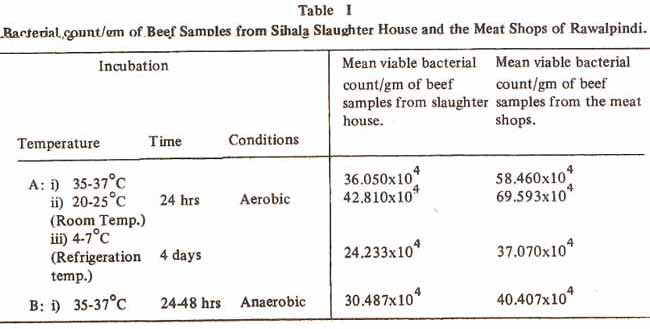
In all, 1293 isolates were obtained from 300 beef samples (Table II).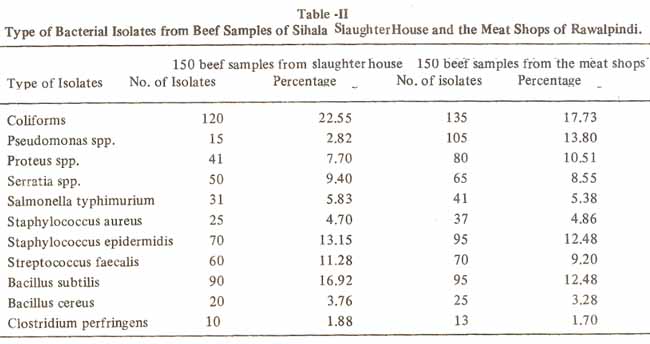
On the basis of biochemical and serological tests these isolates were identified as, Collforms (255), Pseudomonas spp . (120), Proteus spp. (121),Serratia spp (115), Salmonella typhimuriiim (72), Staphylococcus aureus (62), Staphylococcus epidermidis (165), Streptococcus faecalis (130), Bacillus subtiis (185), Bacillus cereus (45), Clostridium perfringens (23).
DISCUSSION
The meat can easily be contaminated with spoilage and pathogenic microorganisms during slaughter and subsequent handling because it is nutritious and proteinacious. Irrespective of the site of collection of beef the bacterial count was high in samples incubated at room temperature (20-25°C) as compared to those incubated at 37°C and at refrigeration temperature (4-7°C)9.
Difference between mean values of viable bacterial count per gram of beef samples collected from the slaughter house and the meat shops was quite significant. Samples from meat shops showed a higher mean viable bacterial count per gram than the meat samples from slaughter house examined under the same conditions. The ambient temperature (20-25°C) and time factors may be the causes for increased number of microorganisms in case of beef samples obtained from markets.10,11
Bacterial isolate obtained were similar to those reported by others.11,12 Microorganisms like proteus, pseudomonas, Escherichia coli, and Collforms are capable of producing maximum growth by consuming meat proteins and causing putrification and hydrolysis of fat. The presence of spoilage type of microorganisms in market meat samples indicates mishandling of meat during transportation and unhygienic conditions of meat shops.13,14
The presence of Salmonella, Staphylococcus, Bacillus and Clostridium species in this study indicate contamination of beef through air, water, soil and human carriers. Toxins liberated by certain strains of Clostridium, Staphylococcus and Bacillus are highly thermostable and can survive on cooking at 100°C for many hours15 Pakistani cooking systems are such that most of the prevailing organisms are destroyed and consumption of meat becomes safe. Still the persons handling the meat in raw state are likely to get the infection. Therefore, the people at risk are meat handlers in the processing plants, butchers and house-wives who handle the meat in raw state.
For the safety of consumers and meat handlers perfect hygienic conditions should be maintained at the slaughter houses and carriers should be detected. Meat should be transported in refrigerated vans and processed hygienically at the shops and stored in deepfreezers.
ACKNOWLEDGEMENTS
Help and valuable suggestions of General M.1.Burney, Executive Director, National Institute of Health, Islamabad are gratefully acknowledged.
REFERENCES
1. Ingram, M. and Dainty, R.H. Changes caused by microbial in changes in foods-changes caused by microbes in spoilage meat. J. Appi. Bacteriol., 1971;34: 21.
2. Eldin, S.M. and Mustafa, A.A. A preliminary investigation on the bacterial load of fresh beef carcasses. Proc. 5th. Vet. Conf. Khartoum, Sudan. Vet. Assoc., 1970.
3. Angellotti, R. in examination of foods for enteropathogenic and indicator bacteria. U.S. Public Health Serv. Pubi. No. 1142. Washington, U.S. Dept. of Health Education and Welfare, 1964.
4. Elliott, R.P., Clark, D.S., Lewis, K.H., Lundbeck, H. and Olson, J.C. Microorganisms in foods; t heirs ignificance and methods of enumeration. 2nd ed, London, University of Toronto Press, 1978; p. 106.
5. Dowell, V.R. Jr. and Hawkins, T.M. Laboratory methods in anaerobic bacteriology. CDC Laboratory Manual. Center for disease control, Atlanta. Georgia, 1974; p.3.
6. Francis, D.W., Peeler, J.T. and Twedt, R.M. Rapid method for detection and enumeration of fecal coliforms in fresh chicken. Appl. Microbiol., 1974;27: 1127.
7. Mildred, M.G., George, K.M. and William, T.M. Salmonellae in foods and feeds, Atlanta, National Communicable Disease Center, 1968, p.1.
8. Cruickshank, R., Dugaid, J.P., Marmion, D.P. and Swani, R.H.A. Medical microbiology. 12th ed. Edinburg, Livingstone, 1973;V.1.
9. Guther, S.L., John, V., Richard, L.O. and James, L.F. Microbiol quality of frozen conuninuted Turkey meat. J. Food Sci., 1978; 42: 1344.
10. PohI, P. and Thomas, J. Lactose positive Enterobacteriaceae isolated from fresh meat. J. Am. Med. Vet. Ass., 1967;111 : 110.
11. Gesche, A.E., Maria, S. and Jorge, E. Bacterial flora in fresh and frozen ground meat. Bull. Inst. Bacterial Chile, 1978;18: 49.
12. Fomin, L., Larissa, C.P. and Simmons, G.C. Contamination of boneless beef with organisms potentially pathogenic to man. Qurensl. Agr. Anim. Sci., 1972;29: 79.
13. Surkiewiez, B.F., Harris, M.E., Elliott, R,P Macaluso, J.F. and Strand, M.M. Bacteriological survey or raw beef patties produced at establishments under Federal Inspection. Appi. Microbiol., 1975;29: 331.
14. Carpenter, J.A., Elliot, J.G. and Reynolds, A.E. Isolation of Salmonellae from pork carcasses. Appi. MicrobioL, 1973;25:731.
15. Sluzewski, R. and Ryszard, P. Studies on the microorganisms of the genus Clostridium with special reference to Clostridium perfringens during production of canned meat. Pol. Arch. weter., 1969; 12: 129.
Journal of the Pakistan Medical Association has agreed to receive and publish manuscripts in accordance with the principles of the following committees:


