

Faiz-ul H. Nasim ( Department of Chemistry, Islamia University, Bahawalpur. )
Qaiser I. Sheikh ( Department of Chemistry, Islamia University, Bahawalpur. )
Muhammad Ashraf ( Department of Chemistry, Islamia University, Bahawalpur. )
Tabinda Kokab ( Department of Chemistry, Islamia University, Bahawalpur. )
Qamar Shaheen ( Department of Chemistry, Islamia University, Bahawalpur. )
January 1987, Volume 37, Issue 1
Original Article

Abstract
Distribution of A, B, AB, 0 and Rh blood groups was determined in the residents of Bahawalpur through a survey of 2036 individuals. The distribution was B, 35.26%, 0, 26.23%, A, 25.69%, and AB, 12.82%. Nintyeight percent individuals were Rh positive and 2% negative. The results when classified according to the sex showed females to be twice more Rh-negative than males and none of the 160 AB male individuals was Rh-negative (JPMA 37 : 7, 1987).
INTRODUCTION
Knowledge of the basic blood groups of the individuals is. necessary as a guide in blood transfusions. It is also utilized in anthropologic surveys, in archeology, in disputed paternity, and in forensic medicine. Rh-grouping provides, in addition, an awareness about the chances of Rh-incompatibility and hence helps to take preventive measures against the pathogenesis of erythroblastosis fetalis.
In British population, the distribution of ABO blood groups has been reported1 to be 0, 47%, A, 42%, B, 8% and AB 3%. In USA the distribution2 of these blood groups is 0, 45%, A, 41%, B, 10% and AB 4%. Moreover, 85% of the white race is Rh-positive; Chinese, Japanese and American Indians are 98-99% Rh positive. In NWFP the distribution of ABO blood groups is B, 36%, A, 33%, 0, 25% and AB 5%, while in Indian Hindus residing in Bombay the distribution is 0, 32%, A, 29%, B, 28% and AB 11%3. In Punjab the distribution is B, 36.61%, 0, 33.14%, A, 21.2% and AB 9.05%.4 Of these 97.24% were Rh positive and 2.76% Rh negative.
The, present survey was planned to investigate the frequency of ABO and Rh blood groups in Bahawalpur, a well-known city of the Punjab province, situated almost in the centre of Pakistan.
MATERIAL AND METHODS
A total of 2036 individuals were examined. They belonged to various localities of the city such as Baghdadul Jadeed, Basti Banga, Basti Darzian, Basti Dewan, Bhatta Jat, Chah Fateh Khan Bazar, Commercial Colony, Goth Gadra, Gulistan Colony, Islamia University, Medical Colony, Model Town A, Model Town B, One Unit Staff Colony, Professor’s Colony, Satellite Town, Shahi Bazar, Trust Colony, and interior areas of the city.
Direct agglutination technique5 was adopted using glass slide and antisera A, B and D (Biological Labs. Auckland Newzealand) for the ABO and Rh grouping, respectively.
RESULTS AND DISCUSSION
Of 2036 individuals (63% males and 37% females) surveyed, 718 (35.26%) had blood group B. This was followed by 0, 26.23% (534 persons), A, 25.69% (523 persons), and AB ‘12.82% (261 persons). The order of distribution (Table I)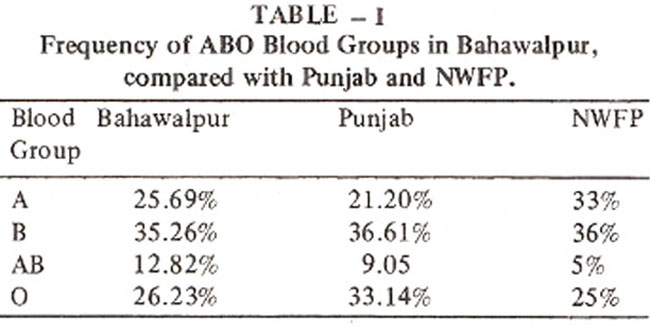
follows the same pattern as reported by Afza l4 et al. for Punjab, but the frequencies vary. The distribution in Bahawalpur shows one variation from that reported for NWFP3. As we move from NWFP to Bahawalpur, the distribution of A and AB groups undergoes certain changes.
Rh grouping showed that 1991 persons (97.79%) were positive and only 45 (2.21%) ‘Rh negative. These figures are comparable with those of Afzal et al.4 Although the frequency of Rh negative persons is lower than in white race,2 it is higher than Chinese, Japanese and American Indians. When the distribution of ABO groups was computed with Rh factor (Table II),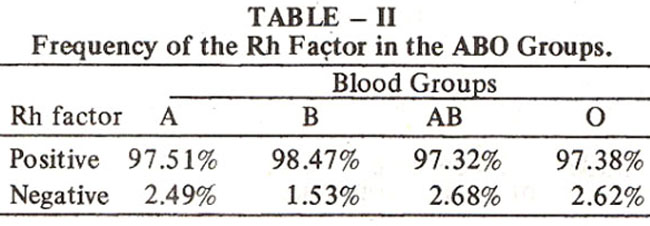
it was found that 98.47% persons with blood group B were Rh positive. This was followed by the persons with blood groups A, 0 and AB.
When Rh factor was reflected against the sex (table III a,b)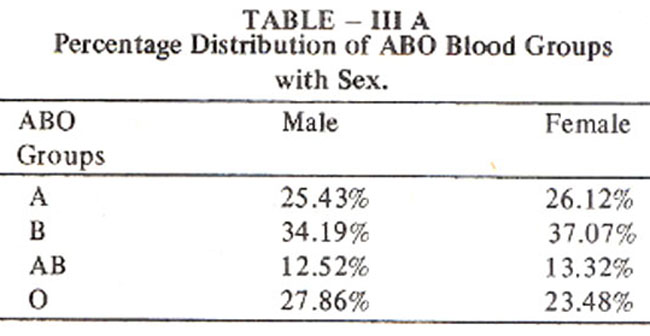
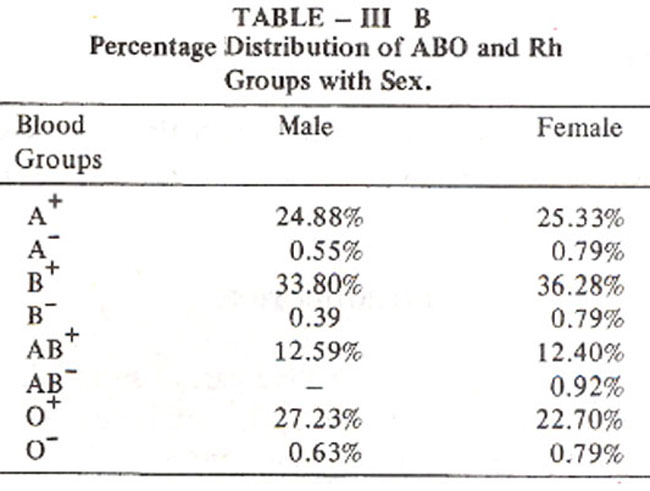
98.44% males were Rh positive and only 1.56% were negative. On the contrary, 3.30% females were found to be Rh negative, twice more than the figure in males. Of 1278 males, 160 were AB and none of these was Rh negative. In contrast, of 758 females 101 were AB and 7 of them were Rh negative. It is claimed that ABO and Rh blood groups are not sex-linked, therefore it is not certain whether this observation is just a matter of chance. A detailed study is needed to confirm these fmdings. The distribution of ABO groups is ‘also different in the two groups. In males it is in the order of B, 0, A and AB, while in females it is B, A, 0 and AB.
ACKNOWLEDGEMENT
We are unable to acknowledge the cooperation of all the persons who proved to be inspiring. However, special thanks are due fOr Mr. Rao M. Sarwar, Mr. M. Shahid Inayat, Mr. Abdul Qadeer, Mr. S. Aftab Hussain, Mr. Malik Perveez Akhter, Miss Noshaba Shereen, Miss S. Durr-i-Shahwar Tirmizi and Dr. M. Bashir-udDin Hashmi.
REFERENCES
1. Russell, N.J., Jones, J.G., Winterburn, P.J. and Basford, J.M. Blood biochemistry. Kent, Croom Helm, 1982; p.104.
2. Gebhardt, L.P. Microbiology. 4th ed. Saint Louis, Mosby, 1970; p. 124.
3. Davis, B.D., Dulbecco, R., Eisen, H.N., Ginsberg, H.S. and Wood, W.B. Microbiology including immunology and molecular genetics. 2nd ed. New York, Harper and Row, 1973; p. 605.
4. Afzal, M., Ziaur-Rehman, Hussain, F. and Siddiqui, R. A survey of blood groups. JPMA., 1977; 27:426.
5. Tietz, N.W. Fundamentals of clinical chemistry.Philadelphia, Saunders, 1976; p. 290.
Journal of the Pakistan Medical Association has agreed to receive and publish manuscripts in accordance with the principles of the following committees:


