

M.S. Iqbal ( Nuclear Chemistry Division Pakistan Institute of Nuclear Science and Technology, P.O. Nilore, Islamabad. )
S.J. Khurshid ( Nuclear Chemistry Division Pakistan Institute of Nuclear Science and Technology, P.O. Nilore, Islamabad. )
January 1987, Volume 37, Issue 1
Original Article

Abstract
Breath cultures were measured for bacterial growth using radiometric methods. The maximum growth with median value of Growth Index equal to 440 was detected within 48 hours. The technique is sensitive, rapid and can be used to detect bacteremia (JPMA 37: 4, 1987).
INTRODUCTION
Radiometric methods for the detection of bacterial growth are becoming of interest because of their rapidity and sensitivity’.1 These methods are based on the detection of14 Carbon Dioxide produced by bacterial metabolism of a14 C-labelled substrate. This technique is being successfully used2 to detect bacteria in blood cultures, to test radiopharmaceuticals for sterility, and further to test antibiotic activity of drugs 3 by using commercially available instrument called BACTEC. Among the other clinical tests breath has also been tested for the presence of volatile compounds (e.g some metabolities) as marker for diseases to some extent4. It has not been in practice to analyse breath samples for the presence of any bacteria as very few bacteria may be carried and it is very difficult to detect them by traditional methods because they lack sensitivity. With the advent of rapid and sensitive radio-metric methods this problem seems to be solved. The non-invasive technique of detection of bacterial growth by the use of BACTEC instrument in breath cultures is presented in this study.
MATERIAL AND METHODS
The healthy humans were asked to breathe under sterile atmosphere (by using Laminar over the entire length of time below threshold growth Index of 30 (Figure 1) indicating that the breath samples do carry some bacteria from human body. Each point on a growth curve is the mean of three measurements and arrows represent standard deviation from the mean. As the standard deviation (on the average ± 10) is relatively low, the sampling technique seems to be satisfactory. From the present Bioflow) for 1 minute and then the sample was collected asceptically directly into the sterile culture vial type 6B (enriched tryptic soy broth for aerobic culture from Johnston Laboratories, Inc.) via a sterile funnel. The vial, while still under laminar flow, was sealed by using a sterile sealing device. A control vial was similarly opened and sealed under the same laminar flow. While collecting the samples the individuals were advised to breathe into the vial thrice with 30 second breathing interval between each breathing. Five samples in separate 6B aerobic vials from different individuals were collected and analysed.
MEASUREMENTS
The test and the control vials were incubated at 37°C with agitation as recommended by the manufacturer. The measurements were made aerobically by using BACTEC Model 460. The growth index (GI) readings were recorded after every 12 hour and plotted to produce the graphs as shown in Figure 1.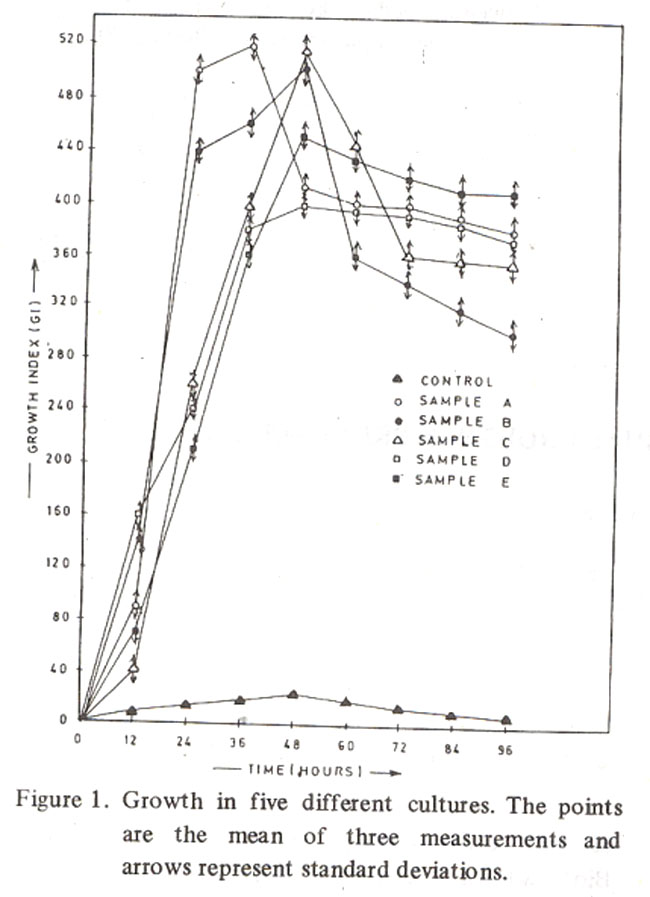
RESULTS AND DISCUSSION
All the five samples showed a growth whereas the control presented a constant reading data the median value (Figure 2)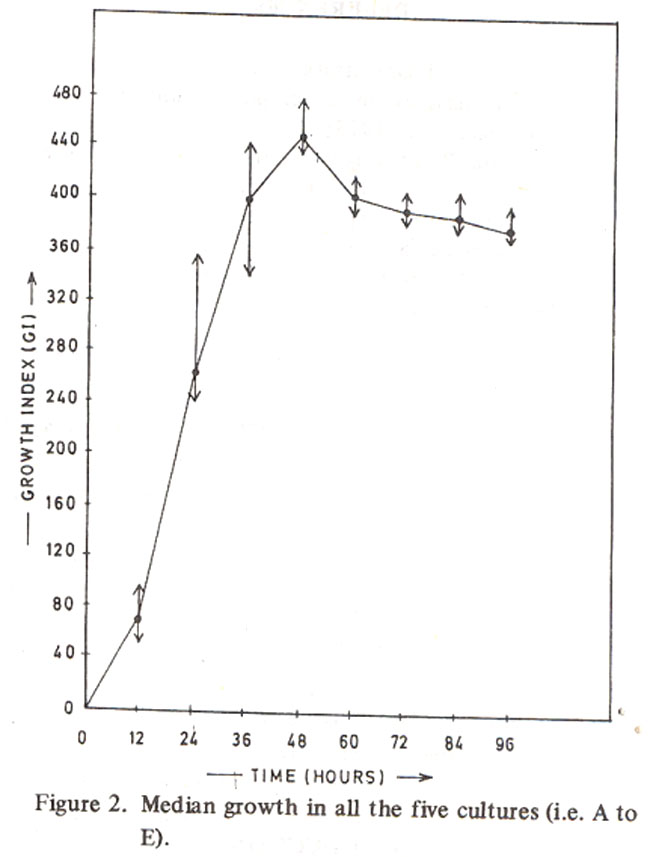
of maximum GI falls near 450 at 48 hour which suggests that the radiometric method can become a valuable tool to detect growth and hence bactermia from breath cultures much more rapidly and accurately.
REFERENCES
1. DeLand, F.H. and Wagner, H.N. Ji. Early detection of bacterial, growth with carbon-14-labelled glucose. Radiology, 1969; 92: 154.
2. Waters, J.R. and Zwarun, A.A. Results of an automated radiometric sterility test as applied to clinical blood cultures. Dcv Indus. Microb., 1973; 14 : 80.
3. Antonio, R.G.D., Camargo, E.E., Gedra, T., Wagner, H.N. Jr. and Charche, P. Rapid radiometric serum test for antibiotic activity. Antimicrob. Agents Qiemother., 1982; 21: 236.
4. Manolis, A. The diagnostic potential of breath analysis. Clin. Chem., 1983; 29 : 5.
Journal of the Pakistan Medical Association has agreed to receive and publish manuscripts in accordance with the principles of the following committees:


