

Zeynep Misirligil ( Department of Pulmonary Diseases and Tuberculosis, University of Ankara, Ankara, Turkey. )
Lutfu Gurbuz ( Department of Pulmonary Diseases and Tuberculosis, University of Ankara, Ankara, Turkey. )
Betul Sin ( Department of Pulmonary Diseases and Tuberculosis, University of Ankara, Ankara, Turkey. )
Kemal Doganay ( Department of Pulmonary Diseases and Tuberculosis, University of Ankara, Ankara, Turkey. )
Ersoz Tuccar ( Department of Biostatistic, Faculty of Medicine, University of Ankara, Ankara, Turkey. )
February 1988, Volume 38, Issue 2
Original Article

Abstract
Eight hundred and eighty one cases of lung Cancer admitted during 1981-86 were retrospectively analysed. Eight hundred and twenty three (93.4%) were above and 58 (6.6%) below the age of 40 years. Percentage increase of adenocarcinoma was significantly higher in young females. No significant difference in the operability or inoperability was seen amongst the two groups. Fifty eight (63.8%) patients below 40 years were smokers. It is suggested that preventing initiation of smoking may minimize the risk of lung Cancer, as it does for other malignancies (JPMA 38: 38 $ 1988).
INTRODUCTION
Cancer is the third leading cause of mortality in Turkey1. The incidence of lung Cancer is highest amongst 50 — 70 years, but 1—5% younger age groups are also involved2. Lung Cancer is presented in a more virulent form and in advanced stage in the under 40 group2. The aim of this study was to determine the frequency of lung Cancer in the younger age group.
MATERIAL AND METHODS
Eight hundred and eighty one cases of lung Cancer, diagnosed at the department of pulmonary medicine and tuberculosis of the faculty of medicine at Ankara University during the period 1981 — 86 were retrospectively analysed. Eight hundred and fifty three were above and 58 below 40 years of age. Sex, age, smoking habits, histopathological characteristics and operability were assessed. Duration from onset of symptoms to diagnosis in the under 40 group was also recorded. Patients with lympho Sarcoma, mesothelioma and pulmonary metastasis from other sites and doubtful or unconfirmed cases were excluded. Statistical analysis was carried out using chisquare test.
RESULTS
The results showed lung Cancer increasing year by year (Table I).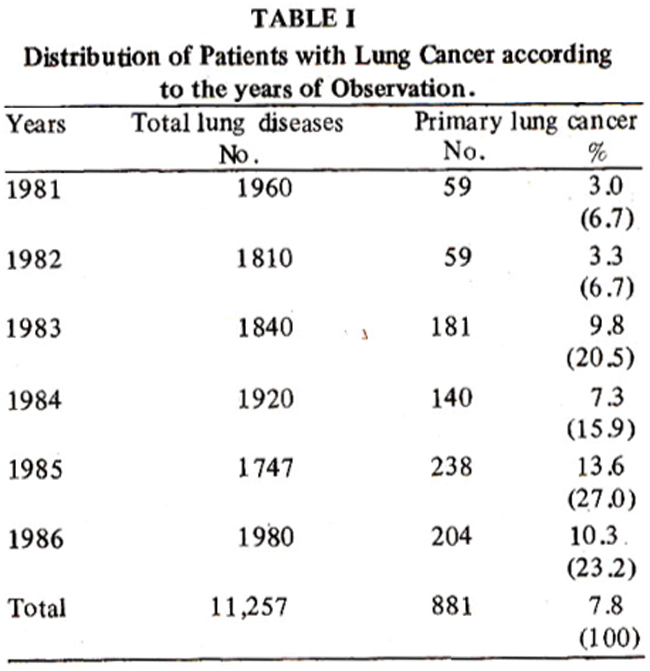
There was no significant (P > 0.05) difference in the percentage frequency of lung Cancer in two groups over six year period (Table II).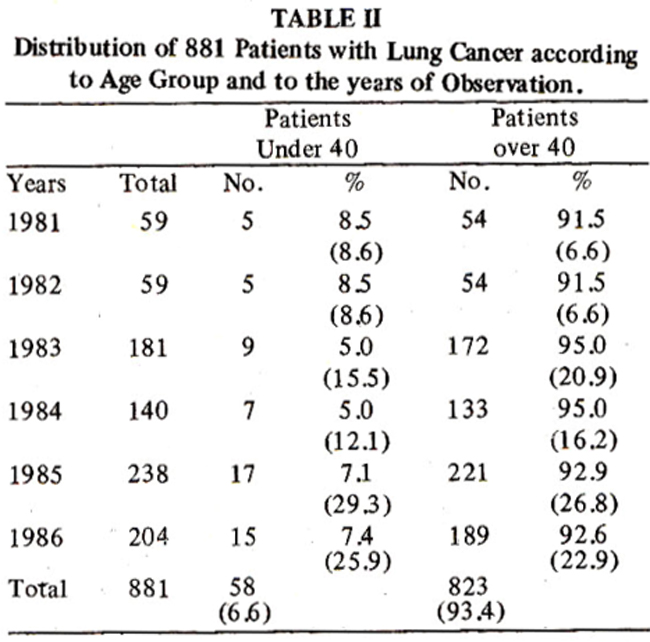
Age and sex distribution is shown in Figure.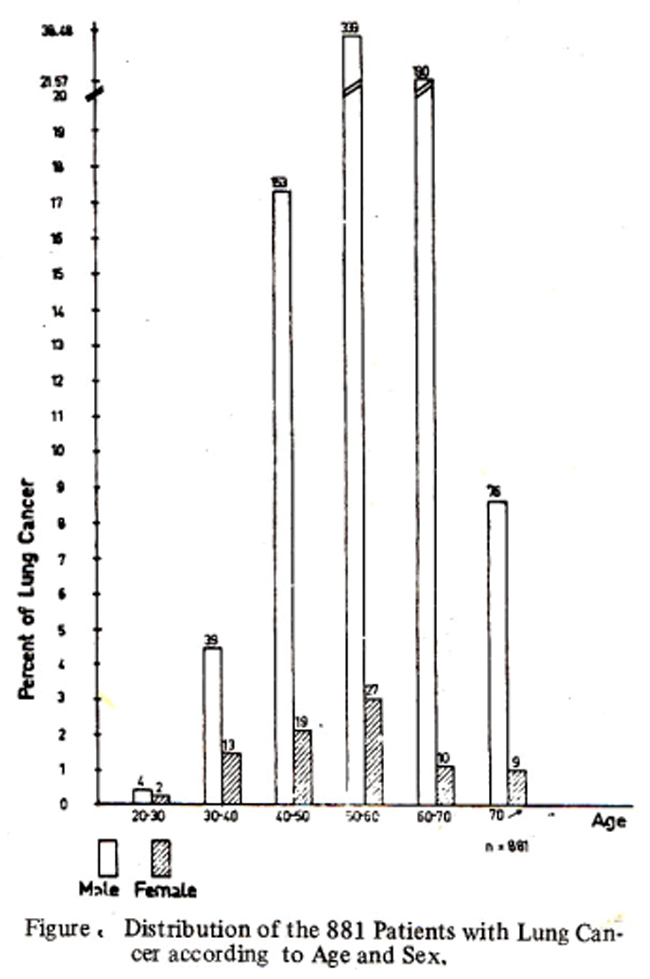
Lung Cancer was more frequent in 50 - 60 years ago group. Of 58 (6.6%) cases below 40 years, 43 (74.1%) were males and 15 (25.9%) females, male/female ratio being 3:1. Eight hundred and twenty three were above 40 years, 758 (92.1%) males and 65 (7.9%) females. Male/female ratio being 11.5:1. This ratio is significantly (P<0.01) different from ratio among below 40. Epidermoid Carcinoma was more frequent in the older and adenocarcinoma in the younger age group (Table III).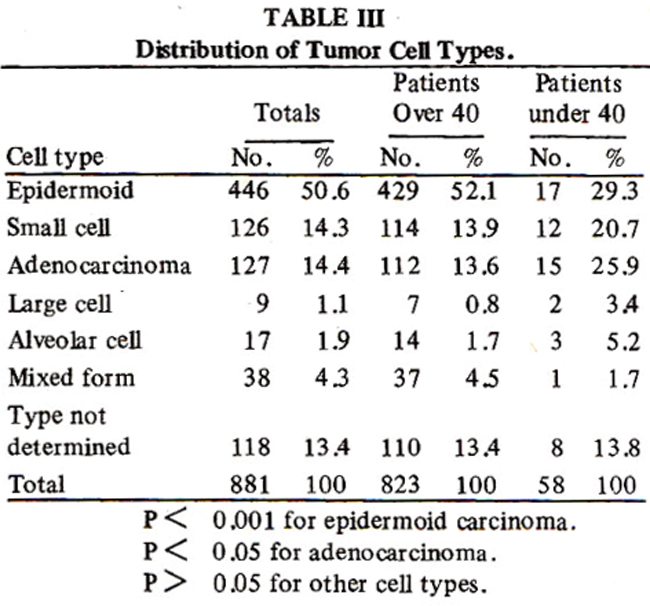
Of the 739 (83.9%) who were smokers, 616 (69.9%) smoked 20-40 cigarettes a day and 123 less than 20 cigarettes a day. Twenty nine (4.7%) in the former and 8 (6.5%) in the latter group were under 40. Of 142 non-smokers 21 were in the younger group. There were significantly (P<0.001) more smokers in the older age group. Epidermoid carcinoma occurred more frequently in smokers (Table IV).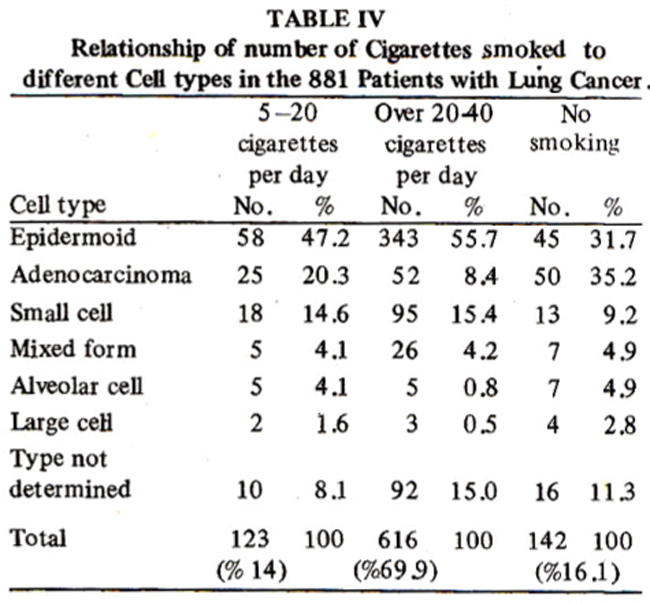
Of the 109 operated cases 8 were in the younger and the remaining in the older age group. The remaining 772 had radiotherapy, chemotherapy, or both or only symptomatic treatment. Of these 7% were below and 94% above 40. Of 58 under 40, 76% were diagnosed 1-4 months after the first clinical manifestation and only 2 had operable tumours.
DISCUSSION
The incidence of lung cancer has been increasing all over the world. The increase has been linked to various factors such as smoking, environmental and occupational pollution3,4. The frequency of lung cancer has also been increasing in Turkey. There were 498 (5.5 percent) patients hospitalized with lung cancer, out of a total of 9037 medical cases, in the Department of Pulmonary Diseases at Ankara Medical Faculty during the years 1973-19765. The frequency lung cancer increased from 59 (6.7%) in 1981 to 224 (23.2%) in 1986 (Table I). Lung cancer generally affects older adults, between 50—60 years but recent reports document lung cancer is becoming more frequent in the third and fourth decades6,7 Decaro and Benfield7 had reported 5 percent under the age of 40 among 718 patients for the period 1959-1979. Larrieu et al2 presented a cumulative number of 4516 lung cancer patients, with 10 percent being under 40 years during the period 1969 to 1975. Roviaro et al8 had found 10 percent under 45 years in their series of 1514 patients with lung cancer for 1960-1980. In our series, there were 58 patients (6.6 percent) under 40 years among the 881 lung cancer patients during the years 1981- 1986(Table II). The male/female ratio of lung cancer in the young patients has been observed to be lower than in older patients7, but Roviaro et al8 showed no significant difference between the sex among young patients. The male/female ratio was 3:1 in this series suggests a higher percentage of woman with lung cancer amongst the young. Lung cancer is rapidly progressive and fatal disease in young patients than in older ones, and has a higher frequency of metastases. The difference in the tumor growth between younger and older patients was investigated by Huang et al9 and suggests young patients may have higher tumor proliferation because of high nuclear protein content (nuclear protein/nuclear DNA ratios). In our series when the diagnosis was made, the disease process was often advanced in both groups. Forty four of 58 young patients had their tumour diagnoses 1 — 4 months after the first clinical manifestation. Only 2 (4.5 percent) of these patients had operable lung cancer. Early diagnosis of lung cancer is impossible with present day methods due to the late appearance of symptoms. The correlation between the cell type of tumour and prognosis is well known. In America adenocarcinoma, in Britain small cell carcinoma, in Italy epidermoid carcinoma have been found to be common in young patients7,8,10. In our series, although epidermoid carcinoma was relatively more frequent but occurrence of adenocarcinoma was significantly higher in younger patients. Although cancer is considered to be a disease of aging, there are many cancer risk factors with their origins in earlier life. Cigarette smoking is the highest risk factor11,12. In our study, although the rate of cigarette smoking was higher in the Older group, in the young group 64 percent (37 of 58 patients) smoked. We suggest that prevention of the initiation of smoking in adolescents and young adults, could minimize the risk of many cancers, especially lung cancer. On the other hand, numerous peculiarities of adenocarcinoma and alveolar cell carcinoma suggest familial factors. They are poorly related to smoking and often found in families with other tumours, acquired immune diseases or heridity disorders of the lung13. We could not investigate family histories of the patients.
REFERENCES
1. Bilir, N. Cancer frequency in Turkey. Kanser, 1981;11: 93.
2. Lnrrieu, A.J. , Jamieson,W.R.E.,Nelems,J.M.B., Fowler, R., Yamamoto, B., Leriche, J. and Murray, N. Carcinoma of the lung in patients under 40 years of age. An. J. Surg., 1985; 149:602.
3. World Health Organization; Directory of on going research in cancer epidemiology, 1986.
4. Marino, L.B., Levy, S.M. Primary and secondary prevention of cancer in children and adolescens; Current status and issues. Pediatr. Clin. North Am., 1986;33: 975.
5. Alper, D., Gurses, H., Sezer, and Karayunus A. Akciger kanserlerinde klinikopatolojik bir arastirma.Tub Toraks, 1978;26:93.
6. Adler, J., Weissberg, D. and Herczeg, E.The fate of patients with lung cancer; five-five year review of 250 cases. br J. Med. Sd., 1983; 19: 134.
7. DeCaro, L. and Bentield, JR. Lung cancer in young persons. J. Thorac. Cardiovasc. Surg., 1982;83: 372.
8. Roviaro, G.C., Varoli, F., Zannini, P., Pascianella, A. and Pezzuoli, G. Lung cancer in the young. Chest, 1985;87: 456.
9. Huang, M.S., Kato, H., Konaka, C., Nishimiya, K., Yoneyama, K., Kowate, N., Katsunuma, H. and Hayata, Y. Quantitative cytochemical differences between young and old patients with lung cancer.Chest, 1985;88: 864.
10. Kennedy, A. Lung cancer in young adults. Br. J. Dis. Chest, 1972;66:147.
11. Stanley, K.E. Lung cancer and tobacco- A global problem. Cancer Detect. Prey., 1986; 9: 83.
12. Mason, Ri., Buist, AS., Fisher, E.B., Merchant, J.A., Samet, J.M. and Welsh, Cii. Cigarette smoking and health. Am. Rev. Respir. Dis., 1985;132: 1133.
13. Mulvihill, J.J. Host factors in human lung tumors; an example of ecogenetics in oncology. 3. NatI. Cancer Inst., 1976;57: 3.
Journal of the Pakistan Medical Association has agreed to receive and publish manuscripts in accordance with the principles of the following committees:


