

Mohammad Arif Munir ( Pakistan Medical Research Council, Central Research Centre, Islamabad. )
Mohammad Saleem ( Nutrition Division, National Institute of Health, Islamabad. )
Zaka-ur-Rehman Mafik ( Nutrition Division, National Institute of Health, Islamabad. )
Maqsood Ahmed ( Nutrition Division, National Institute of Health, Islamabad. )
Amjad Ali ( Nutrition Division, National Institute of Health, Islamabad. )
June 1989, Volume 39, Issue 6
Original Article

Abstract
To assess the incidence of aflatoxins contamination in different commodities, a representative countrywide study was conducted. One hundred composed samples of cereals, grains, spices, condiments and refined and raw sugars were analysed for aflatoxin Bi, B2, Gi and 02. The moisture contents of all.the food samples were also invariably determined. Only 6% of the samples namely maize and red chillies were found to be contaminated with aflatoxin B1 and B2 respectively. The percentage of samples contaminated among maize was 41.6 and the level of aflatoxin B1 ranged between 11.12 ug/Kg to 82.33 ugfKg. In red chillies contamination was 25% and the level of aflatoxin B2 was 41.67 ugIKg (JPMA 39:154, 1989).
INTRODUCTION
Aflatoxins are a group of extremely toxic and carcinogenic metabolites produced by the species of common Aspergillus flavus1,2. The toxins, originally reported as contaminants of ground nuts (pea-nuts), have since been isolated from a wide variety of agricultural commodities. The highest incidence has been reported from tropical and semi-tropical regions of the world3. The presence of aflatoxins at biologically significant levels in dietary foods is a potential hazard to human health. Diseases like Rye’s syndrome, hepatitis and hepatocellular carcinoma (HCC) have been associated with the consumption of aflatoxin contaminated diets4. Several observations bolster the conclusion that aflatoxin is synonymous to hepatoma5-7. An epidemic of hepatitis due to aflatoxin exposure affected over 400 people in India with a mortality rate of 20%3. Aflatoxin Bi was detected in livers of children8. Recent epidemiological studies in Asia (China and Thailand) and Africa (Uganda, Mozambique, Kenya, Swaziland) show a positive correlation between the intake of aflatoxin and the incidence of HCC in man3,9,10. An increased incidence of 10% of HCC has ben observed in an area in U.S.A. where the daily aflatoxin Bi intake was high11. This evidence confirms that sections of the human population regularly consume aflatoxins through such contaminated food which has caused an alarming degree of damage and produced liver cancer even in the absence of moulds12,13. An excellent review on the evidence of aflatoxin intake and carcinogenicity in man and animals is published in a monograph of ICRC10. Apart from the potential risk to human and animal health, the presence of aflatoxins in agricultural products can result in severe economic losses. Since Pakistan is a developing country with a very high fertility rate and the food requirements are increasing, it is therefore necessary to regularly monitor for the presence of various contaminants in food and feed-stuffs. The present study was undertaken to assess the incidence of aflatoxin contamination in non-perishable food commodities.
MATERIAL AND METHOD
Representative samples of various commodities were obtained through the government agencies of the Provinces of Punjab, NWFP, Sindh, Baluchistan and Azad Kashmir. Almost all the districts in Pakistan were covered. The samples were collected from local markets of the various districts, taking care if possible that the product has been cultivated/produced in the area from where it was sampled. A total of 338 samples were received. The samples of like commodities were then composed at divisional level the total number being 100. Details of individual commodity composition is shown in Table I.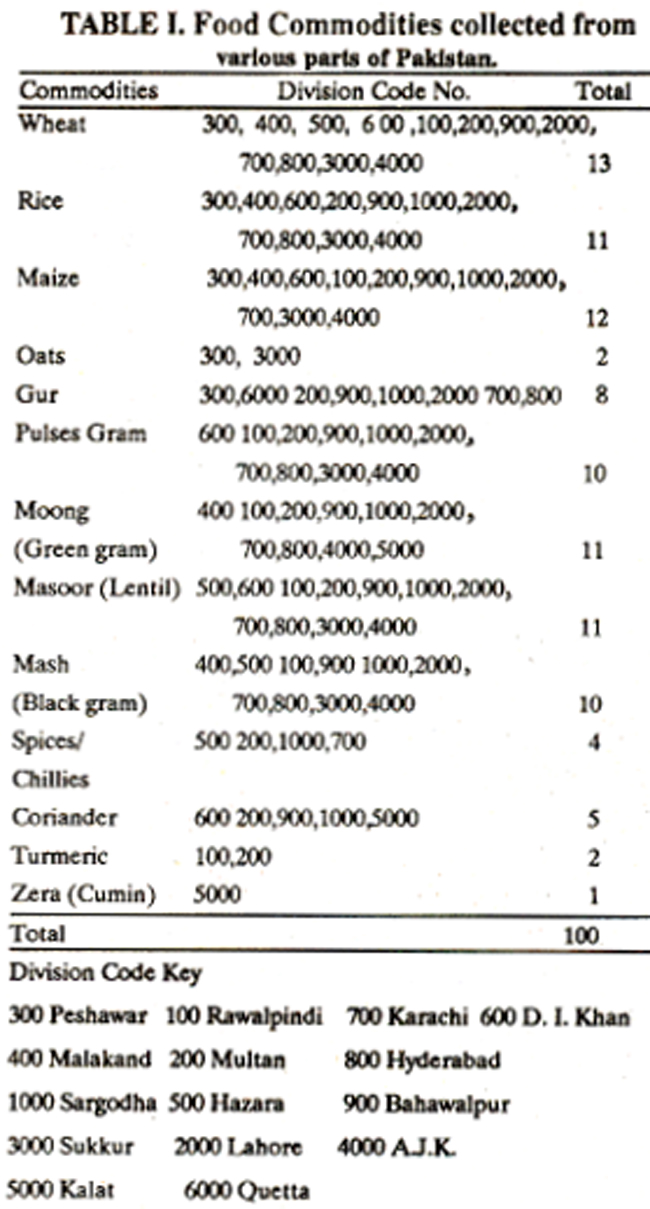
The composed samples were cleaned to remove foreign matter and other impurities, and ground to a coarse powder of uniform particle size. Moisture content was determined at this stage. All samples after preparation were coded, packed and sealed in polythylene bags of high density and stored in deep freezer at -20°C. The 100 composed samples were examined using rapid screening technique to determine the presence or absence of aflatoxin. For this purpose a Mini column method14 was employed to see if there was contamination of the sample. Contamination was then quantified by CB-method14 (official test using Thin layer chromatography). The Rf values were calculated to indicate the type of aflatoxin. Every estimation was performed in duplicate at a confidence level of 2 standard deviation. Aflatoxin reference standards for Bi, B2 and Gi, G2 were obtained from Rijksinstitut vwr volkgezondheit, Bilthoven, Netherland.
RESULTS
Out of one hundred composed samples of cereals, grains, spices, condiments and sweetening agents only 6% (maize and red chillies) were contaminated with aflatoxin B1 and B2. The contamination among maize samples with aflatoxin B1 was 41.6%. The levels of contamination varied from 11.12 ug/Kg to 8333 ug/Kg. The moisture content of these samples varied from 9.9 to 12.1%. Twentyfive percent of chillies samples showed contamination with aflatoxin B2. The level of aflatoxin was 41.67% ugfKg and the moisture content of the same samples was 12.6 % (Table II).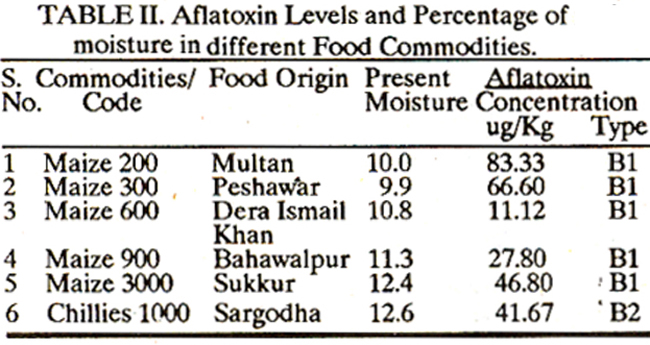
The mean percentage moisture content for commodities free of aflatoxin is shown in Table III.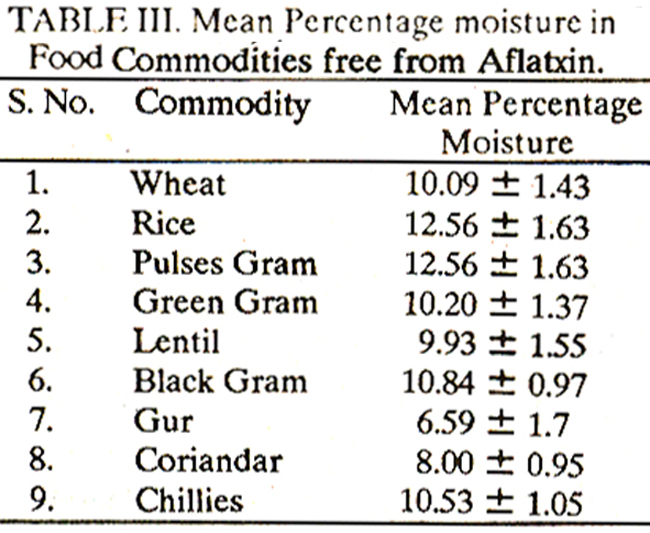
DISCUSSION
The results, of the present study show aflatoxin contamination in maize samples collected from various districts of Multan, Bahawalpur, Sukkur and Dera Ismail Khan, and of chillies collected from Sargodha. Results also show an incidence of aflatoxin contamination in a specific commodity, i.e. maize, only. The number of samples of red chillies analyzed for the presence of aflatoxin is not representative for the country. More samples need to be analyzed to reach a definite conclusion. It is established that moisture is the most important factor in the growth of Aspergillus and subsequent aflatoxin production but the moisture content of all contaminated maize samples was within the standard limits prescribed in the Food Laws15. It is possible that our samples might have been contaminated in the field at the preharvesting stage. Studies have shown that once the food commodity is invaded by the fungus, mycotoxins persists in it even in the absence of causative moulds and these cause an alarming degree of damage to wide spectrum of biolosical systems, liver being the main organ affected12,13. Our results show high levels of aflatoxin B1 contamination in three out of the five contam inated samples of maize, the highest level being 83.33 ug/kg. These levels in all three samples are higher than the prescribed international safety limit (30 ug/Kg) 3. A similar pattern of aflatoxin contamination in maize and maize products has previously been reported from other countries. The level of aflatoxin contamination among maize and maize products was 110 ugfKg in Philippines, 93.0 ug/Kg in Thailand, 53 ug/Kg in Uganda and 18.0 ugIKg in South Eastern United States16. Although our study does not reveal how widespread is the incidence of aflatoxin in various food commodities, and that at present the situation is not alarming, yet the presence of aflatoxins in 6 percent of the commodities must not be overlooked and necessary preventive measures must be taken to avoid further spread. Our study also suggests that agriculture based research organizations should develop resistant varieties of maize, to prevent the persistence and further spread of aflatoxin producing fungi. This would not only increase yields but would also ensure better public health. Moreover, extensive surveillance programmes should be initiated for aflatoxin screening at a national level.
ACKNOWLEDGEMENTS
We acknowledge with appreciation the assistance provided by the Food and Agriculture organization of the United Nations for providing the equipment and chemicals.
REFERENCES
1. Pokrovsky, A.A., Kachenko, L.V. and Tatelyam, V. Aflatoxins; chemical and biological aspects. Toxicon., 1971; 10:25.
2. Jones, B.D. Methods of aflatoxin analysis (G70). London, Tropical Product. Inst., 1972.
3. A report of joint FAO/WHO/UNEP conference on mycotoxins. FAO Food and Nutrition paper 2 Room, 1977.
4. Gilbert. J. Analysis of food contaminants. London, Elsevier, 1984, p.207.
5. Stora, C., Dvorackova, I. and Ayraud, N. Characterization of aflatoxin 81 (AFB) in human liver cancer. Res. Commun. Chem. Pathol. Pharmacol., 1981; 31:77.
6. Baldwin, S. and Parkar, S.S. Effects of dietary fact level and aflatoxin 81 treatment in rat hepatic lipid composition. Food Chem. Toxicol., 1986; 23:1049.
7. Kenseler, T.W., Egner, PA., Dolan, P.M., Groopman, J.D. and Robbuck, M.D. Mechanisms of Protection against aflatoxin tumorigenicity in rats fed 5-(2-Pyrazinyl)-4-methyl-1,2-dithiol-3-thiones (01fipraz) and related 1,2-dithiol-3-thiones and 1,2- dithiol-3-ones. Cancer Res., 1987; 47:4171.
8. Walter, J.R., Yang, C.O. and Kimbrough, D. Aflatoxin and Rye’s Syndrome; a study of liver from disease cases. Arch. Environ. Health, 1985; 40:91.
9. Riemann, H. and Byran, F.L Food-borne infections and intoxications. New York, Academic Press, 1979.
10. ICRC Monograph 1987; Suppl. 7 Vol. 142:83-87.
11. Stoloff, L Aflatoxin as a cause of primary liver-cell cancer in the United States; a probability study. Nutr. Cancer, 1983; 5:165.
12. Robertson, M.A., Harington, J.S. and Bradshaw, B. Observation on cancer patterns among Africans in South Africa; BrJ. Cancer, 1971; 25:377.
13. Singhal, V., Mathur, M., Ramalingaswami, V. and Deo, M.G. Aflatoxin 81-induced injury in monkeys. Arch. Pathol. Lab. Med., 1981; 105:105.
14. Official methods of Analysis, 12th Ed., Association of official analytical chemists (AOAC), Washington D.C., 1975, Section 26, A01-26,A08.
15. The West Pakistan pure food Rules., 1965. Government Printing Press. West Pakistan. 50-51.
16. Stoloff. L Aflatoxin: An overview. In Rocdricks, J.V., Hesseltine, C.W. and Machlman, M.A. Ed. Mycotoxins in human and animal health. Park forest smith. IL.USA. Pathotox Publishers inc.10-77.
Journal of the Pakistan Medical Association has agreed to receive and publish manuscripts in accordance with the principles of the following committees:


