

Gulsah Gurol Arslan ( Dokuz Eylul University, Nursing School, Department of Fundamental Nursing, Izmir, Turkey. )
Arzu Colakfakioglu ( Student of Midwifery, Celal Bayar University, Manisa School of Health, Manisa, Turkey. )
Aygul Sirlan ( Student of Midwifery, Celal Bayar University, Manisa School of Health, Manisa, Turkey. )
Ayden Çoban ( Adnan Menderes University, Aydin School of Health, Department of Midwifery, Aydin, Turkey. )
November 2011, Volume 61, Issue 11
Short Reports

Abstract
The aim of the study was to evaluate the impact of pregnancy-related back pain on quality of life and physical ability in the third trimester of pregnancy. One hundred women in the 28th-40th week of pregnancy were asked to fill out questionnaires including: general questions about background factors, the Katz\\\'s Activity\\\'s Daily Living Index (ADL), and Short Form of WHO Quality of Life Questionnaire (WHOQOL-BREF). Back pain intensity was assessed by visual analog scale (VAS), and functional limitation was measured by Oswestry Low Back Disability Questionnaire (OSW). It was found that, in the third trimester, pregnant women with back pain (PBP) with low pain intensity and moderate functional limitation did not have an impact on quality of life but decreased physical ability when compared to pregnant women with no back pain (NBP). As the back pain intensity of pregnant women increases, physical ability decreases.
Keywords: Quality of life, Functional limitation, Physical ability, Pregnancy-related back pain.
Introduction
Back pain (BP) may be one of the most common problems associated with pregnancy.1 However, 50% or more of all pregnant women report BP during pregnancy.2 Back problems increase during pregnancy2,3 with the highest frequency in the 5th-7th month of pregnancy.3
Many pregnant women have reported that PBP not only compromises their ability to work during pregnancy but also interferes with their activities of daily living4 and health-related quality of life.5 The aim of this study was to evaluate the impact of pregnancy-related back pain in the third trimester on the quality of life and physical ability of pregnant women, and analyze the correlations among the quality of life, physical ability, pain intensity and functional limitations of the pregnant women with PBP.
Patients, Methods and Results
This descriptive and cross-sectional study was conducted between March and June 2009. The research sample consisted of 100 third trimester pregnant women going for regular checkups at the Maternity and Childcare Hospital in Western Anatolia, on Mondays. Of the women, 50 had PBP and 50 had NBP. All the pregnant women who applied to the Maternity and Childcare Hospital in Western Anatolia with the complaint of PBP at the dates indicated were taken as the case group. The control group was selected using probabilistic sampling method among the pregnant women who came to the hospital between the same dates. The number of the women in the control group was equal to the number of those in the case group. The control group consisted of pregnant women with similar features to those in the case group in terms of age, gestational week, number of pregnancy and condition of employment; however, they had no back pain. The criterion for inclusion in the research was last trimester of pregnancy and coming to the maternity hospital for routine check up. Those who had back pain before pregnancy and those with preeclampsia, eclampsia, systemic disease and psychiatric problems were not included in the research. The data were collected through questionnaire survey and face-to-face interview technique. The questionnaire included questions about: age, education, duration of pregnancy, occupation, exercise and number of previous pregnancies. Rating of pain intensity, the Katz\\\'s Activity\\\'s Daily Living Index (ADL), Short Form of WHO Quality of Life Questionnaire (WHOQOL-BREF) and the Oswestry Low Back Disability Questionnaire (OSW) were also included. Pain intensity was measured by a visual analog pain scale (VAS). The study protocol was approved by the administrative authorities of Health Directorate. This approval process also included ethical evaluation. The aims of the study were explained to pregnant women. Those who did not wish to participate in the study were thanked for their time and told that their refusal would not affect their care. Verbal informed consent was obtained from all participating pregnant women.
In Table-1, the scores received by the case and control groups from quality of life scale domains and activities of daily living index were compared. It was determined that the scores of PBP from the quality of living domains; namely, Physical Health, Psychological Health, Social Relationships and Environment were higher than NBP. However, this difference was not found to be statistically significant. The groups\\\' mean score of ADL is given in Table-1.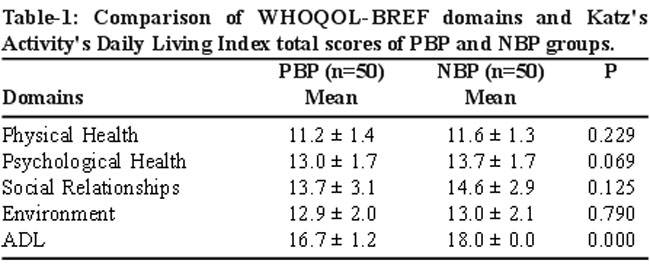
According to the scores received from ADL, it was determined that the pregnant women in both groups could perform the activities of daily living "independently" (13-18 points). It was also determined that the physical ability scores of the pregnant women in the control group was significantly higher than those in the case group (p=0.000). The pain intensity of those in the case group was determined to be 3.9±2.2 on average according to VAS, and their functional limitation was 16.6±6.2 on average according to OSW.
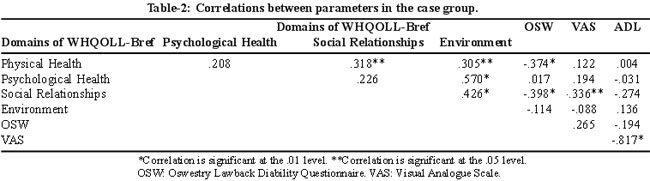
In Table-2, correlations between parameters in the case group were given. Of the quality of life domains, a weak to moderate correlation was determined between Environment domain scores and Physical Health (r=.305), Psychological Health (r=.570), Social Relationships (r=.426). A weak correlation was determined between Physical Health domain scores and Social Relationships domain scores (r=.318). A weak negative correlation was determined between OSW scores and Physical Health (r=-.374) and Social Relationships (r=-.398) domain scores, and between VAS and Social Relationships domain scores (r=-.336). On the other hand, a strong correlation was determined between their pain intensity and physical ability (r=-.817).
Discussion
In this study, the impact of pregnancy-related back pain (PBP) on quality of life and activities of daily living in the third trimester of pregnancy was analyzed. Moreover, the correlations among the quality of life, physical ability, pain intensity and functional limitations of the pregnant women with PBP were also analyzed. Previous studies have stated that pregnancy decreased the quality of life without taking into consideration the pregnancy related back pain.6 According to the results of the World Health Organization Quality of Life (WHOQOL global) Research, the mean scores of physical, psychological, social and environment domains for healthy women were found to be 13.4, 14.0, 14.1, 13.5 respectively.7 In a study conducted on healthy women in Turkey, the mean scores of quality of life domains were found to be 14.5, 13.9, 15.3 and 13.5 respectively.8 In another study conducted with healthy pregnant women in the same region, the mean scores of quality of life domains were determined as 12.9, 13.9, 14.7, 13.4.9 The results of our research are lower than healthy normal women but similar to the results of the research conducted with pregnant women.
In our study, a difference was not found between the quality of life domain scores of pregnant women with PBP and those with NBP. In the study conducted by Olsson and Nilsson-Wikmar (2004), it was stated that the overall quality of life scores of pregnant women with PBP were lower than those with NBP.1 In the same study, the pain intensity of the pregnant women with PBP was 5.9 while the value is found to be 3.9 in our study. It could be concluded that the pain intensity of the pregnant women who participated in the research was not of a value that would affect their quality of life.
Physical ability decreases in the last trimester of pregnancy. A pregnant woman with back problems is even more limited in her activities. Several studies show connection between high pain intensity and decreased functional ability.2,3 In the study, the physical abilities of the pregnant women were evaluated in terms of six domains; namely, bathing, dressing, toileting, transfer, continence and feeding. It was found that all the pregnant women who participated in the research were able to perform all the activities independently, and that the scores of the pregnant women with PBP were significantly lower than those with NBP. Previous studies reported that back pain had a negative impact on the pregnant women\\\'s activities of daily living.5
In our study, the correlations among the quality of life domains of pregnant women with PBP, and their OSW, VAS and ADL scores were analyzed. Among these scores, a strong correlation was only found between their pain intensity and physical ability. In the study of Olsson and Nilsson-Wikmar (2004) conducted on pregnant women with PBP, a significant relationship between the pain intensity scores and physical ability scores was not found (r=0.59).1
Several other studies show a connection between high pain intensity and a decreased functional ability.2,3 A relationship was not found between pain intensity and functional limitation scores in our study as well as the study conducted by Sihvonen et al. (1998) which reported pain intensity scores as 3.9±2.2 and 5.86±11.46 respectively.10 The fact that the pain intensity score was found to be low in the study might have affected the results.
Conclusion
The study demonstrated that the pregnancy-related back pain which had low pain intensity and caused low functional limitation did not have an impact on the pregnant women\\\'s quality of life, however decreased their physical ability. The pain intensity increases, physical ability decreases. We suggest that pregnancy-related back pain should be included within the scope of pregnancy monitoring programmes as well as preventive health programmes. There is an increasing demand for further information in this field.
Acknowledgments
We thank Prof Umran Sevil (Obstetric and Gynecological Nursing Department, Ege University) for her contribution to this study.
References
1.Olsson C, Nilsson-Wikmar L. Health-related quality and physical ability among pregnant women with and without back pain in late pregnancy. Acta Obstetricia et Gynecoogical Scandinavica 2004; 83: 351-7.
2.Östgaard HC, Anderson GBJ, Karlsson K. Prevalence of back pain in pregnancy. Spine 1991; 16: 95-101.
3.Kristiansson P, Svärdsudd K, Von Schoultz B. Back pain during pregnancy: A prospective study. Spine 1996; 21: 702-9.
4. Stuge B, Hilde G, Volestad N. Physical therapy for pregnancy-related low back and pelvic pain: A sistematic review. Acta Obstetricia et Gynecoogical Scandinavica 2003; 82: 983-90.
5. Noren L, Östgaard S, Nielsen TF, Östgaard HC. Reduction of sick leave for lumbar back and posterior pelvic pain in pregnancy. Spine 1997; 22: 2157-60.
6. Hueston WJ, Klasik-Miller S. Changes in functional health status during normal pregnancy. J Fam Pract 1998; 47: 209-12.
7.The WHOQOL Group. What Quality of Life. World Health Forum 1996; 17: 354-6.
8.Alt?parmak S, Eser E. The quality of life in 15-49 years old who one married women. J Fam Soc 2007; 3: 29-34.
9.Alt?parmak S, Yan?kkerem E, Karadeniz G. The relation between the sociodemographic factors and pregnancy of symptoms in the pregnancy women and quality of life. J Clin Sci Doctor 2005; 11: 536-42.
10.Sihvonen T, Huttunen M, Makkonen M, Airaksinen O. Functional changes in back muscle activity correlate with pain intensity and prediction of low back pain during pragnancy. Arch Physical Med Rehab 1998; 79: 1210-2.
Journal of the Pakistan Medical Association has agreed to receive and publish manuscripts in accordance with the principles of the following committees:


