

Syed Muslim Abbas ( Department of Community Health Sciences, Shifa College of Medicine, Islamabad. )
Ali Yawar Alam ( Department of Community Health Sciences, Shifa College of Medicine, Islamabad. )
Atif Majid ( 4th year MBBS Student, Shifa College of Medicine, Islamabad. )
March 2011, Volume 61, Issue 3
Original Article

Abstract
Objective: To identify the probable causes of deaths through verbal autopsy and identify the health problems prevalent in underprivileged and marginalized communities.
Methods: This was a cross-sectional survey conducted at the community of Nurpur Shahan (Urban Slum), Islamabad, Pakistan in January 2010. W.H.O validated questionnaire was used and 300 adults (age > 18 years) were assessed on their knowledge regarding death of their relatives. All data collected was entered into SPSS version 10.0. The data was re-validated and analyzed.
Results: Out of the three hundred deaths, 191(63.7%) were male and 109(36%) were female. One hundred and ninety one (63.7%) deaths were due to heart diseases, 69 (23%) due to accidents and 37(12.3%) due to unknown causes. One hundred and thirty one of the deceased (43.7%) were issued death certificates.
Conclusion: This study concludes that heart diseases are the most common cause of death in the urban slum community followed by accidents. A significant proportion of the deaths went unreported which suggests the need of record keeping of such deaths to enrich epidemiological purposes and health and safety interventions in such communities. Ways and means have to be searched to cater to the cardiac health care needs of the underprivileged and marginalized segments of the society.
Keywords: Verbal autopsy, marginalized communities, unreported deaths (JPMA 61:235; 2011).
Introduction
Verbal autopsy (VA) is a technique designed for finding the reliable reason of death by interviewing the family of the deceased.1 When conducted rigorously, using a standardized questionnaire, VA can establish the most probable diagnosis.2-7 Data obtained by VA can be suitable for demographic or epidemiologic purposes.7-17 The VA technique depends on the exact purpose for which the data will be used.1
In some countries it is the only method of ascertaining such estimates.1 The method is presently being used at about 35 sites primarily in Africa and Asia.8
In the local setting of Pakistan a verbal autopsy study of maternal deaths was conducted in the districts of Talagang and Bhakhar using a questionnaire. Households having a known case of a maternal death were included.5 The results were revealing. A total of 128 deaths were recorded and the risk factors identified were low socioeconomic status, illiteracy, and bad obstetric history. Of the 104 women who died during or after delivery, 38% had delivered in a private facility and 18% in a government facility.5 The quality of services in both private and public sectors was inadequate.5,13 Sixty-nine percent of deaths occurred in the postpartum period, and 51% within 24 hours of delivery.5
The causes of child deaths in a similar study conducted in Karachi slums showed that diarrhoea caused 41% deaths, low birth weight 24%, acute respiratory infection 22% and other causes 13%.6
Another study by Verbal Autopsy conducted in 5 slums of Karachi7 on a population between 15 and 59 years age, showed cardiovascular diseases to be the cause of 55% deaths, TB 17%, and road traffic accidents 8% deaths.7
These studies prove that Verbal autopsy (VA) is currently the only option for obtaining cause of death information in most populations especially those who do not have an effective registry system.12
To the best of our knowledge, a similar study has not been conducted in Nurpur Shahan, an urban slum community of Islamabad. The causes of death are therefore not reported in this and similar communities. This study was therefore undertaken to determine the probable causes of deaths through verbal autopsy and identify the health problems prevalent in such an underprivileged and marginalized community.
Methods
A Cross-sectional Survey was carried out at Nurpur Shahan (urban slum community Islamabad) during January 2010. WHO for which verbal autopsy validated questionnaire was used.18,19 The questionnaire was translated into Urdu and back translated into English to ensure validity. All questions were asked in the local language. An adult who was aware of the events leading to the death of a relative was interviewed. Sample size was calculated using Epi info 3.0 for the estimated adult population (above the age of 18 years) of around 12,000 in Nurpur Shahan area, we sampled 2.5% of this population. This sample size came to 300. Systematic sampling technique which is a form of random sampling was used. In each street we surveyed the 1st household followed by 3rd, 5th and so on. This was done in the form of groups of 4 students each and the presence of a female student was ensured in each group keeping in mind the cultural norms. Inclusion criteria for the study were adults of either gender, above the age of 18 years who gave informed consent. The information collected in the questionnaires was transferred to the SPSS version 10.0 statistical software. For all categorical variables (such as gender, educational status and reported cause of death were presented as frequency and percentages.
Keeping in mind the ethical considerations two principles were upheld during the process of this study. 1) Shifa College of Medicine ethics review committee clearance was obtained. 2) Written informed consent from all adults for participation in the survey was obtained. All data was kept confidential.
Results
The total deaths investigated were three hundred. The age distribution of the deceased was 18 years and above. Majority of them were males 191 (63.7%). The data collected by our survey grossly indicates that a significant number of the deaths in the community are at the ages of 56 years and above. The demographic profile of the deceased is depicted in the Table.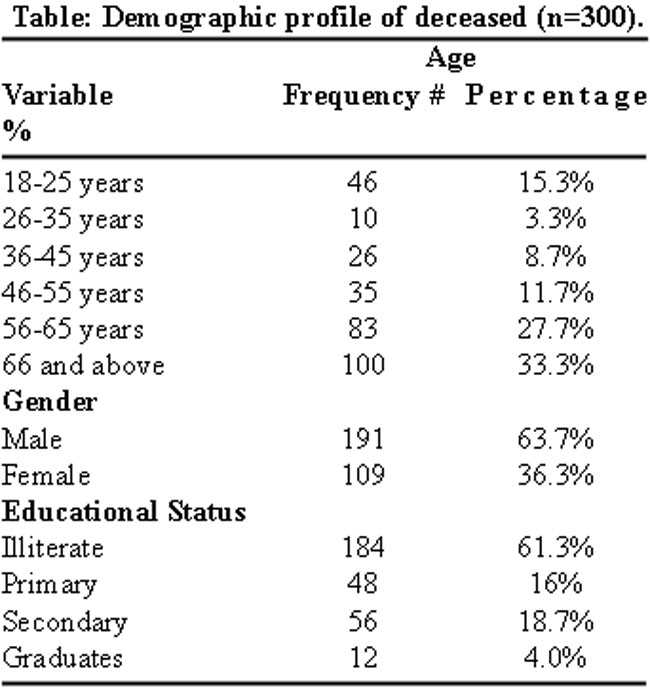
A majority of the deceased had received no formal education 184(61.3%). Only 12 (4%) adults had achieved graduate education, this reflects the low literacy level and probable lack of awareness regarding important health issues in the community.
The findings of verbal autopsy are presented in Figure.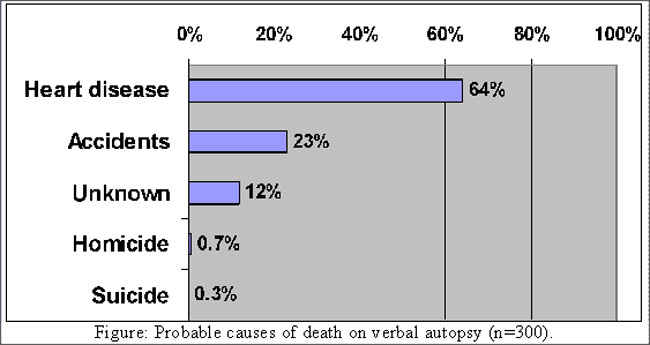
Majority of deaths were due to heart diseases 191(64%). Accidents also caused the death of a sizeable portion 69(23%) of the population. Thirty seven (12%) of the deaths investigated were due to unidentifiable causes. As far as the age of the deceased is concerned, the data confirms that 183 (60.0%) adults who died were 56 years of age and above. This is consistent with studies suggesting that cardiovascular disease is prevalent in majority of the older population in Pakistan.16,17 Accidents also caused the death of a sizable portion 69(23%) of the population.
Regarding the time of illness before death, 113(37.7%) adults remained ill for months to years, 134(44.7%) remained ill for days and 52(17.3%) for weeks.
Discussion
The data collected by our survey grossly indicates that a significant number of the deaths in the community are around the ages of 56 years.20 The male members of the society have a higher death rate compared to the females; This finding is validated by Pakistan demographic and health survey 2006-07.21
This is also supported by the results of a similar study conducted in Chandigarh, India in which 262 verbal autopsies were done. The study group constituted of, 60% males with 23% belonging to the rural areas.2
The most common cause of death in the community of Nurpur Shahan was cardiovascular disease (64%) which suggests a high prevalence of heart disease. Respiratory diseases and sexually transmitted diseases constituted a lesser proportion to the cause of death.
This is comparable to a Verbal Autopsy conducted for adult mortality in 5 slums in the city of Karachi.7 The total population of this study group was 45,389 with 345 deaths, with ages between 15-59 years.7 The deaths caused by cardiovascular diseases were 55%.7
Population based epidemiological studies and notification systems have shown ischaemic heart disease and cerebrovascular disease to be the leading causes of death globally.4
These are followed by lower respiratory infections, chronic pulmonary obstructive disease and diarrhoeal diseases. AIDS and Tuberculosis are now the sixth and seventh causes respectively.
In our study, the duration of illness before death was months in 113(37.7%) adults , weeks in 52 (17.3%) and days in 134(44.7%) persons.
The above findings are similar to a study conducted in western rural Kenya in 2003, with a reported number of 1816 deaths. More than 90% of the deceased had been ill for more than 2 months.9
Lack of education (61.3% adults are uneducated), was identified predominantly in our study. Similarly a verbal autopsy study of maternal deaths conducted in two districts (Talagang and Bhakkar) identified illiteracy and low socioeconomic status as high risk factors.5 These could lead to delayed recognition of symptoms and signs of disease, and delayed access to health care services.
Since most of causes of death go unreported in urban slum communities of developing nations, it would be useful to explore the probable causes of most deaths through verbal autopsy in them. This would help in identifying the health problems and risk factors. Such data obtained could be used for epidemiological purposes and for policy decision making, resource allocation for the needy and poor and devising important health interventions.
Conclusion
This study concluded that Heart diseases are the most common causes of death in Nurpur Shahan followed by accidents and the majority of these deaths were in the 56 years and above age group. The high prevalence of heart diseases in Nurpur Shahan can be attributed to lack of education, minimal awareness and decreased access to health care services. Furthermore, sedentary lifestyle, stress related to low socioeconomic status, little or no exercise, unhealthy diet could have contributed in precipitating this condition.
Comments:
This studied community should be provided health education on various aspects of heart diseases and how it can be prevented. The lack of essential health care services to this underprivileged and marginalized urban slum community has been observed in this study. Cardiac care including medical treatment and surgery are quite expensive. Ways and means need to be looked in to as to how to cater the cardiac needs of this segment of the society. Accidents also caused the death of a sizable portion of the population. This suggests that adequate safety measures should be undertaken and possible hazards and risks identified, which lead to such fatalities. A significant proportion of the deaths went unreported which calls for the need of record keeping of such deaths to enrich epidemiological purposes and health interventions in such communities.
References
1.Chippaux JP. [Concept, application and use of verbal autopsy]. Med Trop (Mars) 2009; 69: 143-50. (Article in French).
2.Soleman N, Chandramohan D, Shibuya K. Verbal autopsy: current practices and challenges. Bull World Health Organ 2006; 84: 239-45.
3.van Eijk AM, Adazu K, Ofware P, Vulule J, Hamel M, Slutsker L. Causes of deaths using verbal autopsy among adolescents and adults in rural western Kenya. Trop Med Int Health 2008; 13: 1314-24.
4.Mathers CD, Boerma T, Ma Fat D. Global and regional causes of death. Br Med Bull 2009; 92: 7-32.
5.Jafarey SN, Rizvi T, Koblinsky M, Kureshy N. Verbal autopsy of maternal deaths in two districts of Pakistan - filling information gaps. J Health Popul Nutr 2009; 27: 170-83.
6.D\\\'souza RM, Bryant JH. Determinants of childhood mortality in slums of Karachi, Pakistan. J Health Popul Dev Ctries 1999; 2: 33-44.
7.D\\\'Souza RM. Role of health-seeking behaviour in child mortality in the slums of Karachi, Pakistan. J Biosoc Sci 2003; 35: 131-44.
8.Engmann C, Jehan I, Ditekemena J, Garces A, Phiri M, Mazariegos M, et al. Using verbal autopsy to ascertain perinatal cause of death: are trained non-physicians adequate? Trop Med Int Health 2009; 14: 1496-504.
9.Mo-suwan L, Isaranurug S, Chanvitan P, Techasena W, Sutra S, Supakunpinyo C, et al. Perinatal death pattern in the four districts of Thailand: findings from the Prospective Cohort Study of Thai Children (PCTC). J Med Assoc Thai 2009; 92: 660-6.
10.Joshi R, Kengne AP, Neal B. Methodological trends in studies based on verbal autopsies before and after published guidelines. Bull World Health Organ 2009; 87: 678-82.
11.Gaym A. Maternal mortality studies in Ethiopia--magnitude, causes and trends. Ethiop Med J 2009; 47: 95-108.
12.Lopman B, Cook A, Smith J, Chawira G, Urassa M, Kumugola Y, et al. Verbal autopsy can consistently measure AIDS mortality: a validation study in Tanzania and Zimbabwe. J Epidemiol Community Health 2010; 64: 330-4.
13.Nisar N, Sohoo NA. Maternal mortality in rural community: a challenge for achieving millennium development goal. J Pak Med Assoc 2010; 60: 20-4.
14.Joshi R, Kengne AP, Neal B. Methodological trends in studies based on verbal autopsies before and after published guidelines. Bull World Health Organ 2009; 87: 678-82.
15.Lathers CM, Schraeder PL. Verbal autopsies and SUDEP. Epilepsy Behav 2009; 14: 573-6.
16.Gill PS, Davis R, Davies M, Freemantle N, Lip GY. Rationale and study design of a cross sectional study documenting the prevalence of Heart Failure amongst the minority ethnic communities in the UK: the E-ECHOES Study (Ethnic--Echocardiographic Heart of England Screening Study). BMC Cardiovasc Disord 2009; 9: 47.
17.Saleheen D, Zaidi M, Rasheed A, Ahmad U, Hakeem A, Murtaza M, et al. The Pakistan Risk of Myocardial Infarction Study: a resource for the study of genetic, lifestyle and other determinants of myocardial infarction in South Asia. Eur J Epidemiol 2009; 24: 329-38.
18.Soleman N, Chandramohan D, Shibuya K. Verbal autopsy: current practices and challenges. Bull World Health Organ 2006; 84: 239-45.
19.Anker M, Black RE, Coldham C, Kalter HD, Quingley MA, Ross D, et al.: A standard verbal autopsy method for investigating causes of death in infants and children, WHO; 1999.
20.Unicef. (Online) (Cited 2010 March 6). Available from URL: http://www.unicef.org/infobycountry/pakistan_pakistan_statistics.html.
21.National Institute of Population Studies (NIPS) [Pakistan], and Macro International Inc. 2008. Pakistan Demographic and Health Survey 2006-07. Islamabad, Pakistan: National Institute of Population Studies and Macro International Inc.
Journal of the Pakistan Medical Association has agreed to receive and publish manuscripts in accordance with the principles of the following committees:


