

Osman Mahir Okur ( Department of Emergency, Numune Hospital, Sivas, Ankara, Turkey )
Abuzer Coskun ( Department of Emergency, Numune Hospital, Sivas, Ankara, Turkey )
Afsin Emre Kayipmaz ( Department of Emergency, Baskent University, Faculty of Medicine, Ankara, Turkey. )
Sedat Ozbay ( Department of Emergency, Numune Hospital, Sivas, Ankara, Turkey )
Cemil Kavalci ( Department of Emergency, Baskent University, Faculty of Medicine, Ankara, Turkey. )
Ummu Gulsum Kocalar ( Department of Emergency, Baskent University, Faculty of Medicine, Ankara, Turkey. )
July 2016, Volume 66, Issue 7
Case Reports

Abstract
Hair-thread tourniquet syndrome is an emergency condition rarely encountered since its first description, and it may be potentially dangerous unless treated. The potential hazard of the condition stems from hair strands wrapping around and strangulating various body processes such as fingers, penis, or clitoris. In this paper we aimed to report the first case of hair-thread tourniquet syndrome affecting a haemangioma of an adult patient.
A 68-year-old woman presented to emergency department for pain in the mass on her back. On physical examination, a haemangioma with a size of about 3x3 cm was noted on the right scapula. When inspected closely, it appeared edematous and strangulated, and there were hair strands wrapped to the bottom of the wound. The hair strands were removed and the strangulated haemangioma was excised.
Keywords: Hair-thread, haemangioma, strangulation
Introduction
Hair-thread tourniquet syndrome is an emergency condition rarely encountered since its first description in Lancet in 1832, and it may be potentially dangerous unless treated.1,2 The potential hazard of the condition stems from hair strands wrapping around and strangulating various body processes such as fingers, penis, or clitoris. Strangulation leads to ischaemia, which in turn may cause serious injury potentially resulting in amputation of the affected tissue.3
Hair-thread tourniquet syndrome is usually known to affect paediatric age group, predominantly in an accidental manner. Trichomania or certain traditions of some societies have been implicated in its etiology although child abuse may also cause this condition.3,4
This condition is rare in adults but Sallami et al reported a case of hair-thread tourniquet syndrome involving the penis of a 37-year-old man.5
In this paper we aimed to report the first case of hair-thread tourniquet syndrome affecting a haemangioma of an adult patient.
Case Report
A 68-year-old woman presented to emergency department with pain on a mass in the back region for 3 days in April 2015. She stated that she had had that mass for 8 years but denied to have such a pain on it before. She had hypertension and diabetes mellitus as co morbidities. On physical examination she had a haemangioma of 3x3 cm on the right scapula. On inspection, the tissue was oedematous and appeared strangulated. Additionally, hair strands were noted to have become tied around the root of the mass (Figure-1)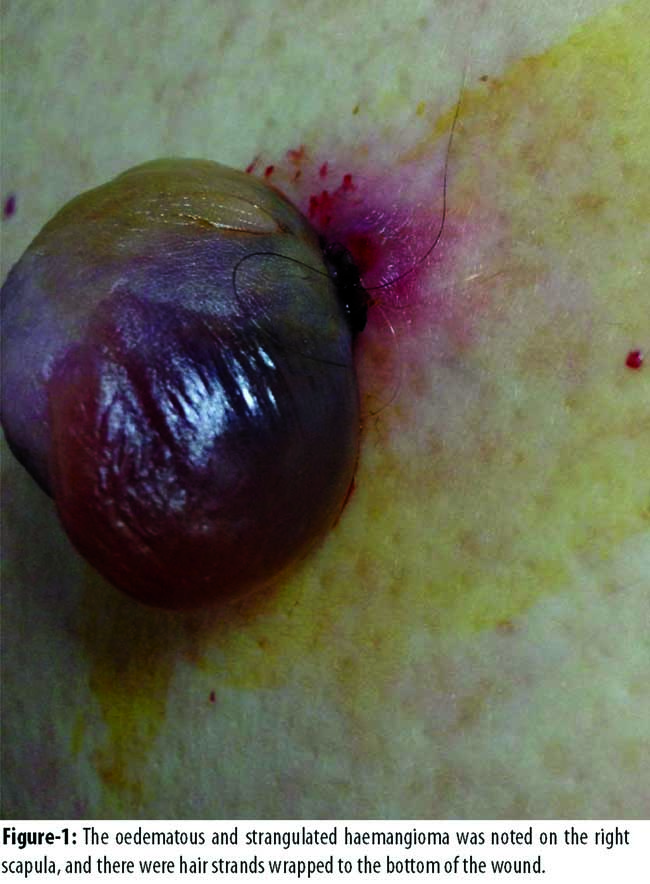
Her other systemic examinations were normal. The hair strands around the lesion were removed and the strangulated haemangioma was excised (Figure-2)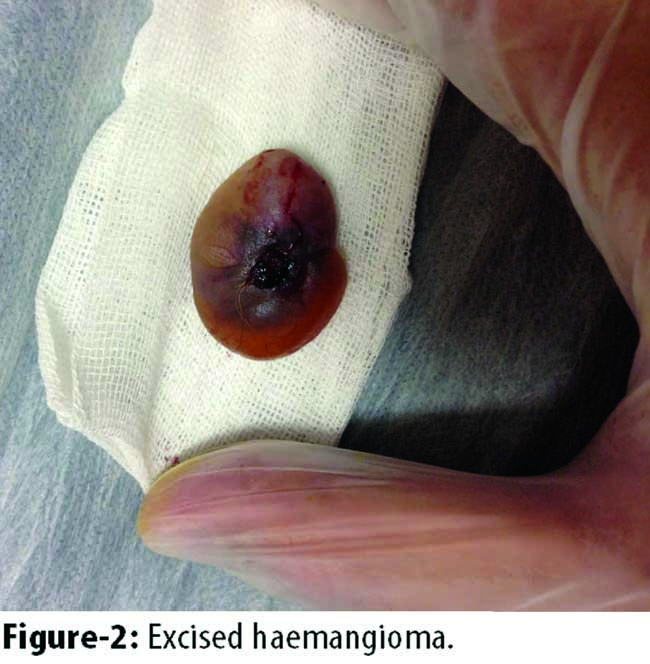
The patient was discharged without any further complication.
Discussion
In a review of the relevant literature, Mat Saad et al reported that the rare, albeit potentially hazardous, hair-thread tourniquet syndrome was usually observed in penis (44.2%), toes (40%), and fingers (8.57%).6 In addition to these regions, hair-thread tourniquet syndrome may also involve highly unusual regions such as uvula.7 In our patient the syndrome spontaneously developed in a haemangioma, a presentation that was previously unknown. As the syndrome is diagnosed by inspection, a careful physical examination is essential for its diagnosis. Hence, our case was diagnosed by observing hair strands wrapped around the haemangioma in a careful inspection. The robust break-resistant structure of hair strands serve as an effective tourniquet to block venous circulation and lymphatic flow in a strangulated tissue. This in turn causes tissue oedema, impairs arterial circulation, and ultimately results in ischaemia within hours to weeks.8 Our patient also presented with pain 3 days after the onset of her complaints. Her haemangioma was highly oedematous and strangulated, as shown in Figure-1. Hair-thread tourniquet syndrome is preferentially treated by cutting hair strands strangulating the tissue to re-establish tissue perfusion. One alternative treatment method in cases that allow some time is to use depilatory creams. Nevertheless, surgical therapy is inevitable in cases where oedema and reepithelization make the above methods unfeasible, as in our case.9
In hair-thread tourniquet syndrome involving fingers a dorsal longitudinal incision over the region of strangulation is recommended.10 In the present case we preferred to perform excision since the strangulated tissue was suitable for excision and ischaemia showed progression over time.
Conclusion
Hair-thread tourniquet syndrome is a rare syndrome but it should be kept in mind since it may result in the loss of affected tissue. It should be included in the differential diagnoses especially in babies with restlessness of unknown origin.
Disclosure: This study was presented as poster presentation at the 11th Turkey Emergency Medicine Congress, 26-29 Oct 2015, Girne, North Cyprus.
Conflict of Interest: The authors declare no conflict of interest.
Financial Source: There is no financial support.
References
1. Dr G. Ligature of the penis. Lancet 1832; 2: 136.
2. Ergin M, Ozer MR, Kocak S, Girisgin AS, Gul M, Cander B. Two Case with Tourniquet Syndrome. J Acad Em Med 2013; 12: 220-1.
3. Kaya H, Sogut O, Iynen I, Nimetoglu MS, Dokuzoglu MA. Hair-Thread Tourniquet Syndrome. JAEMCR 2012; 3: 39-40. [found with different information about authors and journals]
4. Cevik Y, Kavalci C. Hair tourniquet syndrome. Ann Saudi Med 2010; 30: 416-7.
5. Sallami S, Ben Rhouma S, Cherif K, Noura Y. Hair-thread tourniquet syndrome in an adult penis: case report and review of literature. Urol J 2013; 10: 915-8.
6. Mat Saad AZ, Purcell EM, McCann JJ. Hair-thread tourniquet syndrome in an infant with bony erosion: a case report, literature review, and meta-analysis. Ann Plast Surg 2006; 57: 447-52.
7. Akyuz C, Elbistanli MS. Incarceration by rope: A rare cause of uvula edema. Turkish J Emerg Med 2013; 13: 96-7.
8. Sivathasan N, Vijayarajan L. Hair-thread tourniquet syndrome: a case report and literature review. Case Rep Med 2012; 2012: 171368.
9. Au S, Landers JT. Hair-thread tourniquet syndrome: a case report and review of treatment. Dermatol Online J 2014; 20: 1-3.
10.Serour F, Gorenstein A. Treatment of the toe tourniquet syndrome in infants. Pediatr Surg Int 2003; 19: 598-600.
Journal of the Pakistan Medical Association has agreed to receive and publish manuscripts in accordance with the principles of the following committees:


