

Emre Yanikkerem ( Celal Bayar University, School of Health, Istasyonmevki, Uncubozkoykampusu, Manisa, Turkey. )
Aysegul Yasayan ( Celal Bayar University, Hafsa Sultan Hospital, Uncubozkoykampusu, Manisa, Turkey. )
April 2016, Volume 66, Issue 4
Original Article
Vaginal douching practice: Frequency, associated factors and relationship with vulvovaginal symptoms

Abstract
Objective: To determine the frequency, associated factors and relationship with vulvovaginal symptoms and vaginal douching among Turkish women.
Methods: The cross-sectional, analytical study was conducted at Merkez Efendi Hospital, Manisa, Turkey, from January to June 2014 using a questionnaire. Statistical analysis was carried out using SPSS 17.
Results: Of the total 343 women in the study, 91(26.5%) had reported vaginal douching in the preceding year. Statistically significant relationship was determined between the vaginal douching behaviour and couples who had low educationand low income levels, having unplanned pregnancy and had someone in their neighbourhood who douched (p<0.05 each). The most common reason for using vaginal douching was reported to be cleanliness by 85(93.4%) women, prevention of genital infections 75(82.4%), cleaning after/before sexual intercourse 72(79%), during menstruation 49(54%), prevention of vaginal discharge 69(76%), decreasing of unpleasant odours 65(71.4%) and religious beliefs 46(50.5%). Self-reported history of vaginal infection was significantly more common for women who douched compared those who did not (p<0.05).
Conclusion: Healthcare providers should determine the reason and risky groups of women and educate the women to stop the vaginal douching behaviour and harmful effects of vaginal douching.
Keywords: Vaginal douching, Douching, Vulvovaginalsymptoms, Vaginal symptoms. (JPMA 66: 387; 2016)
Introduction
Vaginal douching (VD) for hygiene has cultural characteristics and is a widespread practice among Turkish women and worldwide. VD practice of flushing liquid into the vagina, using of finger or a material for hygiene or therapeutic purpose is an ancient and traditional practice.1,2 Vaginal pH, protective acidic mucus, vaginal mucosal immune response and systemic immunity are the most important components of preventive invasion and proliferation of pathogenic microorganisms.3
Adverse health outcomes associated with VD have been reported in previous studies and most studies agree that VD was associated with a number of adverse health and reproductive outcomes, including pelvic inflammatory disease, endometriosis, reduced fertility, preterm delivery, ectopic pregnancy, low birthweight and possible cervical cancer. The potential health risk of VD has been documented in literature; VD has been linked to sexually transmitted diseases (STDs) such as bacterial vaginosis (BV), upper genital tract infection, clamidydia trachomatis and human immunodeficiency virus (HIV) acquisition.4-13 In childbearing age, BV and vulvovaginal candidiasis are the most frequently vulvovaginitis in gynaecology and affect women physiologically, physically, socially, economically and in terms of reproductive health.3,8 Studies stated that BV at mid-pregnancy was moderately associated with an increased risk of spontaneous preterm birth.4,8,14
Despite the adverse and harmful effects, many women accept VD as a normal and healthy activity for the maintenance of hygiene and continue to douche.It has been noted in some studies in Turkey that the prevalence of VD varies between 38.6% and 80.7%.1,2,15-19 It has also been indicated in international studies that the ratio was between 32% and 76%.4-6,8-10,12,13,20-23
Earlier studies pointed out that VD was more common in women of older age,2,5,8,13,18,19 Black women,12 those with lower socio-economic status and less education,5,9-13,17,24 housewives,15 living in rural areas,17,18 single,14 ethnicity,11 obesity,14 first married at age of 15-19,1 high parity and number of children,1,9,18 in having sex with much older partners,5 plenty of lifetime partners,6,8 hormonal contraceptive use,6 smoking14 and having spontaneous abortions.15
Women used the VD behaviour to manage their personal hygiene and cleanliness before or after sexual intercourse and most of them believed VD as a beneficial practice.5,9,14,15,18,25 Health professionals are in a unique position to provide counselling about the potential adverse effects of health associated with VD.5
The current study was planned to determine frequency and reasons of VD within the preceding year among Turkish women, and to define the relationship between VD practice and characteristics of women who douched. It also aimed at assessing the association of vaginal symptoms and VD behaviours.
Subjects and Methods
The cross-sectional, analytical study was conducted from January to June 2014 in Obstetrics and Gynaecology Clinic at Merkez Efendi Hospital, Manisa, which is located in the western region of Turkey. The study universe comprised 3143 women, and as the number of women in the universe was known, the formula of n=N + pq /d2 (N-1) + t2pq was used to determine the sample size while considering p=0.05.26 The subjects were selected randomly from among the women who came to Merkez Efendi Hospital.
In the study, VD practice was categorised into two groups, douchers and non-douchers, who were categorised on the basis of self-report and were evaluated in terms of the preceding year and the preceding 24 hours.
A three-part questionnaire was used to collect data. The questionnaire was designed on the basis of published literature.1,2,5,6,9,12,15,17,19,20 Content validity was assessed by gynaecology and obstetrics experts.Changes to the questionnaire were made according to the experts\\\' suggestions. Some questions were removed from the questionnaire, and the revised questionnaire was then tested for readability and relevance on 15 women. It was found to be acceptable.
The first part of the questionnaire consisted of 16 questions about women\\\'s characteristics, such as age, education level of women and her partners, employment status of women, perceived income level, place of residence, number of pregnancy, miscarriage, induced abortion etc. The second part included 9 questions about vaginal symptoms such as vaginal discharge, itching, swelling burning, pelvic pain, dyspareunia, polyuria and vulvovaginal candidiasis. No laboratory test was used for vaginal symptoms. Women\\\'s responses were taken as true. History treatment for vaginal infection was also asked in this part of the questionnaire. The third part contained questions related to initiation of VD, from whom they had learned of VD, reasons for the use of VD, frequency of VD, products used, and which part of vagina was douched.
The study was approved by the Celal Bayar University Ethic Committee and the Manisa Health Director. All women signed a written informed consent form. After the collection of data, the women were educated about the adverse consequences of VD and were advised to stop the practice.
Data was analysed using SPSS 17and p<0.05 was considered statistically significant. Chi-square and Fisher exact tests were used to evaluate association between women characteristics, presence of vaginal discharge symptoms and women who did VD and who did not.
Results
Of the total 343 women in the study, 91(26.5%) had reported vaginal douching in the preceding year. The mean age of the subjects was 27.8±5.3 years; 216(63.0%) were younger than 30 years; 281(81.9%) were housewives; 280(81.6%) were living in city centre; 96(28%) had low income level; and 31(9%) had chronic disease. Detailed characteristics of the subjects were noted (Table-1).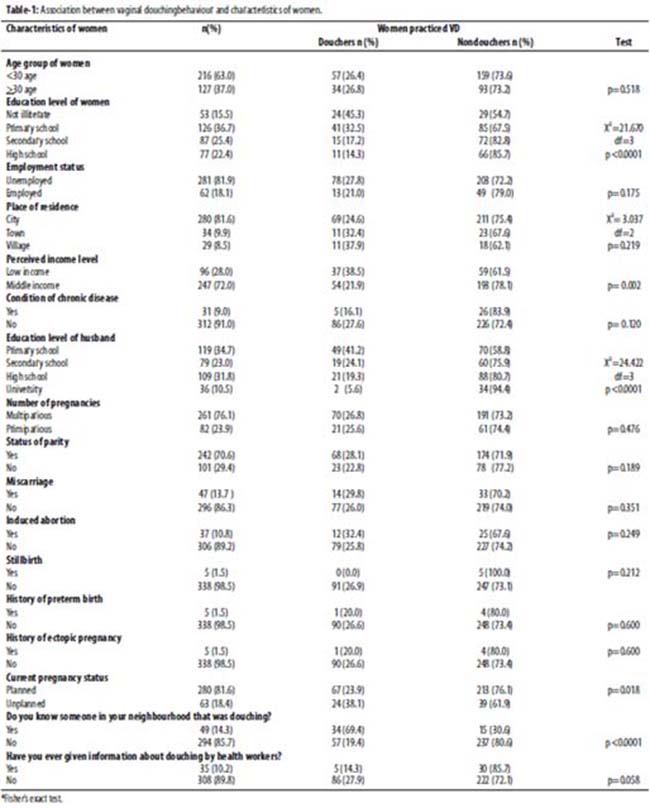
A total of 28(8.2%) women had douched during the preceding 24 hours, 91 (26.5%) reported VD in the preceding 12 months, 46(51.6%) had begun VD before the age of 18 and the mean of the first initiation of VD was 17.9±5.3 (range: 7-36). It was found that 51(56.1%) women had started VD on the advice of their friends and relatives, 35(38.5%) had learned it from their mothers and 5(5.4%) from healthcare providers. Besides, 29(31.9%) women reported that their husbands were supportive of their VD practice. Washing half of vagina and the first part of vagina was reported by 41(45%) women 19(20.9%) women respectively. Overall, 30(33%) women douched every day, 30(33%) women did it at least one or two times a week, 26(28.6%) douched 3 or 4 times a week and 4(4.4%) women practised VD two times a month or less. Of the subjects, 69(76%) used only water, while 22(24%) used water and soap.
The most common reason given for douching was cleanliness by 85(93.4%) women, prevention of genital infections 75(82.4%), cleaning after/before sexual intercourse 72(79%), during menstruation 49(54%), prevention of vaginal discharge 69(76%), decreasing of unpleasant odours 65(71.4%) and religious beliefs 46(50.5%). The other reasons cited were cleaning for menstrual period by 44(48.4%) women, cleaning before sexual intercourse 37(40.7%), preventing pregnancy 43(47.3%), before gynaecological examination 35(38.5%) and after each toilet visit30(33%).
There were 252(73.5%) women who were non-douchers. Reasons for non-practice were reported as: VD increased the risk of vaginal discharge and infection by 87(34.5%) women, VD was unnecessary and having adverse consequences for women health 77(30.6%), and had been advised by healthcare providers to stop VD 35(13.5%).
VD practice was found higher in women with lower educational status, women who had husbands with primary school education level, women with unplanned pregnancy, women who had low income level, and women who knew someone in their neighbourhoods who practised VD (p<0.05 each).
In terms of vaginal symptoms within the preceding year, 130(37.9%) women reported vaginal discharge, itching by 67(19.5%), and pelvic pain by 80(23.3%). Overall, 63(18.4%)women had been treated previously for vaginitis or STDs. Vaginal swelling, burning, itching, dyspareunia, pelvic pain, vaginal odour and vulvovaginal candidiasis were more frequent among women who performed VD (p<0.05 each) (Table-2).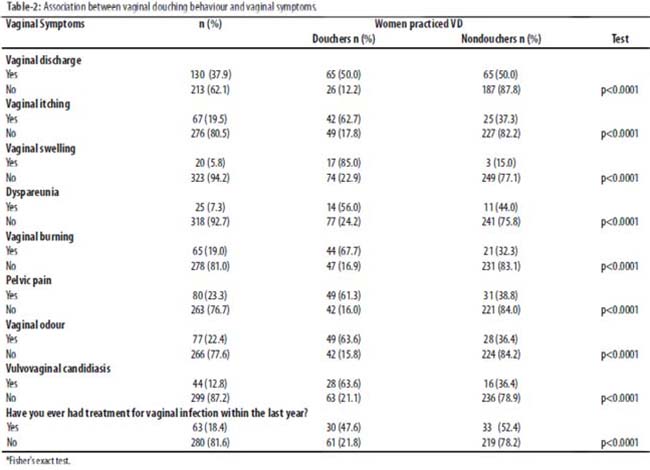
A statistically significant relationship was observed between experiences of vaginal symptoms and performing VD within the preceding year (p<0.05).
Discussion
The prevalence of VD practice within the preceding year by women was 26.5%. According to earlier studies from Turkey, the corresponding rate was 80.7% in Diyarbakir,17 58% in Ankara,19 47.2% in Izmir,2 51.4% in Erzurum1 and 51.6% in Izmir,16 38.6% in Ordu.15 In Antalya, Turkey, 54% women stated that they had practised VD at least once in the preceding 3 months.18 A study among African-American adolescent females demonstrated that 42.5% women had ever douched, 29% reported it in the preceding 90 days.5 According to findings of a study in eight Florida Panhandle countries, 76% women reported having douched at least once.12 A study among military women stated that 54.5% indulged in VD at least once in their time lifetime, 63.5% during the preceding year.13 Prevalence of VD among women depends on geographical locations; 32% in Baltimore,8 46.1% in Alabama,22 57% in Texas;21 37.9% women across the United States reported VD behaviour at least once.9 In the present study the prevalence of VD was lower than those reported in earlier findings.
In the current study, about one-third of women douched every day or at least 1-2 times a week or more than twice a week, and only 4.4% women used VD rarely. One study stated that 73.1% women performed VD regularly.4 In Cambodia, one study demonstrated that 65.6% women practised VD more than once a day.208 A study of VD practice among Latina immigrants reported 25% performed VD regularly, 15% were current regular VD users.6 In the study frequency of VD was similar to some studies in Turkey.1,19
In the present study most women had learned VD from their friends, relatives, mothers and healthcare providers. The finding is similar to those of earlier studies.2,7,12,18,21 Hadimli et al. stated that 40% women had learnt VD from their mothers/relatives/friends.16 Hacialioglu et al. stated that 60.8% women acquired the habit from their elder relatives.1 Another study stated that women who practised VD were more likely to have learnt about douching from their mothers (39.9%), 29.9% of them from television, 20.7% from friends, and 4.6% from healthcare providers.9 Many studies pointed out that the VD behaviours should be accepted as a cultural and traditional habit/or belief and passed down from generation to generation. Health professionals should continue to educate all age groups of women about the risks and adverse outcomes of VD.
In many studies, like in the current study findings, VD has commonly been practised by lower socioeconomically status(educational status of women and income level)1,2,5,8-10,12-14,16-19,23 and increased age.1,5 Some studies stated that VD was not associated with the age and marital status of women.20 The findings were important for healthcare workers who are working in gynaecology, obstetric and public health clinics for giving information about VD for risky groups.
Similar to the study findings, women in Muslim countries mostly prefer water only or water and soap together for VD.1 Only water use for VD behaviour was found in Cambodia (88.4%),20 Antalya, (55.2%)18 Ankara (70%)19 and Izmir, (60%)2 in Turkey. However, commercial and trademark products were used more often in some developed countries.19,25 A study found that 58% women used commercial douching products and 3.7% of them used home-mixed solution such as soda and water, vinegar and water, water, bleach solutions.12 One study found that women who had douched regularly used many other female hygiene products (feminine sprays, wipes, powders) than women who did not do VD.23 Contrary to the findings, as these products were not common in Turkey, in our study only water usage for VD was more frequent.
In the study, since most women believed that VD was beneficial behaviour, they used VD for hygiene, health aims and for decreasing vaginal discharge. Earlier studies also found similar findings about the reasons for VD as follows: genital hygiene and cleanliness,1,2,4-7,9,12,14,17-19,21-25 religious reason (ghusul),1,17,18 to prevent pregnancy,1,9,19 reduce odour/cleaning before or after sexual intercourse and menstruation.1,5-7,9,12,19,21-23 prevention of any vulvovaginal complaints or treatment of infection,12,18,19,23 before having a pelvic exam.23 In the current study, about one-third of women mentioned that their husbands were requesting for VD. Similarly, DiClemente et al. pointed out that three out of four males had positive attitudes towards VD.5 Pleasing the partner was found as another reason in another study.25 Healthcare providers should develop potential strategies to address VD beliefs to counteract misconceptions about the benefits of VD.11 In view of the results of other studies and our findings, it is suggested that health professionals should determine the reasons why women used VD and educate women not only of younger age but also all age groups (their mothers, family members, friends that play an important role in initiating this practice).18 Healthcare professionals should determine women\\\'s beliefs and practice about VD and develop effective educational interventions about vaginal physiology, hygiene and the prevention of vaginal infection to change women\\\'s practice.13
Consistent with the findings in earlier studies,17,19,20 our study revealed that women who practised VD had significantly more vaginitis symptoms (vaginal discharge, swelling, burning, itching, dyspareunia, pelvic pain, vaginal odour and vulvovaginal candidiasis). One study in Turkey found that an odorous vaginal discharge and itching were the most common complaints, followed by dyspareunia and dysuria.17 Hacialioglu et al. stated that vaginal discharge, vulvar pain, vaginal itching or inflammation and vaginal smell was seen in women who douched within the preceding year.1 Association between STD status and VD practice were also investigated in earlier studies, and some of them identified no significant association5 and others defined significant relationships.22 Other studies stated that the prevalence of VD was higher in women who had vulvovaginitis.1,3
It has been reported in literature that VD may result in microfloral changes in vaginal bacteria and may increase the risk of vulvavaginitis, pelvic inflammatory disease (PID), ectopic pregnancy, preterm delivery and cervical cancer. Previous studies also indicated that VD was associated with BV which was related to adverse outcomes such as spontaneous abortion or preterm delivery8,12,13 and trichomoniasis,8,12 vaginal pH over 4.414 and vaginal infections were more common as frequency of douching increased.12 It has been pointed out that VD was one of the main factors for BV which is an important infection that increases transmission of STD and HIV, the most common cause of vaginal discharge in women. In one study BV was found higher in women who had candida vaginitis (85%) and those who had vaginal discharge (15%).25 Many women believed that VD was a health-promoting activity, and for this reason women should be informed about the risk of VD on women\\\'s health. Especially nurses, who work in public health, should communicate with all people to promote sexual health and give information about the risk of VD habits.
Only one out of ten women in the study stated that they had been informed of VD risks by healthcare providers. In Florida, one study underlined that if women had been convinced by healthcare providers, they would have had an impact on their decision to stop douching.12 In the study, after education about adverse consequences of VD, women were influenced by health workers to stop VD.
The current study had some limitations. Firstly, the findings of research cannot be generalised to all women in Turkey. Secondly, self-reported vaginal symptoms were accepted as true without examination. Despite the limitations, the topic was investigated for the first time in Manisa, Turkey. The study findings may contribute to important information about VD and also healthcare providers may consider the topic while taking care of women.
Conclusion
VD was widely practised by women with lower educational status, with unplanned pregnancy, with low income level, women who had someone in their neighbourhood that douched, and women with vaginal symptoms. Cleanliness, prevention of genital infections, cleaning after/before sexual intercourse and during menstruation, prevention of vaginal discharge, decreasing of unpleasant odours and religious beliefs were the most common reasons for using VD. Based on the findings, health professionals should give education to women who had lack of information about VD to stop the behaviour.
References
1. Hacialioglu N, Nazik E, Kiliç M. A descriptive study of douching practices in Turkish women. Int J NursPract. 2009; 15: 57-64.
2. Sen E, Mete S. Vaginal douching practice of women in Turkey. DokuzEylul University School of Nursing Electronic Journal. 2009; 2: 3-15.
3. Giraldo PC, de Carvalho JB J, do Amaral RLG, da SilveiraGonçalves AK, Eleutério J, Guimarães F. Identification of immune cells by flow cytometry in vaginal lavages from women with vulvovaginitis and normal microflora. Am J ReprodImmunol. 2012; 67: 198-205.
4. Khodary MM, Shazly SA, Ali MK, Badee AY, Shaaban OM. The patterns and criteria of vaginal douching and the risk of preterm labor among upper Egypt women. J Low Genit Tract Dis. 2013.
5. Diclemente RJ, Young A M, Painter JL, Wingood GM, Rose E, Sales JM. Prevalence and correlates of recent vaginal douching among African American adolescent females. J PediatrAdolescGynecol. 2012; 25:48-53.
6. Redding KS, Funkhouser E, Garcés-Palacio IC, Person SD, Kempf M C, ScarinciIC. Vaginal douching among Latina immigrants. Matern Child Health J.2010; 14:274-82.
7. Mark H, Sherman SG, Nanda J, Chambers?Thomas T, Barnes M, Rompalo A. What has changed about vaginal douching among African American mothers and daughters? Public Health Nurs. 2010; 27: 418-24.
8. Brotman RM, Klebanoff M, Nansel T, Andrews WW, Schwebke JR, Zhang J et al. A longitudinal study of vaginal douching and bacterial vaginosis-a marginal structural modelling analysis. Am J Epidemiol. 2008; 168:188-96.
9. Cottrell BH, Close FT. Vaginal douching among university women in the southeastern United States. J Am Coll Health. 2008; 56:415-21.
10. Misra DP, Trabert B. Vaginal douching and risk of preterm birth among African American women. Am J ObstetGynecol. 2007; 196:140-e1.
11. Markham CM, Tortolero SR, Addy RC, Baumler ER, McKirahan N K, Escobar-Chaves SL, et al. Factors associated with frequent vaginal douching among alternative school youth. J Adolesc Health. 2007; 41: 509-12.
12. Cottrell BH. Vaginal douching practices of women in eight Florida Panhandle counties. J ObstetGynecol Neonatal Nurs. 2006; 35:24-33.
13. Lowe NK, Ryan-Wenger NA. Factors associated with vaginal douching in military women. Mil Med. 2006; 171: 1015-9.
14. Thorp JM, Dole N, Herring AH, McDonald TL, Eucker B, Savitz DA, et al. Alteration in vaginal microflora, douching prior to pregnancy, and preterm birth. PaediatrPerinatEpidemiol. 2008; 22: 530-7.
15. Erbil N, Alisarli A, Terzi HÇ, Ozdemir K, Kus Y. Vaginal douching practices among Turkish married women. GynecolObstetInvest. 2012; 73:152-7.
16. Hadimli A, Can HÖ, Sogukpinar N, Bozkurt ÖD, Akmese ZB, Koçak YÇ, et al. Do women make vaginal lavage with the aim of genital hygiene? NWSA-Medical Sciences. 2012; 7:16-27.
17. Güzel AI, Kuyumcuoglu U, Celik Y. Vaginal douching practice and related symptoms in a rural area of Turkey. Arch GynecolObstet. 2011; 284:1153-6.
18. Kukulu K. Vaginal douching practices and beliefs in Turkey. Cult Health Sex. 2006; 8:371-8.
19. Karaer A, Avsar AF, Özkan Ö, Bayir B, Sayan K. Vaginal douching practice in Turkish women: who is douching, and why?Aust N Z J ObstetGynaecol. 2005; 45:522-5.
20. Heng LS, Yatsuya H, Morita S, Sakamoto J. Vaginal douching in Cambodian women: its prevalence and association with vaginal candidiasis. J Epidemiol. 2010; 20:70.
21. Short M.B, Black WR, Flynn K. Discussions of vaginal douching with family members. J PediatrAdolescGynecol. 2010; 23:39-44.
22. Annang L, Grimley DM, Hook EW 3rd. Vaginal douche practices among black women at risk: Exploring douching prevalence, reasons for douching, and sexually transmitted disease infection. Sex Transm Dis. 2006; 33: 215-9.
23. Grimley DM, Annang L, Foushee HR, Bruce FC, Kendrick JS. Vaginal douches and other feminine hygiene products: women\\\'s practices and perceptions of product safety.Matern Child Health J. 2006; 10:303-10.
24. Ege E, Timur S, Zincir H, Egri M, Sunar Reeder B. Women\\\'s douching practices and related attitudes in eastern Turkey. J Obstet Gynaecol. Res 2007; 33: 353-9.
25. Alcaide ML, Mumbi M, Chitalu N, Jones D. Vaginal cleansing practices in HIV infected Zambian women. AIDS Behav 2013; 17:872-8.
26. Sumbuloglu K, Sumbuloglu V. Biostatistics. Ankara: Hatipoglu publishing house, 1990; pp 229.
Related Articles
Journal of the Pakistan Medical Association has agreed to receive and publish manuscripts in accordance with the principles of the following committees:


