

Muhammad Sikander Ghayas Khan ( Riphah College of Rehabilitation Science, Riphah International University Lahore. )
Qurrat ul Ain ( Final Year MBBS, Student of Dow University of Health Science, Karachi. )
Syed Imtiaz Hussan ( Riphah College of Rehabilitation Science, Riphah International University Lahore. )
Salman Basher ( Riphah College of Rehabilitation Science, Riphah International University Lahore. )
Humaira Iram ( Riphah College of Rehabilitation Science, Riphah International University Lahore. )
Bilal Umar ( Riphah College of Rehabilitation Science, Riphah International University Lahore. )
February 2015, Volume 65, Issue 2
Original Article

Abstract
Objective: To recognise and identify the importance of Anatomy as a subject for physiotherapists/students.
Methods: The cross-sectional descriptive study was conducted from January to October 2011 at Riphah International University, Lahore, and comprised physiotherapists registered with Pakistan Physical Therapy Association and students pursuing undergraduate physiotherapy studies at the University. A survey proforma consisting of six questions was used for data collection which was analysed using SPSS 17.
Results: Of the 500 questionnaires distributed among physiotherapists and students, 286(57.2%) were collected back duly filled. Overall, 280(97.9%) respondents said Anatomy was important in physical therapy, 179(62.58%) said Anatomy was a difficult subject to retain knowledge of, 155(54.38%) were of the view that only Clinical Anatomy should be studied, 204(71.32%) were in favour of performing dissection, 259(90.55%) found that teaching videos were essential for the study of Anatomy, and 89(31.11%) believed Anatomy could be memorised by multiple readings.
Conclusion: Despite being a difficult subject, Anatomy is an essential subject for medical professionals.
Keywords: Anatomy, Physical therapy, Dissection, Future option, Clinical practice. (JPMA 65: 153; 2015).
Introduction
The word Anatomy is derived from the Greek word Anatomia that is a term derived from anatemnein meaning; \'to cut up\' or \'cut open\'. Anatomy is taught to all 1st year students of medical and allied health subjects, namely doctor of physical therapy (DPT), dentistry, speech pathology and nursing.1 Anatomy has been a major part of the medical curriculum for many years, but in the past few years, the volume of teaching Anatomy has gradually decreased beyond the realm of safe practice in the medical field.2-4 The trend may lead to critical consequences as Anatomy has been a constant element in medical curriculum and provides the very base of medical learning. In the public programme, "Anatomy for Beginners" 94% were of the opinion that doctors should have practical experience of real human anatomy, and it may be a legal claim in the future.5 Diluted focus on anatomy is affecting the quality of surgeons.6
Knowledge of Anatomy helps the doctors to conduct clinical examination, to formulate differential diagnosis, and to connect with other professionals counselling the patients and applying different strategies for treatment. Dissection has been a conventional and leading teaching method, but nowadays the scheme of teaching Anatomy has been modified and includes the inspection of pre-dissected specimens, didactic teaching, use of models, use of 3D imaging computer learning, slides and tapes, and teaching of living and radiological anatomy.7
There is an increasing evidence of group study in the medical field. Team-based learning (TBL) is a useful way of incorporating interactive learning. As medical schools are creating integrated and interdisciplinary courses during the preclinical years, TBL is particularly useful because of its emphasis on teamwork, and problem solving for clinical application. Good strategies for memorising gross anatomy is TBL, because it requires students to learn anatomical facts out of which they form anatomical concepts for clinical problem-solving. TBL also requires regular preparation and attendance.8
Doctors are potential individuals who teach Anatomy in medical schools.9-11 Due to deficiency of anatomists, surgeons are teaching Anatomy in USA, and in UK, medical doctors are teaching Anatomy as temporary lecturers. Major factors that influence the decision to select teaching as a career path are: career succession, teacher as a role model, love of Anatomy, and interest in the subject. Other less important reasons are: personal interest and lifestyle, income also influences the choice of career among medical students. Most medical doctors develop interest in this specialty during their house job training and that has an important influence on career choice.9
Subjects and Methods
The cross-sectional descriptive study was conducted from January to October 2011 at Riphah International University (RIU), Lahore. At the time of the study, 700 physiotherapists were registered with Pakistan Physical Therapy Association, and there were 400 DPT students enrolled with RIU. On the basis of convenience sampling, the sample size was calculated using the formula N=N/1+Ne2. A survey proforma containing six questions was used for data collection. To each question, there were three options; A (agree), B (disagree) and C (do not know). The collected data was analysed using SPSS 17.
Results
Among the possible 1,100 physiotherapists and students, 500(45.45%) questionnaires were distributed and 286(57.2%) of them were collected back duly filled. There were 81(28.32%) Post-Professional Doctor of Physical Therapy (PPDPT) practitioners, and 205(71.67%) undergraduate DPT and B.Sc. Physiotherapy students.
Overall, 280(97.9%) respondents said Anatomy was important in physical therapy, while 6(2%) did not agree. Replying to the second question, 179(62.58%) said Anatomy was a difficult subject to retain knowledge of, while 103(36%) did not agree. Further, 155(54.38%) were of the view that only Clinical Anatomy should be studied, but 128(44.75%) disagreed. In answer to the third question, 204(71.32%) were in favour of performing dissection for understanding the subject and retaining the knowledge, but 87(27%) did not think so. Besides, 259(90.55%) found that teaching videos were essential for the study of Anatomy, while 21(7.3%) did not share the opinion. Finally, 89(31.11%) believed Anatomy could be memorised by multiple readings, but 150(52.44%) disagreed (Table).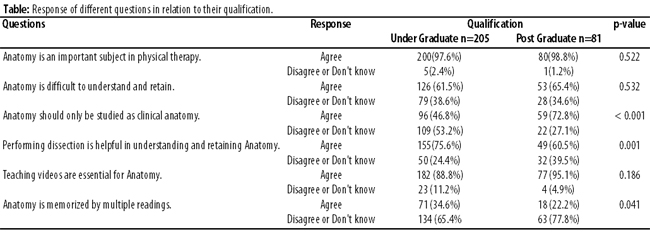
Discussion
Results of the study emphasise the importance of the teaching methods of Anatomy for physiotherapists. Clinical Anatomy is considered a pillar in the practice of physiotherapy.12 Results highlight the importance of anatomy, as 98% subjects agreed that Anatomy was an important subject while only 2% had a different opinion. Similar significant results were obtained in a study conducted in Nigeria where 98% of 353 subjects agreed with this concept.9 In our study, 63% subjects said Anatomy was difficult to understand and memorise, while 36% disagreed with the opinion. In a study done at a medical school in southern India, first year students said Anatomy was not only difficult to learn but also may not be appreciated easily. A good 71.23% of our participants believed that performing dissection is helpful in understanding Anatomy and retaining the knowledge. Dissection provides three dimensional view of structures and is a good method for learning linkages and positions that are difficult to rote-learn and that is why students supported Anatomy.5 Anatomical knowledge is more important in future medical professionals, therefore to find out the exact need of dissection more research on Anatomy is needed.13 Besides, 90.55% respondents in our study agreed that teaching videos were essential for teaching Anatomy. Visual information is more useful and helps in learning and retaining the knowledge for a longer time and it can be recalled immediately. Computer-aided instructions are essential in this regard. In all areas of medical education, this modality has great potential. The formation of high-quality graphics is necessary in the study of Anatomy as it is a descriptive science as well as a highly visual-oriented discipline. Despite the presence of multimedia facilities, there are still reservations about their usage on a routine basis. It is clear that there is a continuous need for research to authenticate and validate the reservations.12
Conclusion
Despite being difficult, Anatomy is an essential subject in medical and allied health professions, as it is a direct method that helps students deepen their understanding and knowledge of the human body. Since its beginning, anatomical information is delivered through lectures, demonstrations, and problem-based laboratory sessions, reinforced by dissection of cadavers and other visual aids. Further research is recommended with larger sample size.
References
1. Vishnumaya G, Ramnarayan K. An appraisal of anatomy teaching and learning by undergraduate nursing students in a multiprofessional context: a study done at a medical school in South India. Bratislavské lekárske listy 2009;110:506.
2. Collins TJ, Given RL, Hulsebosch CE, Miller BT. Status of gross anatomy in the U.S. and Canada: Dilemma for the 21st century. Clin Anat 1994;7:275-96.
3. Utting M, Willan P. What future for dissection in courses of human topographical anatomy in universities in the UK? Clin Anat 1995;8:414- 7.
4. Cottam WW. Adequacy of medical school gross anatomy education as perceived by certain postgraduate residency programs and anatomy course directors. Clin Anat 1999;12:55-65.
5. Turney B. Anatomy in a modern medical curriculum. Ann Royal Coll Surg Engl 2007;89:104.
6. Older J. Anatomy: a must for teaching the next generation. Surgeon 2004;2:79-90.
7. Kerby J, Shukur ZN, Shalhoub J. The relationships between learning outcomes and methods of teaching anatomy as perceived by medical students. Clin Anat 2011; 24: 489-97.
8. Vasan NS, DeFouw DO, Compton S. A survey of student perceptions of team?based learning in anatomy curriculum: Favorable views unrelated to grades. Anat Sci Educ 2009;2:150-5.
9. Oluwatoyin O, Uvie O, Grace A. The prospect of anatomy as a career choice among clinical year medical students in Nigeria. Ann Afr Med 2009;8:90-4.
10. Willan PL, Whitimor I, Humpherson JR. Career progress of temporary lecturers in anatomy: A surgical success story. Clin Anat 1998;11: 50-4.
11. Anand MK, Raibagkar CJ, Ghediya SV, Singh P. Anatomy as a subject and career option in view of medical studentsin India. J Anat Soc India 2004;53:10-4.
12. Lee HB, Allison G, editors. A comparative study of the presentation of anatomy by lectures versus ICAL packages to physiotherapy students. Proceedings of the International Interactive Multimedia Symposium; 1992.
13. Winkelmann A. Anatomical dissection as a teaching method in medical school: a review of the evidence. Med Educ 2007;41:15-22.
Related Articles
Journal of the Pakistan Medical Association has agreed to receive and publish manuscripts in accordance with the principles of the following committees:


