

Gulistan Erdal ( Department of Agricultural Economics, Gaziosmanpasa University, Tokat, Turkey. )
Hilmi Erdal ( Department of Technical Programs, Tokat Vocational School, Gaziosmanpasa University, Turkey. )
Kemal Esengun ( Faculty of Economics and Administrative Sciences, Akdeniz University Antalya, Turkey. )
Gungor Karakas ( Gaziosmanpasa University Hospital, Biochemistry Laboratory, Tokat, Turkey. )
February 2015, Volume 65, Issue 2
Original Article

Abstract
Objective: To investigate smoking habits, related factors and level of consciousness among college students in Turkey.
Methods: The study was conducted at Gaziosmanpasa University, Tokat, Turkey, in May 2013. Data was obtained through face-to-face questionnaires. It was tested using Binomial Logit Regression Model. In addition, students were asked to answer a five-score question group in order to determine the reflections and judgments of smoker students.
Results: Of the 253 students in the study, 125(49%) were males. Overall, there were 101(40%) smokers. Smoking ban was found to lower cigarette smoking among the smokers (p<0.0001). On the other hand, smoking habit of parents and friends, income levels and differences in places where they lived positively affected cigarette smoking (p<0.05).
Conclusion: Tobacco policies and precautions taken to lower tobacco use resulted in considerable decrease in cigarette consumption.
Keywords: Education, Tobacco control, Youth cigarette use. (JPMA 65: 136; 2015).
Introduction
Tobacco consumption is among the leading causes of preventable death cases in the world. It kills about 6 million people worldwide and results in damage worth hundreds of billions of dollars each year. Most of the deaths take place in relatively poor countries. This fact is expected to be more prominent in the decades to come. By 2030, tobacco is expected to kill more than 8 million people worldwide each year; 80% of them being in low- and middle-income countries. It is estimated that tobacco consumption could lead to the death of a billion people unless action is taken.1
According to World Bank income ranking, Turkey is in the middle-income group based on the year 2009. Percentage of population using any tobacco product is 46.6% among males and 14.5% among females. Among youngsters within 13-15 age group, 6.9% are active cigarette smokers and 89.3% are affected as second-hand smokers at home.2 Tobacco consumption is the leading death cause for males in Turkey (38%) and Kazakhstan (35%). The greatest portions of female deaths as a result of tobacco consumption are in Maldives (25%) and the USA (23%).2
One of the major consequences of increased tobacco consumption in Turkey is the elevated number of lung cancer cases. There was a 45-fold increase in the number of patients admitted to hospitals with lung cancer diagnosis in the 40-year period from 1960 to 2004. During the same period, the increase in the population of Turkey was only 2.5 fold.3
The government of Turkey is determined to build a \'Smoke Free Turkey\', and a survey called Global Adult Tobacco Survey (GATS) was conducted to reveal the tobacco consumption status of Turkey. This report could be beneficial for monitoring the MPOWER (Monitor tobacco, Protect people, Offer help, Warn, Enforce bans, Raise taxes) policy package for tobacco control in Turkey.3
There are many reasons for cigarette consumption such as stress reduction, problems about life, peer pressure, desire for social acceptance, family history (taking the smoking parent as role model), low educational level and poverty. Younger smokers, on the other hand, generally smoke since they think it makes them look mature and increases their self-respect and freedom.3
Tobacco use, whether in smoking or other forms, has been rising in recent years in low- and middle-income countries (LMICs) and is expected to account for 80% of global tobacco use by 2025.4 Unlike the developed countries where cigarette consumption among school-age children has been decreasing, cigarette consumption in developing countries are on rise among school children.5
The present study was planned to investigate cigarette consumption habits, related factors and level of consciousness among college students in a university in Turkey, a developing country. One of the reasons to investigate the level of consciousness was to find out the prejudices about cigarette smoking, and the other was to reveal the effect on students of measures taken by Turkish government against tobacco use to protect people.
Subjects and Methods
The study was conducted at Gaziosmanpasa University, Tokat, Turkey, in May 2013. A face-to-face questionnaire was administered to the participating students. Gaziosmanpasa University is located in the Black Sea region of Turkey and accepts students from all over the country. The total number of students at the university was 20,659 in 2011. Students from the Faculty of Arts and Sciences, Faculty of Agriculture, Faculty of Economic and Administrative Sciences, Faculty of Education, College of Physical Education and Sport, Tokat Vocational School of Health Services and Tokat Vocational School were part of the study sample. Total number of students in these schools was 12,338.
The sample size was determined using Equation 1.6
N= NPQZ2 / [(N-1)d2 + PQZ2 = (1)
Where n was sample size; N was the number of students in target population;
P was probability of smoking in students (50% hypothetical);
Q was the probability of non-smoking students (1-P); Z was the Z value (e.g. 1.65 for 90% confidence level); and d was tolerance (0.05).
Students in each school, gender and daytime/night time status were proportionally sampled based on their percentage within the total student number. Thus a homogenous distribution was achieved within the university.
Semi-structured pre-tested questionnaire forms were filled regarding tobacco consumption practices.
Data on tobacco consumption and other variables such as age, gender, origin of students, reasons for smoking, age at initiation of smoking, knowledge regarding harmful effects of tobacco and reflections and judgments of smoker students were obtained. All the variables were analysed using SPSS version 20 and EViews 5.0. Binomial Logit Regression Model was used to determine the relationship between socio-economic status of the students and their smoking preferences, because there were only two alternatives for tobacco consumption, i.e. smoking or non-smoking.
Models in which dependent variables take the values 0 or 1 are known as discrete variety models. Logit and Probit models are set on the basis of response variable whether they are created as \'yes\' or \'no\'. Least squares method cannot be applied in discrete dependent variable models because their error terms are not in normal distribution and they have different variances.
On the other hand, in Binomial Logit Model, R2 is not considered an appropriate measurement for the fitness of the model.7 However, many alternatives have been proposed as a measurement for the fitness of the model.8-11 McFadden-R2 value based on likelihood ratio (LR) test has been one of the most commonly used criteria.12 This value was also used in the present study to evaluate the fitness of the model.
Logit models are generally used in order for the estimated values of dependent variables to be between 0 and 1 in general. Binomial Logit Model has the feature that supposes the estimated value of probability to be between 0 and 1. A probability model of bivalent dependent variable as a Logit Model is:13
Pi = E(Yi = 1/Xi) = 1 / 1+e-(b1+ b2 ci)
In our study, ci was a vector of socioeconomic and demographic characteristic of students and b denoted a vector of parameters to be estimated. Parameters of Binomial Logit Model were estimated using maximum likelihood (ML) method.7
Factors affecting cigarette smoking of students were also determined. At first, many factors were studied using simple regression analysis. The ones that turned out to be statistically significant were taken to the multiple model and thus the best model was worked out.
Finally, Binary Logit Model was established as follows:
SMOKING = b0 + b1SMOKBAN+ b2INC + b3MOM + b4DAD + b5FRIEND + b6RESI.
In the study, SMOKING meant a student\'s smoking preference (smoking 1, non-smoking 0); SMOKBAN meant to find out if smoking ban lowered cigarette consumption (yes = 1, no =0); INC meant student\'s income (more than 403 Turkish Lira [TL] = 1, less than 403 TL = 0); MOM meant a smoking mother (yes = 1, no =0); DAD meant a smoking father (yes = 1, no =0), FRIEND meant a smoking close friend (yes = 1, No =0); RESI meant student\'s residence (urban =1, otherwise = 0 ; rural = 1, otherwise = 0).
Results
Of the 253 students in the study, 125(49%) were males. Overall, there were 101(40%) smokers (Table-1).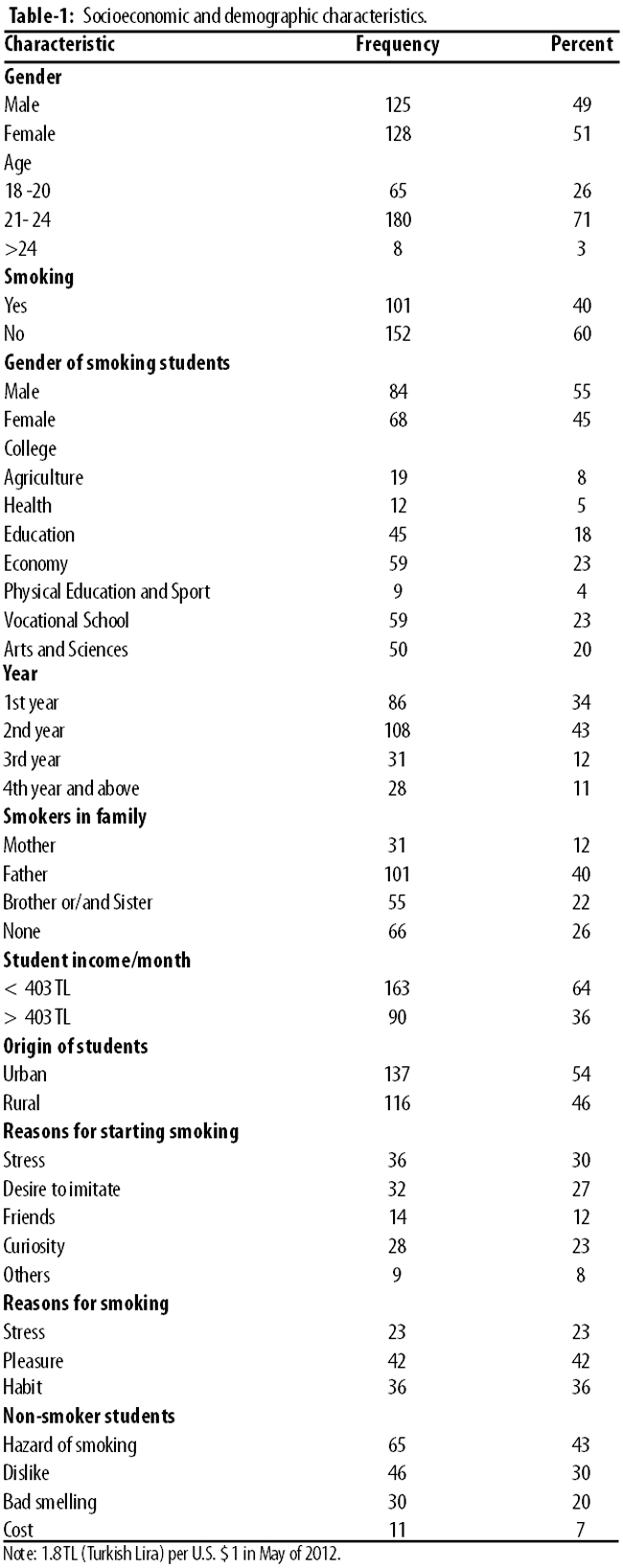
The mean daily number of cigarettes used by the smokers was 18.46. Among the students, 187(74%) had at least one smoking person in the family. In the families of smoking students, percentages of smoking mothers, fathers and brothers/sisters were 17%, 44% and 25% respectively. In the families of non-smoking students, on the other hand, percentages of smoking mothers, fathers and brothers/sisters were 9%, 36% and 18% respectively. There was no smoking member in the families of 38% of the smoker students.
The average amount of monthly support from the family was 403 Turkish Lira (TL). Of these students, 38% smoked. Average monthly family support of smoking students was 429 TL, while that of non-smoking ones was 387. The monthly cigarette cost of a smoking student was 140 TL, which was about one-third of the support they got from their families.
Students had different reasons to start smoking, including stress 36(30%), desire to imitate 32(27%), curiosity 28(23%), friends 14(12%) and others 9(8%). The reasons to continue smoking, on the other hand, were pleasure 42(42%), habit 36(36%) and stress 23(23%). Percentage of non-smoker students who smoked earlier was 11.07%. The reasons given by non-smoker students for not smoking were the hazard of smoking 65(43%), dislike 46(30%), bad smell 30(20%) and its cost 11(7%).
There was no clear differences among different years of college and 41%, 36%, 48% and 43% of the students in the first, second, third and fourth year of college were smokers, respectively.
As for reflections and judgments of students towards smoking, 93.2% of the smoker students believed that smoking is harmful to health (average score 1.3) (Table-2).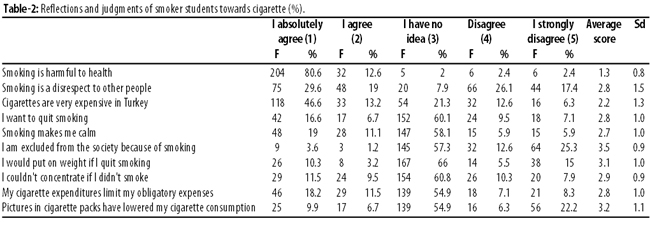
The ones who considered it unrespectful attitude were 48.6%, while who did not were 43.5%. Those who considered the price of cigarettes to be very high were 59.8%, while 18.9% considered not expensive and 21.3% had no idea.
Besides, 37.9% students did not agree that the smokers were excluded from society and 57.3% had no idea.
Further, 29.7% mentioned that smoking costs limited their obligatory expenses, while 15.7% did not agree. Of the smoker students, 16.6% said that they were affected by pictures on cigarette packs and 28.5% said they were not.
Based on the results of Logit Model, probability statistics, equivalent of F-statistics in the Model, was significant at 1% level of probability. McFadden R-square value, which shows the explanatory power of the model, was 0.4355 (Table-3).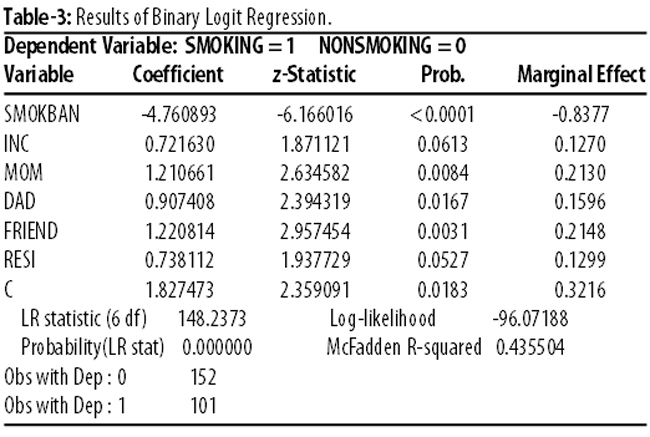
Factors significantly affecting the smoking behaviour were smoking habits of mother and close friend (p<0.01). Effects of father\'s smoking and the place of living were significant at 5% level of probability and positive, while that of student\'s income was significant at 10% level of probability and positive.
The smoking ban negatively affected the cigarette consumption preferences of the students at 1% level of probability. As it can be seen from the marginal effect of this variable, each unit of increase in smoking bans resulted in a 0.84 units of decrease in cigarette consumption. Finally, the cigarette consumption probability of a student with an income of at least 403 TL and coming from urban areas, whose parents and friends were smoking and whose consumption was affected by the regulations against smoking was 77%.
The cigarette consumption probability of a student with an income of at least 403 TL and coming from urban areas, whose parents and friends were smoking but whose consumption was not affected by the regulations against smoking was 99%.
Discussion
Investigations into the frequency of smoking among children and the young show different ratios in different parts of the world. About one-third of high school students in the US were reported to be smokers.14 Another study comprising primary, secondary and high school students in the US found that smoking percentage among all school children was 15%.15 This percentage was 21.4% in Italy.16 The present study found 40% smoking prevalence among university students.
Among the factors that promote young people to start smoking are family members (mother, father, brothers and sisters) and friends.17,18 Another study in Jordan pointed out the effect of friends as the single most important factor for students to start smoking.19
Our study found that 86% of the smoking students had at least one smoking person in the family. In the families of smoking students, percentages of smoking mothers, fathers and brothers/sisters were 17%, 44% and 25%, respectively.
A study on college students in China showed that women do not smoke, while 37.7% of men did.20 Cigarette offering and sharing, uncommon behaviours in other cultures, are common and considered good in China in general.21 Cigarette offering and sharing strongly promotes initiation of smoking and results in failure of the efforts to quit smoking among Chinese men. In a study, data from 6,426 young people was analysed using Multinomial Logistic Regression. This study showed a significant protective effect of family against cigarette use in all ethnic groups.22 In our study, families of the students were found to be a significant factor in cigarette use.
In another study conducted in Ghana, tobacco use was found to be significantly higher in poor regions, among people with lower level of education, lower income, among people using alcohol and among parents. Tobacco use was 7% among males and 0.4% among females. Tobacco use was also found to be associated with low probability of purchasing a health insurance plan.23 In a study conducted in Pakistan, tobacco use was 36% in males and 9% in females. Smoking was also found to more prevalent in illiterate, married persons and those with poor general health.24 In our study, 40% people (55% males and 45% females) were smokers.
In another study conducted in Pakistan, high proportion of people, including men and women, consumed tobacco. Most of them were unaware about tobacco consumption hazards, and passive smoking.25
Our study specifically located the beneficial effects of smoking bans on lowering cigarette consumption. In high-income countries, policies for smoke-free public areas and workplaces lowered tobacco consumption to as low as 3-4%.26 In addition, quitting success of smokers in smoke-free workplaces were twice as successful as those of the ones in workplaces where smoking was allowed.27
Some studies were also conducted among university students, including medical school students. Smoking prevalence among university students ranged between 7.8% and 58.0%. Among university students, smoking prevalence was much lower among first-year students and increased as the years passed.28-30 One study31 investigated smoking prevalence and its determinants among fourth- and fifth-year students in southern Turkey. Among students, smoking prevalence was quite high and increased with age (ranging from 26.6% to 43.7%). The smoking behaviour of \'best friends\' was the most powerful determinant of smoking and this was consistent across age groups.
Conclusion
Smoking is a major health problem all over the world. Strict applications of tobacco control programmes can lower cigarette consumption. As quantitatively proven in the present study, tobacco policies and precautions taken to decrease tobacco use implemented in Turkey have undeniably resulted in considerable decrease in cigarette consumption. . However, in addition to smoking bans, stronger precautions are still needed, especially in schools. If this is done, Turkey, with its determined and strong stance against smoking, will provide a role model for other countries.
References
1. World Health Organization WHO. Report on the global tobacco epidemic, 2011. [online] [cited 2012 Oct 12]. Available from: URL: http://whqlibdoc.who.int/publications/2011/9789240687813_eng.pdf.
2. Tobaccoatlas. 4th ed. [online] [cited 2012 Jun 12]. Available from: URL: http://www.tobaccoatlas.org/harm/deaths/male_deaths_pdf.pdf.
3. The Ministry of Healty of Turkey. Ministry of Health, Primary Health Care General Directorate, Global adult tobacco survey (GATS) Turkey report, 2010. [online] [cited 2011 Aug 3]. Available from: URL: http://www.who.int/tobacco/surveillance/en_tfi_gats_turkey_2009.pdf.
4. Kegler M, Kingsley B, Malcoe L, Cleaver V, Raid J, Solomon G. The functional value of smoking and non-smoking from the perspective of American IndianYouth. Family Community Health 1999; 22: 31-42.
5. Nelson D, Giovino G, Shoplard D, Mowery P, Mills S, Eriksen, M. Trends in cigarette smoking among US adolescents, 1974 through 1991. Ame J Public Health 1995: 85: 34-40.
6. Akbulut Ö, Yildiz N. Basic Formulas and Tables in Statistical Analysis. Erzurum-Turkey: Aktif Publishing House.; 1999
7. Thomas RL. Modern Econometrics: An Introduction. New York: Addison-Wesley; 2000.
8. McFadden D. The measurement of urban travel demand. J Public Eco 1974; 3: 303-28.
9. Ben-Akiva ME, Lerman SR. Discrete choice analysis, theory and application to predict travel demand. London: MIT Press; 1985
10. Kay R. Little S. Assessing the fit of the logistic model: a case study of children with haemolytic uraemic syndrome. Applied Stat 1986; 35: 16-30.
11. Cramer J. Predictive performance of the binary logit model in unbalanced samples. Statistician 1999; 48: 85-94.
12. Neyman J, Pearson ES. On the use and interpretation of certain test criteria for purposes of statistical inference. Biometrika 1928; 20: 175-240
13. Davidson R, Mackinnon JG. Econometric theory and methods. New York: Oxford University Press, 1999.
14. Durant RH, Smith JA. Adolescent tobacco use and cessation. Primary Care 1999; 26: 553-75.
15. Coogan PF, Adams M, Geller AC, Brooks D, Miller DR, Lew RA, et al. Factors associated with smoking among children and adolescents in Connecticut. Am J Prev Med 1998; 15: 17-24
16. Effuso L, Barra D, Del Castello E, Gaeta L, Gaeta G. Factors influencing the age at which adolescents start smoking. A comparison between a big and a small city. Ital Heart J; 2002: 1: 64-8.
17. Lam TH, Chung SF, Betson CL, Wong CM, Hedley AJ. Tobacco advertisements: one of the strongest risk factors for smoking in Hong Kong students. Am J Prev Med 1998; 14: 217-23.
18. Molyneux A, Lewis S, Antoniak M, Hubbard R, McNeill A, Godfrey C, et al. Is smoking a communicable disease? Effect of exposure to ever smokers in school two groups on the risk of incident smoking in the firs tyear of secondary school. Tob Control 2002; 11: 241-5.
19. Haddad L, Malakeh G, Malak Z. Smoking habits and attitudes towards smoking among university students in Jordan. Int J Nursing Studies 2002; 39: 793-802.
20. Xiang H, Wang Z, Stallones L, Yu S, Gimbel HW, Yang P. Cigarette smoking among medical college students in Wuhan, People\'s Republic of China. Prev Med 1999; 29: 210-5.
21. Kohrman M. Depoliticizing tobacco\'s exceptionality: Male sociality, death and memory-making among Chinese cigarette smokers. China J 2007; 58: 85-109
22. Mahabe-Gittens EM, Xiao Y, Judith SG. The role of family influences on adolescent smoking in different racial/ethnic groups. Nicotine Tob Research 2012; 14: 264-73.
23. John RM, Mamudu HM, Liber AC. Socioeconomic implications of tobacco use in Ghana. Nicotine Tob Research 2012;14:1205-12.
24. Alam SE. Prevalence and pattern of smoking in Pakistan. J Pak Med Assoc 1998; 48: 64-8.
25. Nisar N, Qadri MH, Fatima K, Perveen SA. Community based study about knowledge and practices regarding tobacco consumption and passive smoking in Gadap Town, Karachi. J Pak Med Assoc 2007; 57: 186-8.
26. Fichtenberg CM, Glantz SA. Effect of smoke-free workplaces on smoking behaviour, systematic review. Br Med J 2002; 325: 188.
27. Bauer JE, Hyland A, Li Q, Steger C, Cummings KM. A longitudinal assessment of the impact of smoke-free worksite policies on tobacco use. Am J Public Health 2005; 95:1024-9.
28. Demirel Y, Sezer RE. Smoking prevalence among University Students in Sivas region. Erciyes Med J 2005; 27: 1-6.
29. Ilhan F, Aksakal FN, Ilhan MN, Aygün R. Smoking prevalence among Gazi university faculty of medicine. TAF Preventive Med Bulletin 2005; 4: 188-98.
30. Özen S, Ari M, Gören S, Palanci Y, Sir A. Rates of smoking and alcohol use among class-1 and class-6 medical faculty students. Anadolu Psikiyatri Dergisi 2005;6:92-8.
31. Akpinar E, Yoldascan E, Saatçi E. The smoking prevalence and the determinants of smoking behavior among students in Cukurova University, Southern Turkey. West Indian Med J 2006; 55: 414-9.
Related Articles
Journal of the Pakistan Medical Association has agreed to receive and publish manuscripts in accordance with the principles of the following committees:


