

Rehana Rehman ( Department of Biological and Biomedical Sciences, Aga Khan University, Karachi. )
Ambreen Usmani ( Department of Anatomy, Bahria University Medical and Dental College, Karachi. )
Quratulain Omaeer ( Department of Anatomy, Bahria University Medical and Dental College, Karachi. )
Hina Gul ( Research Analyst, SMAR International (Pvt) Ltd. )
December 2014, Volume 64, Issue 12
Original Article

Abstract
Objective: To evaluate the effectiveness of mentorship programme with respect to emotional wellness of medical students.
Methods: The cross-sectional questionnaire-based survey was carried out from March 2009 to February 2013 comprising first year medical students of five consecutive batches from two medical colleges. They were divided into two groups; Group A had non-mentored students from a medical college in Karachi, while Group B had mentored students of Bahria University Medical and Dental College, Karachi. Responses on aspects of emotional wellness was taken on a 4-point Likert scale; never, sometimes, mostly and always. Predictive Analysis Software version 18 was used for statistical analysis.
Results: Out of the 500 questionnaires distributed to each batch, 423(84.6%) were returned filled in Group A and 450(90%) in Groups B. Overall, 873(87.3%) responses were obtained. Group A had 275(65%) females whereas in Group B there were 275(61%) females. The mean age of the overall study population was 20±2 years. The scores of emotional wellness were better in Group A compared to Group B 21.36±4.54 vs. 20.54±4.340 (p<0.028). The feeling of being cheerful and helpful was valued by 212(50%) students of Group A and 180(40%) of Group B (p<0.008). The satisfaction of being needed by family members and recognising stresses of life was significant in Group A (p<0.0001 vs. p<0.014). Group B had low emotional wellness scores yet 369(82%) had never consulted psychologists and psychiatrists compared to 13(0.03%) of Group A (p<0.02). Help from family members was also acquired by non-mentored students (p<0.003).
Conclusion: Emotional support provided by mentoring programme of Bahria University Medical and Dental College minimised the stress, limited consultation by psychologists or psychiatrists, and reduced reservations of parents and students of first year medical education.
Keywords: Mentoring, Mentors, Emotional wellness, Emotional intelligence. (JPMA 64: 1352; 2014).
Introduction
The concept of mentoring dates back to the Greek era when Odysseus, a great warrior in Greek mythology, left for Trojan war and entrusted his friend Mentor for guidance of his son Telemachus. "Mentor" is a trustworthy guide or a counsellor who has enormous contributions in shaping up his/her mentees\' personality.1 The practice of mentoring commenced as an essential feature of career development of medical students in the late 1990s.2 Medical colleges induct students from diverse ethical and educational backgrounds who are now exposed to a new, stressful, demanding and voluminous curriculum.3,4 Mentoring programmes are thus designed for providing support and encouragement to the mentees right from the start of their medical career.1
Wellness is based on modifications required for successful existence of mind, body and spirit of medical students.5 Emotional wellness (EW) is one of the spokes of the wellness wheel which is preordained to have an optimistic approach, high self-esteem, with the ability to identify and share a wide range of feelings among each other in an affirmative manner. Emotions have strong impact on individual\'s moods and thoughts, and drive one\'s interests throughout the day and night.6 A study mentioned that positivity in emotions and life can certainly improve quality of life, performance and help an individual live longer.7
The medical school curriculum is designed to comply with the objectives of medical training to achieve competence in the required skills, knowledge, personal and professional development.8 The purpose of medical training is to produce highly talented, well educated and proficient physicians who acknowledge their responsibilities. There is a direct relationship between personality and performance and this relationship becomes increasingly meaningful as learners advance through medical training. It has been proven by many researches that mental health declines after students start their medical college.9 The training also exerts some negative effects on mental and emotional health of medical students and develop psychological stress which may show the way to harmful consequences like poor academic performance and lessened competence skills.10
The structured mentorship programme at Bahria University Medical and Dental College (BUM&DC) has been in place for the past five years. Students get acquaintance about structured mentoring, mentors and mentoring groups during the first week of their admission in an ice-breaking session. For 10 mentees, there is one mentor. Each group spends most of the first week with their assigned mentor. The objective is to acclimatise students to their mentors as well as with the environment of the university. When the academic session begins, the mentees meet their mentor once a week which is part of the weekly schedule and at this time both the mentor and the mentee are given time to interact with one another. The mentors maintain a portfolio for achievements and issues of mentees; nevertheless the mentor has the authority to decide if she/he wants to withhold some information of their mentee due to privacy and confidentiality (Annexure). The mentors communicate with their supervisors for additional issues and counselling, if required. All the supervisors then discuss various issues with the academic coordinator who is the overall in-charge of the mentoring programme. The meeting of academic coordinator with supervisors is held on the last Friday of each month.
The role of mentoring programme for medical students to overcome the difficulties faced by medical students has been extensively evaluated by a number of researchers. A study mentioned that mentors in a mentorship programme engage selflessly in recreating their mentees both professionally and personally.11 The role of mentors in imparting emotional aide and boost-up for the mentees has also been observed by others. Mentors support to withstand psychological stress and provide a support system for their mentees was noticed by a study.12 It was observed that a healthy mentor-mentee relationship fortified self-learning, developed confidence and high self-esteem in the mentees for their career and personality building.13 The mentees received social support, emotional assistance, reassurance and guidelines from the mentors who were their role models and career guides with the help of a number of structured mentoring programmes.11,13 We designed this study to observe the effect of structured mentoring programme on EW of medical students.
Materials and Methods
The cross-sectional questionnaire-based survey was conducted from March 2009 till February 2013 after approval from Research and Ethics Committee of BUM&DC. Data was collected by convenience sampling over a period of five years during which 100 students each from consecutive batches of first year from BUM&DC and another medical college without a mentoring programme were involved. Group A students were those not exposed to a mentoring programme whereas students of BUM&DC who had at least three mentoring sessions comprised Group B. Students of both genders, aged 18-24 years, belonging to all ethnic groups who gave consent were included. Students with acute or chronic illnesses were excluded. In order to achieve 80% power with a 15% estimated prevalence in project area and a two-sided 5% level of significance, the minimum sample size calculated for both the groups was 260.14 The close-ended questionnaire tailored from the Wellness Wheel evaluated aspects of EW on four points ranked \'never\', \'sometimes\', \'mostly\', \'always\' (Annexure) and numbered 0-4 from the lowest to the highest ranks.15 The survey was carried out after taking consent from the respective Deans of A and B groups. The students were given briefing about the objective of the research.
Computation of frequency, proportion and percentages was executed with the help of Predictive Analysis Software (PASW) version 18. Mean and standard deviation were computed for continuous variables. Scores of EW in each group were compared by simple proportion testing. The comparison of categorical variables of EW in Group A and B was done by chi-square test, and p value less than 0.05 was considered significant.
Results
Out of the 500 questionnaires distributed to each batch, 423(84.6%) were returned filled in Group A and 450(90%) in Group B. Overall, 873(87.3%) responses were obtained. Group A had 275(65%) females whereas in Group B there were 275(61%) females. The mean age of the overall study population was 20±2 years. The scores of emotional wellness were better in Group A compared to Group B 21.36±4.54 vs. 20.54±4.340 (p<0.028).
In Group B, 222(49%) sought advice from the mentors: 85(19%) always, 92(20%) mostly, and 145(33%) sometimes, whereas 128 (28%) never sought mentor\'s help.
The mean EW scores in Group A vs. Group B were 21.36±4.54 vs. 20.54±4.340 (p<0.028). Item analysis of EW showed that in Group A, 212(50%) were more cheerful and hopeful compared to 180(40%) in Group B (p<0.08). Self-exploration and improvement was valued by 317(75%) in Group A compared to 275(61%) of Group B (p<0.001). The satisfaction of being needed and valued by family members was possessed by 335(79%) students of Group A and 288(64%) in Group B (p<0.0001). Besides, 190(45%) of the non-mentored students of Group A were able to recognise stresses of life compared to 158(35%) of the mentored Group B (p<0.014)). In Group B 182(40%) students were able to overcome anxiety attacks themselves compared to 17(0.04%) in Group A (p<0.001) (Table-1).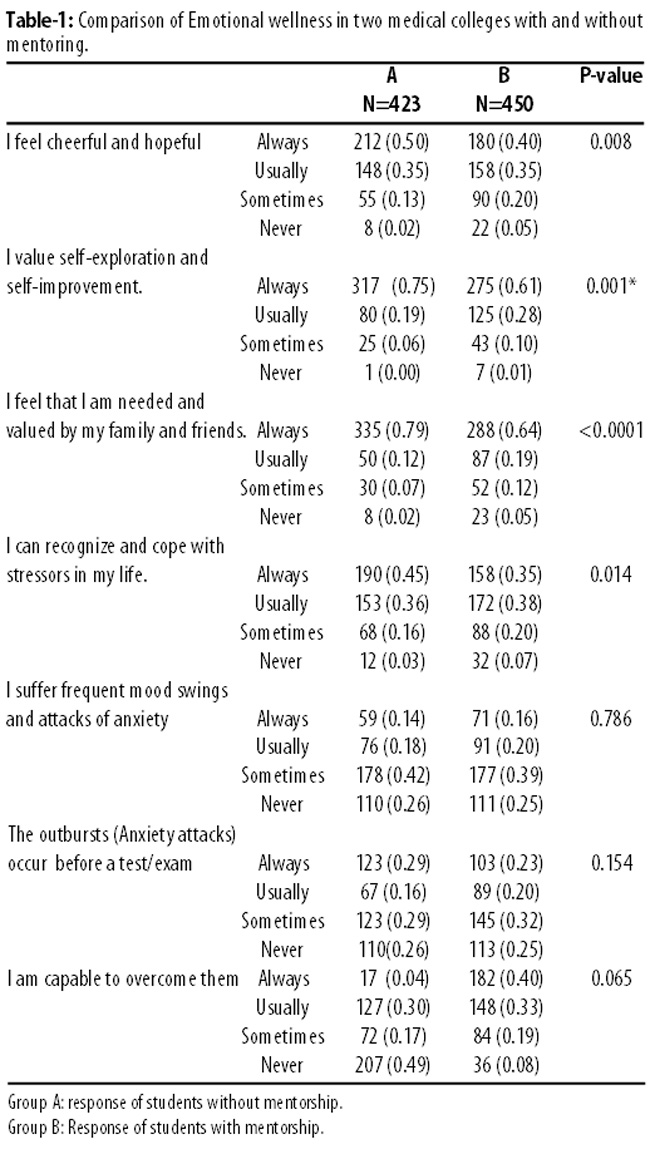
Even though students of Group A had good EW scores, 381(90%) had to take help from psychologists and psychiatrists off and on compared to 32(7%) of Group B (p<0.02). In Group B, 179(40%) students were able to help others during emotional outbursts compared to 17(0.04%) in Group A (p<0.09). The non-mentored Group A was supported by family members whereas relatives were not bothered by the mentored Group B (p<0.003) (Table-2).
Discussion
The large-scale study of medical students found that EW was related to some sort of support. This support can be in the form of family, friends or mentors. In our study those students who craved for family, friends or psychological support were the ones who had no mentor assigned to them. Although they were found to have a better EW score, but very few were found to be able to overcome anxiety and be a helping hand to others.
It is seen that emotional instability is usually at its peak during the years of adolescence. It has been reported by many studies that medical studies enhance stress and frustrations, forcing the students to consider professional help of psychologists or psychiatrists.16 After seeking and going through professional sessions, these individuals are able to cope with stresses, and are also under self control.17 Emotional instability results in withdrawal from extracurricular and academic activities with less or no participation and involvement in the college. Such attitudes lead to lower grades along with low attendance and even drop outs.18
Multiple stressors have influence on the well-being of medical students. A study reported that stress found in medical students is associated with psychosocial and educational origin.19 The most commonly observed factors that lead to stress were increased expectations from parents, frequent exams, excessive curriculum load, future concern related to job and lack of sleep.19
Medical students come across gloominess and mental pressure at a rate that is higher than the general population. One study reported that depression is one of the important issues in medical students.20 Findings from a series of studies also indicate that those students who have a low EW score can later on in life encounter mental health issues. These students constantly seek help and feel less confident without someone\'s support, are usually dependant on others for their success and are unable to achieve anything in life if that support is withdrawn. In our study, mentors helped students with low EW scores to become independent who did not seek constant help from relatives or psychologists to cope with stresses and anxiety attacks.
On the contrary, medical students who had good EW scores looked-for psychologists and psychiatrists in comparison to those whose mentors guided them. Evidence shows that those individuals who are assigned mentors for their well-being improve drastically; they improve socially and academically compared to those who themselves seek guidance and support. Such mentored students are relaxed, mentally healthier and are able to deal with stressful situations.11 Our result emphasise that males sought help from mentors for improvement in learning capabilities. In another study, the male gender preference was found to be three times more for mentorship. Such students are always ready to help and guide others and share their experiences with their peers.12 A study for young people aged 6-18 years showed that when teachers work in collaboration with parents, the outcome of mental health and well-being is improved.21 Similarly, another study observed that 28%-38% residents in Oncology, Surgery and Neonatology feel burned out mentally, 47.9% show high levels of exhaustion, and 46.3% report depersonalisation.22 These reported complaints were shown to have originated from medical schools which tend to continue during residency and beyond. This situation can be handled if reduced EW is catered to during the undergraduate level. However, even at the stage of residency this issue can be addressed if the residents are provided proper and prompt opportunities to develop self-care practices to help cope with the stress of medical profession. In such situations, emotional intelligence (EI) should also be assessed. EI is the ability that can be used to indicate, assess and control one\'s emotions. It also is the ability to understand the emotions of others individually or in groups. There are some models of EI which are used to measure this intelligence; one such test which is widely accepted is known as Mayer-Salovey-Caruso Emotional Intelligence Test (MSCEIT). It is based upon problem-solving items which are based on emotion-based scenarios or items. These tests can be applied on medical students or residents to initially identify those who may need to be educated and taught special skills to cope with stress and stressful situations. Several studies support that those with higher EI had the ability to deal with stressful conditions and were less vulnerable to such situations.23
Wellness health behaviours that buffer stress reactivity include physical activity like mild exercises, a nutritious diet which must be low on sugars, mind body exercises like yoga or prayers, seeking social support and getting a restful sleep.24,25 Another emerging remedy is internet psychotherapy (iPT) which has shown to be of benefit to patients and clinicians. In this regard recent studies indicate that trans-diagnostic iPT interventions which treat symptoms of anxiety and depression are equally beneficial as done by a therapist. This methodology could also be applied to medical students since it is based on models of cognitive behavioural and interpersonal therapies.26 But this methodology must only be applied if a structured mentoring programme does not exist in a medical college or a combination of the two may also be implemented. However, studies on implementation of iPT intervention on medical students must be conducted to validate this finding.
Our study was limited due to lack of recommended quantitative tests and consideration of family and socio-economic background of students in mentored and non-mentored groups of students. Moreover, dissimilarity of curriculum design, educational environment and teaching methodologies in two different medical colleges has not been taken into account. The study, however, highlights the role of mentoring programmes and mentors in providing psychological help and support. The encouragement from mentors can thus enable a medical student to prosper professionally and personally by means of a positive behaviour, great motivation to acquire excellence in career.16 Nevertheless, for fruitful and successful mentoring, mentor\'s enthusiasm, sincerity and devotion is a must and at the same time favourable environment at the medical institution is also required.
Conclusion
The well-being of medical students is exposed to a number of challenges which add to stress, mental infirmity, depression and a number of psychological ailments. The result is a catastrophic decay in the competence, proficiency and potential of future healthcare providers. A sound mind, body and spirit of emerging doctor is required to enable him/her to bear the responsibility of self, family as well as the community. Mentoring programmes should be established to reinforce academic progress, psychological well-being, personality development and counselling of all medical students.
References
1. Usmani A, Sultan ST, Omaeer Q. Ethical Implications In Mentoring Medical Students. Asian Human Rights Commission. (Online) (Cited 2014 Jan 5). Available from URL: http://www.humanrights.asia/opinions/columns/AHRC-ETC-019-2011.
2. Frei E, Stamm M, Buddeberg-Fischer B. Mentoring programs for medical students- a review of the pubmed literature 2000-2008. BMC Med Educ 2010; 10: 32.
3. Rehman R, Afzal K, Kamran A. Interactive lectures; A perspective of students and lecturers. J Post grad Med Inst 2013; 27: 152-6.
4. Rehman R, Khan R, Akhaai MA, Hassan F. Approach of freshly inducted medical students towards learning at Bahria University Medical & Dental College. J Pak Med Assoc 2013; 63: 320-6.
5. Rehman R, Syed S, Hussain M, Shaikh S. Health and Spirituality "walk along" in wellness journey of medical students. J Pak Med Assoc 2013; 63: 495-500.
6. Algoe SB, Fredrickson BL. Emotional fitness and the movement of affective science from lab to field. Am Psychol 2011; 66: 35-42.
7. Carstensen LL, Pasupathi M, Mayr U, Nesselroade JR. Emotional experience in everyday life across the adult life span. J Pers Soc Psychol 2011; 79: 644-55.
8. Rehman R, Iqbal A, Rehan R. Do adults learn by experience; Student\'s perceptions and performance in Neuro Physiology Lab Course. Rawal Med J 2012; 37: 206-10.
9. Dyrbye LN, Thomas MR, Shanafelt TD. Medical student distress: causes, consequences, and proposed solutions. Mayo Clin Proc 2005; 80: 1613-22.
10. Jafari N, Loghmani A, Montazeri A. Mental health of Medical Students in Different Levels of Training. Int J Prev Med 2012; 3: S107-12.
11. Usmani A, Omaeer Q, Sultan ST. Mentoring under graduate medical students: Experience from Bahria University. J Pak Med Assoc 2011; 61: 790-4.
12. Naz AS, Rehman R, Hussain M. Medical students\' endeavor to make use of their mental capabilities. J Pak Med Assoc 2013; 63: 568-72.
13. Dimitriadis K, Von der Borch P, Störmann S, Meinel FG, Moder S, Reincke M et al. Characteristics of mentoring relationships formed by medical students and faculty. Med Educ Online 2012; 17: 17242.
14. Bland JM. An Introduction to Medical Statistics, 3rd ed. Chapter 18, determination of sample size. Oxford: Oxford University Press, 2000; pp 335-47.
15. Vander Bilt University. Wellness Resource centre. (Online) (Cited 2009 Jan 5). Available from URL: http://(www.vanderbilt.edu/wellnesscenter/wellnesswheel.html).
16. Van Batenburg-Edder T, Jolles J. How does emotional wellbeing relate to underachievement in a general population sample of young adolescents: a neurocognitive perspective? Front Psychol 2013; 4: 673. doi: 103389/fpsyg.2013.00673.
17. Gomati KG, Ahmed S, Sreedharan J. Causes of stress and cope strategies adopted by undergraduate health professions students in a university in United Arab Emirates. Sultan Qaboos Uni Med J 2013; 13: 437-41.
18. Samaranayake CB, Fernando AT. Satisfaction with life and depression among medical students in Auckland, New Zealand. N Z Med J 2011; 124: 12-7.
19. Shah M, Hasan S, Malik S, Sreeramareddy CT. Perceived stress, sources and severity of stress among medical undergraduates in a Pakistani medical school. BMC Med Educ. 2010; 10: 2.
20. Goebert D, Thompson D, Takeshita J, Beach C, Bryson P, Ephgrave K, et al. Depressive symptoms in medical students and residents: a multischool study. Acad Med 2009; 84: 236-41.
21. Barry MM, Clarke AM, Jenkins R, Patel V. A systematic review of the effectiveness of mental health promotion interventions for young people in low and middle income countries. BMC Public Health 2013; 13: 835-54.
22. Lebensohn P, Dodds S, Benn R, Brooks AJ, Birch M, Cook P et al. Residence wellness behaviors: relationship to stress, depression and burnout. Fam Med 2013; 45: 541-50.
23. Miri MR, Kermani T, Khoshbakht H, Moodi M. The relationship between emotional intelligence and academic stress in students of medical sciences. J Educ Health Promot 2013; 2: 40.
24. Rehman R Sadiqa Syed, Sheikh S .Relationship of lifestyle choices in relation on body fat mass in young adults. J Ayub Med Coll Abbottabad 2010; 22: 147-50.
25. Shaikh S, Rehman R, Ezdi L. Selection of active life styles by male / female healthy young medical students. Med Channel 2011; 18: 9-12.
26. Titov N, Dear BF, Johnston L, Lorian C, Zou J, Wootton B et al. Improving adherence and clinical outcomes in self guided internet treatment for anxiety and depression: randomized controlled trial. PLoS ONE 2013; 8: e62873.
Journal of the Pakistan Medical Association has agreed to receive and publish manuscripts in accordance with the principles of the following committees:


