

Farah Shaukat ( Student Final Year MBBS, Ziauddin University, Karachi, Pakistan. )
Ambreen Fatima ( Student Final Year MBBS, Ziauddin University, Karachi, Pakistan. )
Nosheen Zehra ( Department of Community Health Sciences, Ziauddin University, Karachi, Pakistan. )
Mohamed Amirali Gulamhussein ( Student Final Year MBBS, Ziauddin University, Karachi, Pakistan. )
November 2014, Volume 64, Issue 11
Student's Corner

Abstract
Objective: To Assess the knowledge about childhood autism among fourth year medical students in public and private medical universities of a metropolitan city.
Methods: The cross-sectional descriptive study was conducted in Karachi from January to August 2012. Two medical universities - one each from public and private sectors - were selected using non-probability convenience sampling technique. Fourth year medical students present at the time of data collection were included in the study. Data collection was done by Knowledge About Childhood Autism Among Health Worker questionnaire from fourth year medical students. Data was analysed using SPSS 20.
Results: Of the 157 students in the study, 62(39.6%) were males and 95(60.4%) were females; 84(43.5%) were from public medical university and 73(46.5%) were from private university. Total mean score obtained out of the maximum 25 was 12.30±4.71. The mean score obtained by public medical students was 12.40±4.69 and 12.1±4.76 by those of private university.
Conclusion: The scores reflected shortcoming in knowledge about childhood autism among the study population. In order to bridge knowledge deficit, awareness-generation activities must be held more frequently.
Keywords: Autism, Pervasive developmental disorder, Medical university students. (JPMA 64: 1331; 2014).
Introduction
Autism spectrum disorders (ASDs) are complex, lifelong, neuro-developmental conditions of mainly unknown cause. Since Leo Kanner first described childhood autism in 1943, there have been changes in the concept of the disorder.1 The most striking shift of all has been the move from seeing autism as a condition involving social and emotional withdrawal to a view of autism as a disorder of development involving severe cognitive deficits.1 Since then awareness, knowledge and further research about this condition have continued to expand globally with observation from several surveys indicating increasing prevalence.2,3 Whereas there is increasing awareness and research on childhood autism and other pervasive developmental disorders in many developed countries,4 knowledge and epidemiological research about these conditions are at low level in developing countries.5 This may be due to lack of research infrastructure and available research training programme.
In South Asian developing countries, including Pakistan, ASD prevalence is unknown.5 Indicating lack of existing research infrastructure and availability of well-trained and experienced human resources for conducting autism surveillance and research. Medical students, who will be a part of multidisciplinary healthcare teams, are responsible for the initial assessments and treatment of children with autism. Appreciating this importance of early recognition and intervention for children with autism with regards to better prognosis, a study6 evaluated the level of awareness about childhood autism among medical students in London. It observed that fourth year students were more likely to correctly respond to questions related to diagnostic criteria and core symptoms.7 The findings suggest that more emphasis should be placed on teaching medical students about childhood autism to enhance early diagnosis and intervention.6
One Indian study assessed diagnostic practices for autism among healthcare professionals. It included 165 psychiatrists, 95 psychologists and 677 paediatricians in the survey. The study reported that professionals perceived autism a rare disorder and 80% reported that the diagnosis of autism is difficult.7 A study done in Nigeria reported that the mean score on Knowledge about Childhood Autism Among Healthcare Worker (KCAHW) was 10.67±3.73. KCAHW is a reliable tool to assess baseline knowledge about childhood autism among healthcare workers. This revealed a low level compared tothe mean score of 12.35±4.40 obtained among healthcare worker in an earlier study.8
Pakistan is a developing country with a population of 181 million.9 It has 89 medical education institutions of which 51 are private and 38 are public.10 Only a few provide research training or offer workshops in health research.11
To our best knowledge, there has not been any study evaluating and comparing the knowledge of medical students belonging to public and private institutions on autism and ASD. The objective of the current study was to assess the knowledge of childhood autism among fourth year medical students. Only fourth year medical students were included because at this level of MBBS, medical students have completed Basic Sciences and are exposed to clinical wards. Therefore, they are more likely to come across cases such as autism and ASD.
Subjects and Methods
The cross-sectional descriptive study was conducted among medical students of Karachi from January to August 2012. After obtaining permission from the institutional ethics committee, two medical universities were selected by non-probability convenience sampling technique. One was a private medical university and the other was a public medical university.
The sample size was calculated by using World Health Organisation (WHO) sample size determination software. Keeping confidence interval (CI) 95%, approximated proportion of medical student's awareness about autism as 46%12 and precision as 0.05, the sample size was calculated as 382. There were total 98 students enrolled in fourth year MBBS of private university, while there were approximately 200 students in public university. Data was collected before the scheduled session in classroom and all the 4th year medical students present at the time of data collection were included in the study. Those who were either absent or did not give consent were excluded.
Data was collected through a self-administered and structured KCAHW questionnaire. The questionnaire originally has 19 questions,13 but it has been pretested and modified in order to assess the knowledge of students related to intelligence quotient (IQ) and education of an autistic child. It contains a total of 25 questions. Each of the questions had three options to choose from. The correct option, as justified from literature, was scored 1. The questionnaire was further divided into four parts.
Part 1 contained nine item questions that addressed impairment in social interaction. A maximum of 9 and minimum of 0 score were possible in this domain. Part 2 contained five questions that addressed impatient in speech, language and behaviour characteristics. Maximum of 5 and minimum 0 were possible in this domain. Part 3 contained seven item question addressing the causes, risk factors and co-morbidities associated with autism. A maximum of 7 and minimum of 0 score was possible. Part 4 contained 4 questions addressing the IQ level of the autistic, its association with socio-economic class and to what extent special education services was important. Maximum of 4 and minimum of 0 score could be obtained.
Overall, a maximum total score of 25 and minimum total score of 0 were possible.
The mean total score among a particular sample is the measure of level of knowledge about childhood autism among that population. A maximum score of 25 indicates adequate knowledge.
After completion, the questionnaires were collected immediately from the respondents to avoid any discussion with colleagues. Data was analysed using SPSS 20, and mean scores were calculated for the two medical universities.
Categorical variables were presented as frequency and percentages and numeric variables as mean and standard deviation (SD). Data was checked for normality and then Chi Square was applied for finding association between categorical variables. The mean total score were related to gender, university and previous awareness variables of the respondents using non-parametric Mann-Whitney-Wilcoxon Test. P value less than 0.05 was taken as significant.
Results
A total 98 forms were distributed in private and 200 in public university out of which total 73(74.5%) and 84(42%) completely filled questionnaires were received respectively. The total sample size, as such, stood at 157(52.68%). Within the sample, public sector representation was 84(53.5%) and that of the private sector was 73(46.5%).
Overall, there were 62(39.6%) boys and 95(60.4%) girls. The mean age of the medical student was 21.9±0.8 years. Total 56(35.6%) students had previous knowledge on childhood autism: 28(38.3%) from private, and 28(33.3%) from public university.
The total mean score on the KCAHW questionnaire was 12.30±4.71. The mean score for public sector was 12.40±4.69 and that of the private sector was 12.1±4.76.The mean scores in Domain 1were 5.71±2.49 for private and 5.80±2.49 for public university. The mean scores in Domain 2 were 2.67±1.55 for private and 2.82±1.42 for public sector. Domain 3 mean scores were 2.25±1.50 and 2.57±1.32 for private and public students respectively. Domain 4 mean scores were 1.42±0.77 and 1.28±0.70 for private and public medical students respectively.
On the basis of the total mean score of 12.30±4.71, data was dichotomised into above average and below average. Thus 84(53.5%) students had knowledge above the mean score and 72(46.6%) had lower scores. The difference in terms of public and private students (p<0.109) was statistically insignificant (Figure).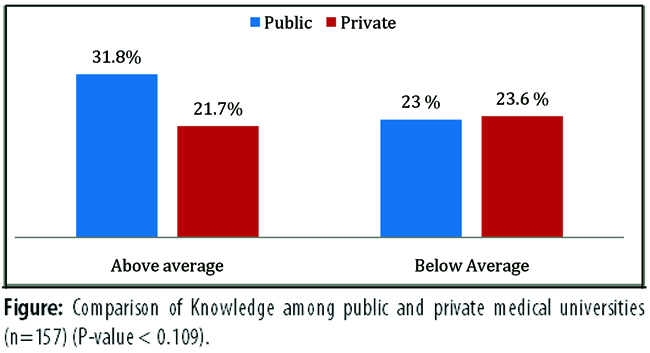
The total mean score and the mean score in Domains 1, 2 and 3 were higher among public medical students, while respondents of private university scored higher in Domain 4 (Table-1).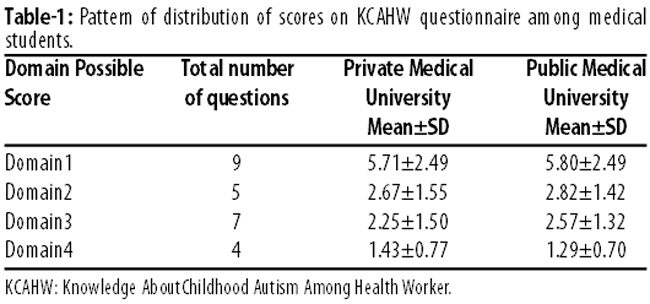
The total mean score of the two sets of students on the basis of previous awareness proved to be significant (p<0.025). Regarding gender and university orientation from two different sectors, the comparisons were found to be insignificant (Table-2).
Respondents had gained previous knowledge mostly from non-fiction books 12(7.6%) followed by Internet 10(6.3%) and voluntary work 8(5.1%). Very few students (n=15, 9.6%) had obtained knowledge through clinics or ward rounds.
Discussion
Knowledge of fourth year medical students from private and public medical universities was assessed in this study. After a thorough literature search, no article could be located covering the topic locally. In this study, the total mean score on the KCAHW questionnaire among the medical students was 12.30±4.71 out of 25. This is not markedly different compared to the study that was done in Nigeria on medical students which gave a mean score of 12.24±3.24.8
In this study, 113 medical students out of 157 correctly defined autism as a pervasive developmental disorder that affects children's social, communication and behavioural development. This can be due to increase in the exposure of these disorders through relations with peers, television, movies and various media outlets. In most domains, higher mean score was obtained by public medical students, indicating that they are more likely to recognise the signs and symptoms of childhood autism. This can be attributed to the availability of heterogeneous patients from all socio-economic classes who are willing to be treated by a person in the white coat. The longer exposure and readily available patients in the public institutes give the medical students a chance to interact with patients from all departments and enhance their clinical knowledge.
Previous awareness about autism was a factor that influenced knowledge about childhood autism with private sector students scoring higher than the respondents from public institutionon the KCAHW questionnaire. Some of the students had attended continuing medical education (CME) about psychiatric and paediatric disorders during their fourth year MBBS tenure and thus were aware about the term autism. The discrepancy in knowledge found among medical students belonging to public and private medical institutes is likely due to the variation in periods of posting and hours of lecture allocated during undergraduate training periods of these students. This concurs with earlier findings.6
No significant association was found between knowledge about childhood autism and age of the medical student. This is consistent with a study done in Nigeria on undergraduate medical, nursing and psychology students which reported that those who are older might not necessarily score higher on the KCAHW questionnaire.13
The total mean score in this study was low and was a reflection of deficit in knowledge, education and awareness of autism among medical students. This is consistent with the low level of knowledge and awareness among health workers, final year undergraduate medical students and general population in Nigeria which is attributed to less numbers of lectures and hours of posting.3,7,12,14
Autistic child is an important part of our society and has the right to enjoy all resources of a society in an effective way. This can be made possible by early diagnosis and prompt intervention by friends, family and healthcare workers. Keeping this in view, we strongly recommend that education on pervasive developmental disorders should become a part of five-year medical curriculum of MBBS. This will broaden the horizon of students' knowledge on new emerging problems and will be able to provide effective care to autistic child. This concurs with the study in Nigeria, which states the need of incorporating basic clinical experience in the undergraduate training programme.3
Several studies have assessed GP knowledge related to common health problems.15 However, to the best of our knowledge, no study is done to assess the level of childhood autism knowledge among students belonging to different sectors of medical education. Although the topic covered in this study was novel, but the small sample size was a major limitation. As the study population comprised only fourth year medical students and due to low response rate, the sample size was far from what the target sample size was as calculated by the WHO calculator. Besides, the KCAHW questionnaire is designed to be self-administered and responses were collected immediately, which only gave point assessment knowledge. Since the questionnaire was modified after pre-test, therefore it needed a validity check which was not done. The questionnaire also didn't assess explanations and cultural beliefs held by the respondents. Future studies should explore the subject with appropriate sample size and a validated questionnaire.
Conclusion
Knowledge deficit was evident about childhood autism among the medical students. In order to bridge the knowledge gap, and to help autistic child live a wholesome life, it is imperative to provide education in public and private sectors via CME and basic clinical exposure.
References
1. Rutter M. Language Disorder and Infantile Autism. Springer US. 1978; pp 85-104.
2. GelderMG, Lopez-Iborr JJ Jr, Andeason NC. New oxford textbook of psychiatry. Oxford University Press, London; 2003.
3. Wing L, Potter D. The epidemiology of autistic spectrum disorders: Is the prevalence rising? Ment Retard Dev Disabil Res Rev 2002; 8: 151-61.
4. Igwe MN, Bakare MO, Agomoh AO, Onyeama GM, Okonkwo KO. Factors influencing knowledge about childhood autism among final year under graduates Medical, Nursing and Psychology students of University of Nigeria, Enuga. Italian J Pediatr 2010; 36: 44.
5. Rahbar MH, Ibrahim K, Assassi P. Knowledge and Attitude of General Practitioner Regarding Austim In Karachi, Pakistan. J Autism Developmental Disorders 2011; 41: 465-74.
6. Daley TC, Sigman MD. Diagnostic Conceptualization of Autism among Indian Psychiatrist, Psychologist and Pediatrician. J Autism Developmental Disorder 2002; 32: 13-23.
7. Shah K. Research in brief: what do medical students know about autism? Autism 2001; 5: 127-33.
8. Bakare MO, Ebigbo PO, Agomoh AO. Knowledge about childhood autism among health care workers on availability of facilities and law caring for the need and rights of children with childhood autism and other developmental disorders n Nigeria. BMC Pediatric 2009; 9: 12.
9. Population Reference Bureau (2012). 2012 World Population Data Sheet. Population Reference Bureau [online] [cited 2011 August 3]. Available from: URL: www.prb.org.
10. List of medical schools in Pakistan [online] [cited 2011 August 3]. Available from URL: www.wikipedia.com.
11. Doddani S, LaPorte RE. Way to strengthen research capacity in developing countries; effectiveness of a research-training workshop in Pakistan. Public Health 2008; 122: 578-87.
12. Campbell JM, Barger BD. Middle school students\' knowledge of autism. J Autism Dev Disord 2011; 41: 732-40.
13. Bakare MO, Ebigbo PO, Agomoh AO, Menkiti NC. Knowledge about childhood autism among health care workers (KCAHW) questionnaire: description, reliability and internal consistency. Clin Pract Epidemiol Ment Health 2008; 4: 17.
14. Igwe MN, Ahanotu AC, Bakare MO. Assessment of knowledge about childhood autism among paediatric and psychiatric nurses in Ebony state, Nigeria. Child Adolescent Psychiatry and Mental Health 2011; 5: 1.
15. African Network for Prevention and Protection against Child abuse and Neglect (ANPPCAN), Nigeria Chapter: Communiqué on a project to increase the level of awareness on autism and develop a mechanism for care and support of children with autism in Enugu State, South Eastern Nigeria 2007.
Related Articles
Journal of the Pakistan Medical Association has agreed to receive and publish manuscripts in accordance with the principles of the following committees:


