

Ayse Sonay Kurt ( Department of Nursing, Faculty of Health Science, Selcuk University, Konya, Turkey. )
Serap Balci ( Department of Pediatric Nursing, Faculty of Nursing, Istanbul University, Turkey. )
Dilek Kose ( Department of Nursing, School of Health, Children's Health and Disorders, Sakarya University, Sakarya, Turkey. )
November 2014, Volume 64, Issue 11
Original Article

Abstract
Objective: To assess test anxiety levels and related factors among students preparing for university exams.
Methods: The descriptive, cross-sectional study was conducted at Istanbul University, Turkey, and comprised students preparing for exams in two private courses for the 2010-11 academic year. Data was collected via an original questionnaire and the Test Anxiety Inventory. SPSS 20 was used for statistical analyses.
Results: Of the 1250 students who qualified for the study, the final sample size was 376(30%). Of them, 210(55.9%) were females, and 154(41%) were 18 years old. Students\' mean Test Anxiety Inventory scores were 39.44±11.34. Female students\' overall test anxiety scores and mean emotionality subscale score were significantly higher than those of their male counterparts. Students whose mothers had an educational attainment between primary school n=170 (45.2%) and a high school diploma n=184 (48.9%), as well as those with four or more siblings n=49 (15%), had significantly higher mean overall Test Anxiety Inventory scores.
Conclusion: Among other things, test anxiety is influenced by maternal educational level, type of high school, number of exams, and number of siblings. Preparing a relaxed study environment for students, providing the family monetary or social support, and encouraging participation in social activities are recommended to decrease anxiety in students preparing for university exams.
Keywords: Adolescent, Anxiety, Stress management, Stress, Coping strategies. (JPMA 64: 1235; 2014).
Introduction
Adolescence is a transitional period characterised by physical and psychological changes as well as an increase in freedom and responsibilities.1,2 The World Health Organisation (WHO) defines that adolescence is a stormy time that occurs between the ages of 10 and 19 during which many problems may arise for adolescents and their families.3 During this time, adolescents experience rapid changes and major conflicts, and may have difficulty adapting to the problems.4-6 Rapid cognitive development and intensified emotions contribute to exam-related stress and anxiety, especially as adolescents are pushed to begin considering prospective professions.2,4,5
Stress can be viewed as the individual\'s efforts to account for environmental conditions that come in conflict with physical and psychological desires. Physical conditions or psychological aspects of one\'s social environment can facilitate or complicate adaptation to the environment, depending on their relationship to the individual. At times when adaptation becomes more difficult, the organism begins to tire physically and psychologically.7
This description of stress applies to the anxiety most adolescents experience when preparing for certain exams, and wondering if they will get through. Test anxiety is a special kind of anxiety-worry mixed with fear which arises especially in situations where the individual is being evaluated in an academic context. This anxiety may prevent effective use and communication of the information learned for the exam, resulting in failure.7,8
Anxiety levels differ among adolescents,9 and may be influenced by factors such as age; gender; parental occupations, educational levels, and attitudes towards children; socio-economic status; number of siblings; and prior academic achievement.9-11 The current descriptive, cross-sectional study was carried out to assess the test anxiety levels of students preparing for university exams and the factors influencing this anxiety.
Subjects and Methods
The descriptive, cross-sectional study was conducted at Istanbul University, Turkey, and comprised students preparing for exams in two private courses for the 2010-11 academic year. There were 1250 students fitting the description at the time of the study. The sample size was calculated by sampling formula of known population (n= Nt2pq/d2 (N-1) + t2pq)12 where n was the Sample size; N was the Population size; and t was the value for selected alpha level of 0.025 in each tail = 1.96 (the alpha level indicates the level of risk the researcher is willing to take that true margin of error that may exceed the acceptable margin of error).
Besides, (p)(q) was the estimate of variance which was 0.25 (maximum possible proportion 0.5) * 1 (maximum possible proportion 0.5) which produce maximum possible sample size. Finally, d was the acceptable margin of error for proportion being estimated at 0.05 (error a researcher is willing to accept).
The sample size, as such, was determined as 376. The study was approved by the ethical committee of Istanbul University, Istanbul Faculty of Medicine, and informed consent was obtained from all the participants. Data were collected via a questionnaire developed on the basis of literature review4,7,8,10,11 and discussion with experts, and the Test Anxiety Inventory (TAI). The Inventory was developed by Spielberger et al. in 1980 and was adapted into Turkish in 1986.14 The total questionnaire (TAI-T) contains 20 items, each of which is scored on a 4-point Likert-type scale, with possible responses of 1 = never, 2 = sometimes, 3 = frequently, and 4 = always. The range of scores is 20-80; the higher the total score, the higher the anxiety level.13 Cronbach\'s alpha value was found to be 0.81 for this study, indicating good internal consistency.
The questionnaire, which contained 46 questions on students\' age, gender, the number of exams, parental educational level, number of siblings, and factors which appeared to influence test anxiety level, was developed to measure individuals\' self-evaluations and attitudes towards tests. It had two subscales, Worry and Emotionality. The Worry subscale (TAI-W) evaluated the cognitive aspect of test anxiety (i.e. obsessive thinking, depression, or anhedonia), and comprised items2-5,8,12,17 and 20. The total score varied between 8 and 32; the higher the total score, the higher the cognitive manifestations of anxiety. The Emotionality subscale (TAI-E) evaluated the physiological aspect of test anxiety (i.e., racing heart, insomnia, loss of appetite), and comprised items.1,6,7,9,10,11,13-19 The total score varied between 12 and 48; the higher the overall score, the higher the physiological manifestations of anxiety.
In accordance with the recommendations of the experts, the questionnaire was revised and a pilot study was conducted on 10 students to assess the understandability of the study instrument.
All the 376 students in the study completed the questionnaire in their classrooms and there were appropriate arrangements to ensure privacy.
Data was evaluated using SPSS 20. Descriptive statistics (percentage, mean, and standard deviation) and the Mann-Whitney U test were used to compare quantitative data, a one-way analysis of variance (ANOVA) was used for inter-group comparisons of normally distributed data, Tukey\'s honest significant difference (HSD) was used for post-hoc analyses, and Student\'s t-test was used to compare the groups. Results were evaluated assuming a 95% confidence interval (CI) and a significance threshold of 0.05.
Results
Of the 376 participants, 210(55.9%) were females, 184(48.9%) had graduated general high school, and 154(41.0%) were 18 years old. The overall mean age was 18.5±1.07 years. As for the participants\' parents, 170(45.2%) of the mothers, and 114(30.3%) of the fathers had only primary school diplomas. Besides, 190(50.5%) subjects had only two siblings and 182(48.4%) were preparing to take the exam for the second time. The mean TAI-T score was 39.44±11.34, mean TAI-W score was 14.46±4.33, and the mean TAI-E score was 27.02±8.20.
When students\' mean TAI scores in terms of gender were compared, a significant relationship was found between the mean TAI-T scores and the mean TAI-E scores, with 210; (55.9%) female students scoring higher than the 166(44.1%) male students,
In terms of demographic characteristics, the mean TAI scores significantly differed with respect to maternal educational level, type of high school, and number of siblings. Tukey\'s HSD demonstrated that students whose mothers had primary school (n=170; 45.2%) or general high school degrees (n=184; 48.9%) as well as students who had four or more siblings (n=49; 13.0%), had significantly higher TAI scores than the rest. Mean TAI-W subscale scores significantly differed with respect to parental educational level, number of test retakes, and high school type. Tukey\'s HSD showed that those students whose mothers had primary school diplomas (n=170; 45.2%), whose fathers had university degrees (n=137; 36.4%), and who had three or more test retakes (n=121; 32.2%) had significantly higher mean TAI-W subscale scores. Mean TAI-E subscale scores significantly differed with respect to parental educational level, type of high school, and number of siblings. Tukey\'s HSD showed that those students who had general high school diplomas (n=184; 48.9%), whose parents had university degrees (mothers; n=77; 20.5%, and fathers; n=137; 36.4%) and who had four or more siblings (n=49; 13.0%) had significantly higher mean TAI-E subscale scores.
Fear of failure significantly differed with respect to TAI-W, TAI-E, and TAI-T scores. Post-hoc analysis revealed that students who feared being publicly disgraced (n=5; 1.3%) experienced more physical and mental manifestations of test anxiety than did their peers who did not fear being unsuccessful (n=17; 4.5%), but who feared being less successful than their friends (Table-1).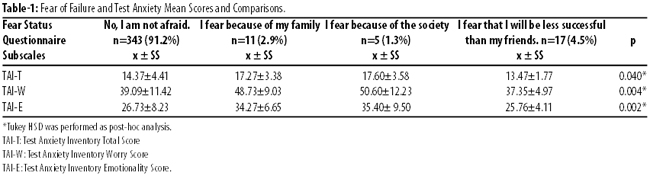
The majority of participants stated that their parents lived together (n=326; 86.7%), were middle class (n=337; 89.6%), and they did not have any bad habits (n=300; 79.8%). Just over half (n=207; 55.1%) of the students who smoked had fewer than 10 cigarettes a day; and nearly half (n=162; 43.1%) of the students who consumed alcohol the frequency was once a day. When asked to define their personality, 194(51.6%) said they were \'happy,\' while 44(11.7%) said they were \'nervous.\' Students\' negative characteristics and personality did not significantly influence their TAI scores. Nearly all of the students stated they received family monetary/social support for attending school (n=373; 99.2%), that they could communicate with the people around them (n=367; 97.6%), and that they did not keep diaries (n=340; 90.4%). The majority stated that neither they (n=360; 95.7%) nor any of their family members (n=333; 88.6%) had any medical or psychological disorders requiring long-term treatment, that they did not work after school or on holidays (n=322; 85.6%), that they did not receive private tutoring apart from the private courses they were enrolled in (n=334; 88.8%), and that they did not know what profession they wanted to go into (n=303; 80.6%). However, none of these characteristics significantly influenced TAI scores.
Characteristics which were found to influence TAI scores were also noted (Table-2).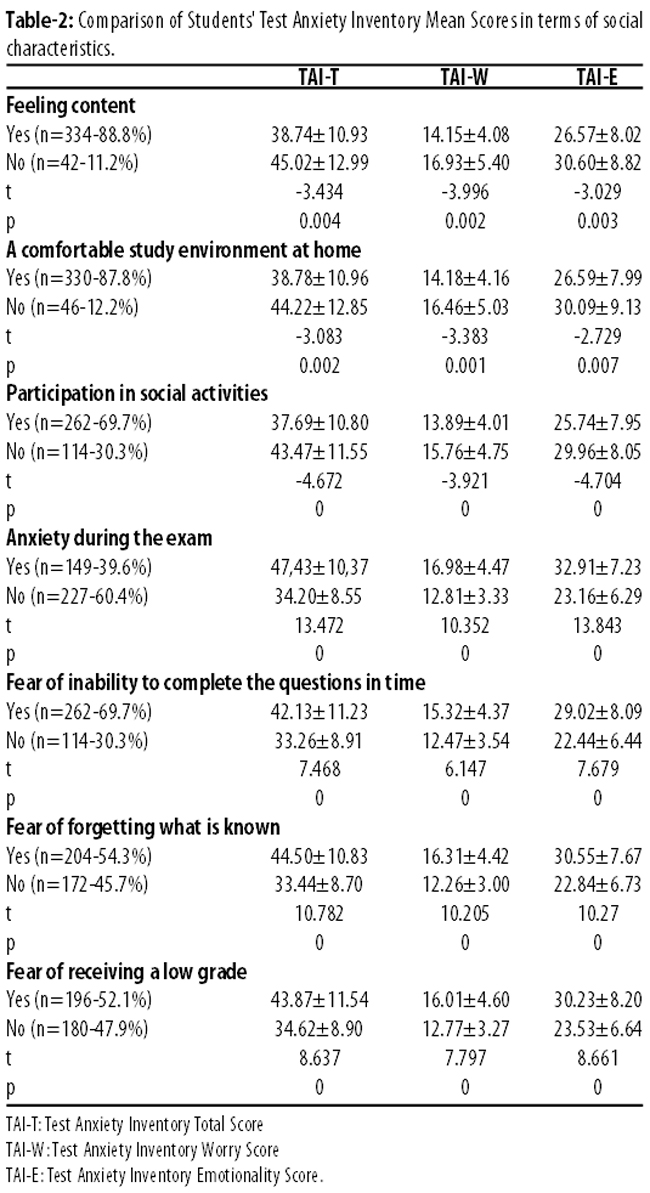
Those who reported feeling happy (n=334; 88.8%), who had comfortable study environments at home (n=330; 87.8%), and who participated in social activities (n=262; 69.7%) had significantly lower mean TAI-T, TAI-W and TAI-E scores; while those who got anxious (n=149; 39.6%) and who feared forgetting what they knew (n=204; 54.3%) and feared receiving low scores (n=196; 52.1%) had significantly higher TAI-T, TAI-W, and TAI-E scores.
Discussion
Test anxiety is a significant problem which negatively influences results for many students. While every student experiences anxiety to a varying degree, each individual experiences anxiety differently, and this anxiety may lead to serious problems. For this reason, students should be on screened for anxiety, with necessary precautions taken for both students and their families.13,14 Previous studies have demonstrated that test anxiety may vary depending on individual characteristics9 such as age, gender, parental educational level, socio-economic status, number of siblings, and individual academic achievement level.7,9,11,15 Previous studies10,16,17 analysing the relationship between gender and test anxiety found that female students experienced more test anxiety than male students. The results of the current study are in line with such findings. This may be because females are generally considered to be more emotional than males, and tend to experience emotions such as fear and anxiety more intensively. They tend to feel the need for a profession that will provide them with a clear social identity and economic freedom more intensely than men.
In the current study, students who had a general high school diploma, whose mothers had primary school diplomas, and who had four or more siblings experienced significantly more anxiety, with students\' anxiety scores increasing along with the number of test retakes. However, this relationship was not strong enough to be statistically significant. The relationship between attending general high school and higher levels of anxiety is in line with the findings of earlier studies.11,17 This elevated anxiety level may be due to the fact that students do not need to complete an entrance examination to attend general high school, in contrast to students who attend super/Anatolian/science high schools. The lower level of academic success associated with students attending general high school may have contributed to their elevated anxiety levels. Additionally, while students\' anxiety levels were not significantly influenced by parental educational level, as maternal educational level decreased, TAI scores tended to increase. This might stem from the fact that mothers with less education might be more authoritarian towards their children.
Previous studies reported a positive association between anxiety level and the number of siblings12,18 and the number of test retakes.11 In contrast, students who feel content and have a comfortable study atmosphere at home19,20 and those who participate in social activities16,21,22 have decreased levels of exam anxiety. The results of the current study support these findings. We hypothesise that an increase in the number of siblings might necessitate more material and emotional sharing, in addition to making it necessary to choose a profession and begin earning money immediately. These factors could certainly result in increased anxiety. The relationship between the number of test retakes and anxiety levels may be due to the fact that students taking the exam for the first time are more confident of themselves and believe they are going to be successful, while those who previously failed their examinations fear that they will fail again. In line with previous findings16,21,22 the present study found that students who participate in social activities have significantly less test anxiety. These findings strengthen the argument that social activities decrease students\' emotional tension and release energy, decreasing anxiety.
Previous studies postulated a positive relationship between test anxiety level and depression.21 The present study confirmed this relationship, with students who reported feeling content reporting less physical and mental test anxiety. Participating in private preparatory courses, choosing a profession, and studying during holidays were not found to influence test anxiety, in line with previous findings.23-25
The most important reasons previously reported for student test anxiety were fears regarding an inability to finish questions in time, forgetting the information for the test, and getting low marks.7,8 The current study confirmed these findings.
Conclusions
Preparing a relaxed study environment for students, providing family monetary/social support, and encouraging participation in social activities are recommended to decrease study anxiety in students preparing for university exams.
Acknowledgements
We would like to thank all the students who participated in the study.
References
1. Ball JW, Bindler RC. Pediatric nursing caring for children. 4th ed. United States of America: Prentice Hall; 2008.
2. Kinik E, Approach to adolescents. In: Hasanoglu E, Dusunsel R, Bideci A, (eds). Fundamental Pediatrics. Ankara: Gunes Medical Publishing, 2010; 1561-62.
3. World Health Organization. Adolescent Friendly Health Services. Geneva. 2002. (Online) (Cited 2010 March 15). Available from URL: http://www.whqlibdoc.who.int/hq/2003/ WHO_FCH_CAH_02.14.pdf.
4. Basut E. Stress, coping, and adolescent. Turk J Child Adolesc Ment Health 2006; 13: 31-6.
5. Bundak R, Neyzi O, Gunoz H, Darendeliler F. Adolescence. Neyzi O, Ertugrul T. (eds). Pediatrics. 4th ed. Istanbul: Nobel Medical Publishing, 2010; 81-99.
6. Kollar LM. Health promotion of the adolescent and family. In: Hockenberry MJ, (ed). Wong\'s Essentials of Pediatric Nursing, 7th ed. United States of America: Mosby, 2005; pp 494-500.
7. Ergene T. The Relationships among Test Anxiety, Study Habits, Achievement, Motivation, and Academic Performance among Turkish High School Students. Educ Sci 2011; 36: 320-30.
8. Yesilyurt F. Ways of coping with test anxiety and the OSS and the OKS. Istanbul: Remzi Publishing; 2007.
9. Inanc BY, Bilgin M, Atici MK. Developmental Psychology. 2nd ed. Istanbul: Pegem A Publishing; 2007.
10. Rezazadeh M, Tavakoli M. Investigating the Relationship among Test Anxiety, Gender, Academic Achievement and Years of Study: A Case of Iranian EFL University Students. English Language Teaching 1999; 2: 68-74.
11. McDonald AS. The prevalence and effects of test anxiety in school children. Educ Psychol 2001; 21: 89-101.
12. Yazicioglu Y, Erdoga S. SPSS applied scientific research methods. Ankara: Detail Publishing; 2004.
13. Oner N. Handbook of test anxiety inventory. Istanbul: Publication of guidance to spread higher education foundation; 1990.
14. McDonald AS. The prevalence and effects of test anxiety in school children. Educ Psychol 2001; 21: 89-101.
15. Kapikiran S. The relationship between test anxiety and some psycho-social variables of university students. Pamukkale Uni J Educ 2002; 1: 35-43.
16. Ali MS, Mohsin MN, Sherawan A. Gender differences in terms of test anxiety and attitude towards science. Int J Environment, Ecology, Family and Urban Studies (IJEEFUS) 2013; 3: 133-8.
17. Putwain DW. Test anxiety in UK school children: Prevalence and demographic patterns. Br J Educ Psychol 2007; 77: 579-93.
18. Alti Ozbas A, Sayin A, Cosar B. Investigation of the relationship between examination anxiety and elderly maladaptive schemas of students who are preparing for university examination. J Behav Psychother Res 2012; 1: 81-89.
19. Ergene T, Yildirim I. Test anxiety, submissive behaviour and social support as a predictor of academic achievement. Hacettepe Uni J Educ 2003; 25: 224-34.
20. Sahin H, Gunay T, Bati H. University Entrance Exam Anxiety of Senior High School Students in the province of Izmir, District of Bornova. STED 2006; 5: 107-113.
21. Sazak N, Ece S. Anxiety level of students high school entering special aptitude test. Süleyman Demirel Uni Burdur J Educ 2004: 5; 102-13.
22. Yildirim I, Genctanirim D, Yalcin I, Baydan Y. Academic achievement, perfectionism and social support as predictors of test anxiety. Hacettepe Uni J Educa 2008; 34: 287-96.
23. Cassady CJ, Johnson ER. Cognitive test anxiety and academic performance. Contemporary Educa Psychol 2002; 27: 270-95.
24. Hong E, Karstensson L. Antecedents of state test anxiety. Contemporary Educ Psychol 2002; 27: 348-67.
25. Sud A, Parabha I. Test anxiety and academic performance: Efficacy of cognitive/ relaxation therapies. Psychological Studies 1995; 40: 179-86.
Journal of the Pakistan Medical Association has agreed to receive and publish manuscripts in accordance with the principles of the following committees:


