

Nurgul Gungor Tavsanli ( Celal Bayar University, School of Health, Sehitler Mah. Istasyon Mevkii PK. 45020 Centrum, Manisa, Turkey. )
Nesrin Sen Celasin ( Celal Bayar University, School of Health, Sehitler Mah. Istasyon Mevkii PK. 45020 Centrum, Manisa, Turkey. )
July 2014, Volume 64, Issue 7
Original Article

Abstract
Objective: To determine how nurses who encounter stressful live events adapt themselves, and to examine the relation between their personal characteristics and stressful events.
Methods: The cross-sectional study was conducted between February and April 2007, and comprised all nurses working at the two public-sector hospitals in Manisa, Turkey. Data was collected using a pre-tested questionnaire. Data was analysed using SPSS version 11.0.
Results: Of the total 87 nurses, 33 (37.9%) were in the 28-32 age group; 67 (77.0%) were married; 35 (40.2 %) had a child; 61 (70.1 %) had an income equivalent to their expenses; 44 (50.6 %) had an associate degree; 21( 24.22 %) had 10-12 years of experience in the profession; 76(87.4 %) were working as service nurses, and 31 (35.6%) had worked for 1-3 years in this service.
Conclusion: There was a relationship between some of the socio-demographic characteristics of the nurses and stressor life events.
Keywords: Stressor life events, Nursing, Sociodemographic characteristics, Adaptation. (JPMA 64: 802; 2014).
Introduction
People try to fit into life through a process of continuous re-orientation. They accommodate by changing physically, physiologically and behaviourally.1 Change is a kind of stress that we are obliged to adapt psychologically and physically.2
Stresses that have the nature-of-life crises are created by events which give shape to every life by themselves such as serious illness, birth, death of a family member, or the loss of a job.3,4
The change coming from the reaction to a stressor is called adaptation. Adaptation is the process of trying to maintain a certain inner and outer equilibrium in the person, and acts to join the concepts in the understanding of the human behaviour. Adaptation involves both psychological and physical wellbeing and can be thought of as an effort to cope. When the person encounters stress, the process of adaptation begins. If adaptation is successful, equilibrium is maintained; if not, the person becomes ill and adaptation to the illness begins.4-6
According to the adaptation theory of Holmes and Rahe,7 changes in lifestyle influence a person\'s psychological adaptation. People encountering stresses over a long period of time have an increased risk of getting ill. Exposure to stress results in physical problems like headache, back pain, shoulder ache, hypertension, tachycardia, digestive system diseases; psychological problems like getting easily angry, weakness, decidophobia, loss of concentration, and depression, and behavioral symptoms like incessant movement and sexual dysfunctions.4,8-10
Studies have shown that life events are concerned with socio-demographic characteristics like age, gender, marital status, occupation and working hours.4,5,8 One study suggests that one in every six women and one in 12 men has experienced a depressing event at least once. Women are generally expected to carry the load of both business and family life. Working women work a second shift which starts when they reach home, and is related to housework and child care, increasing their load and their stress levels.11 Various social and cultural factors cause women to behave more emotionally than men.4 It is thought that nurses, both because they are women and because they have difficult working conditions, are more affected by life events.
One of the missions of nurses is also to protect the mental health of society. Today, the most important factor affecting the mental health of society is stress. Nurses play important roles in determining the causes of stress and in removing them. The stress and adaptation theory helps nurses to understand the apparently happy or strange behaviour of people and to determine the aims of nursing practices.12 The mission of a nurse, according to the adaptation theory, is to decrease the strength of stressors, to increase the ability to adapt to the stressors, and to protect the system from dangerous stressors.6 The aim of this study was to determine how nurses who encounter stressful life events adapt themselves, and the relation between their personal characteristics and stressful life events.
Subjects and Methods
The cross-sectional study comprised all the nurses of the two public hospitals in Manisa, a city located in the western part of Turkey: Manisa Moris Sinasi Children\'s Hospital and Manisa Public Hospital, and 169 nurses in the hospitals according to the hospitals\' records in Manisa. Data was collected from February to April 2007. The nurses who were present on data collection days represented the study sample. Simple random sampling method was used and the questionnaire was distributed to working in the day shift (8am - 4pm). No subject refused to participate in the study, but off-duty nurses were excluded. Permission from the institutional review committee and informed consent of the subjects were obtained prior to data collection.
The questionnaire, composed of 20 questions, was first created by Holmes and Rahe in 1967, and was later adapted to Turkey by Sorias in 1982, and included a list of 107-question Life Events.7,13
The reliability coefficient of the scale was found to be r = 0.93-0.97 in a 1972 study by Mendels and Weinstein and r = 0.83-0.87 in a 1982 study by Sorias.13,14 The scale has been used in various studies of life events.15
The Life Events List (LEL) included life events in the preceding four years, the date of these events, the severity of such events, and the difficulty of adaptation to them. Life events included in the scale were collected under the headings of economic status, health status, education, work, relations with family, close relatives and friends, sex life, loss (economic, health-related, loss of a spouse, etc.) and change of location.
Nurses were asked to score the 107 items on a scale of 0 to 100 in accordance with the ascending order of the negative impact of such events. These scores were added together, and the nurses were evaluated according to the final total score.
In order to assess the probability of illness, the scores were categorised as: 1-150: No important life change; 150-199: Minor life change (33% probability of illness); 200-299: Moderate life change (50% probability of illness); and 300-above: Major life change (80% probability of illness).
SPSS version 11.0 was used for statistical analysis. Measurement averages of the variables, arithmetic averages and standard deviations were worked out. Chi-square and Kruskal Wallis tests were used to compare mean life events groups on the basis of nurses\' sociodemographic characteristics. The significance level was set at p<0.05.
Results
Of the total 169 nurses working at the two hospitals 87 (51.2%) were included in the study, and their socio-demographic characteristics were noted (Table-1).
Overall, 39 (44.8%) nurses had experienced disturbing major life changes, and 37(42.5%) had experienced a major life change which had had an effect on adaptation.
A statistically significant relationship was found between age groups, marital status and disturbing life changes (p<0.031 and p<0.037) and between age groups and life changes causing adaptation (p<0.044 and p<0.001) (Table-2).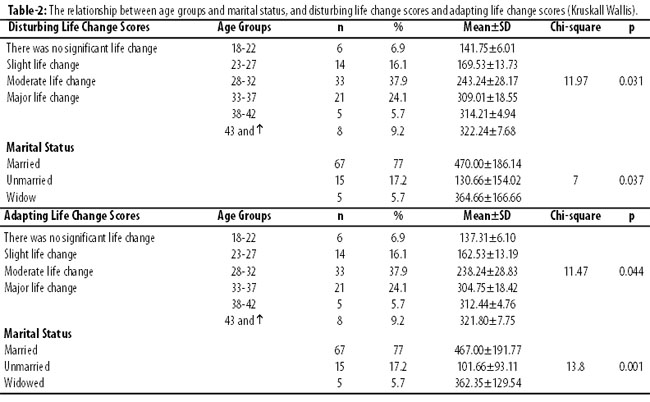
Statistically significant differences were found between the institution where the nurse was working and the adapting life change scores (p<0.001) and between the institution where the nurse was working and the disturbing life change scores (p=0.001) (Table-3).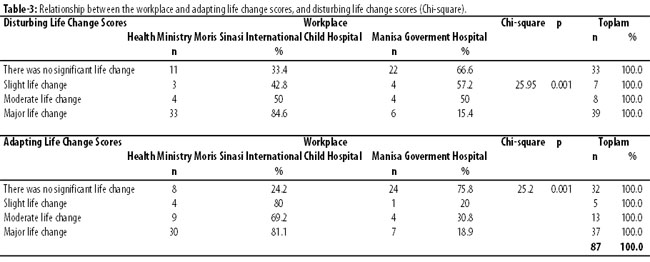
Discussion
Results of the current study showed that 39 (44.8%) nurses with a disturbing life change had had a major life change, and 37 (42.5%) nurses with an adapting life change had had a major life change. In a study on elementary school teachers, it was discovered that the teachers had had a minor life change.16 The difference between the two studies is thought to be due to the more stressful and busy work environment of the nurses compared to the teachers.
When we looked at the relationship between the socio-demographic features of the nurses and life events which they had experienced, a statistically significant relationship was found between age groups and disturbing and adapting life changes (p<0.05 and p=0.001). In earlier studies, a statistically significant relationship was found between age and life events.17,18 However, another study reported no statistically significant relationship was found between age and life events.16 The reason behind the finding of a statistically significant difference occurring with age is thought to be due to the weakness of nurses in coping with stress as they get older, and the stress of the job adding to the burden of their private lives.
A statistically significant difference was found between the marital status of the nurses and the life events they had experienced (p<0.05). Disturbing and adapting life changes seemed to have been experienced more by married nurses. In some earlier studies, no statistically significant difference was found between marital status and life events.16,19 In another study, a statistically significant difference was found between the marital status and life events of nurses.17
A statistically significant difference was determined between the institutions where the nurses worked and their life events (p=0.00). A statistically significant difference was also determined on this account in a couple of earlier studies.19,20 This difference is thought to originate from the effect of working conditions on the work experiences of the nurses by increasing the number of life events they experience.
Conclusion
The study found a relationship between various socio-demographic characteristics of the nurses and their life events, and it was also understood that the life events which nurses experienced created major life changes and made it difficult for them to adapt.
References
1. Baltas A. Outstanding achievement exams and in learning not crushed under stress. 9th ed. Istanbul: 1994; pp 8.
2. Sahin, N. Coping with Stress: A Positive Approach. Ankara: Turkish Psychological Association Publications; 1994.
3. Atkinson RL, Atkinson RC, Smith EE. Introduction to Psychology. Hilgard\'s Introduction to Psychology. 12th ed. Arkadas Yay?n lar?; 1996; pp 489-520.
4. Tatar Ç. To investigate the relationship between depression and styles of coping with stress of nurse. [Master Thesis]. Izmir: Ege University Health Sciences Institute, 2004.
5. Willams DR, House JS. Stress, social support, control and coping: a social epidemiological view. Health Promotion Research, Towards a new social epidemiology. WHO Regional Publications, European Series, 1991; pp 147-17.
6. Birol L, Akdemir N. Internal Medicine and Nursing Care. 2nd ed. Ankara: System Offset, 2004.
7. Holmes TH, Rahe RH. The Social Readjusment Scale. J Psychosomatic Research 1967; 2: 213-8.
8. Baltas Z. Stress and Health. IX. National Congress of Psychology. Turkish Psychological Association. Istanbul: Bogaziçi Univ, 1996; pp 221-7.
9. Baltas A, Baltas Z. Stress and Ways of Coping. 18th ed. Istanbul: Remzi Bookstore, 1998.
10. Tastan S. Stress and Stress Management. Management & Organization and Human Resources Management. Ankara: Publications TODAIE, 2004; pp 253.
11. Cam E. Stress in working life and female workers in the public. J Hum Sci 2003: 1303.
12. Kageyama T, Kobayashi T, Nishikido N, Oga J, Kawashima M. Assocation of Sleep Problems and Recent Life Events with Smoking Behaviors among Female Staff Nurses in Japanese Hospitals. Industrial Health 2005; 43: 133-41.
13. Sorias S. Investigation of the effects of stressful life events in the patient and normal subjects. [Thesis]. Izmir: Ege University Faculty of Medicine. Department of Psychiatry, 1982.
14. Mendels J, Weinstein N. The Schedule of Recent Experiences; A Realiability Study. Psychosomatic Medicine 1972; 34: 527-32.
15. Berksun OE, Ünal S, Gögüs AK. Life events as a precipitating factor and psychiatric illness. J Psychiatry 1991; 2: 141-5.
16. Bulut Bozkurt N. Correlations of various coping styles and stressful life events in eelementary school teachers. J Edu Ekim 2005; 13: 467-78.
17. Eskin M, Akoglu A, Uygur B. Traumatic Life Events and Problem Solving Skills in Psychiatric Outpatients: Relationships with Suicidal Behavior. Turkish J Psychiatry 2006; 17: 266-75.
18. Gülseren S, Aydemir Ö, Küey L, Kültür S. Distinctive and Overlapping Features of Patients with Major Depression, Anxiety Disorders and Comorbid States-3: a Comparative Study in Terms of Life Events. J Psychiatry 1997; 8: 115-24.
19. Doruk A. Adjustment disorder and life events. Anatolian J Psychiatr 2008; 9: 197-202.
20. Coskun A, Savas HA, Tanar D, Arkonaç O, Erkoç S, Güveli M. Life events in patients with bipolar disorder. Düsünen Adam J Psychiatr Neurological Sci 1995; 8: 48-51.
Journal of the Pakistan Medical Association has agreed to receive and publish manuscripts in accordance with the principles of the following committees:


