

M. H. A. Beg ( K. V. SITE Hospital, Karachi. )
August 1982, Volume 32, Issue 8
Case Reports

Familial epistaxis is often encountered by Otolaryngologists. Osier in 1901 described a triad of symptoms consisting of epistaxis, positive family history and multiple telangiectasia. Harrison (1957) regards this phenomena as \'rare\' and Mc Caffrey et al. (1977) calls it unusual Multiple Telangiectasia, the cause of which is unknown, has a dominant familial trait. It may be very easily missed when located in the region of the nose unless a careful examination is carried out.
A case of repeated episodes of epistaxis secondary to telangiectasia of the nasal mucosa over a period of 20 years is reported (JPMA 32:191, 1982).
Case Report
A 70 year old man from Abbottabad presented in the outpatients department with a history of recurrent nose bleeds for the last twenty years. He also complained of lethargy, headaches and general weakness.
On examination the patient appeared severely anaemic. Anterior Rhinoscopy showed gross septal deviation to the right with a large septal perforation. He admitted to being cauterized on four occasions as a treatment for epistaxis. A detailed examination of the upper respiratory tract revealed multiple telangiectasia spread over the tongue, palate and nasal mucosa (Fig 1 and 2).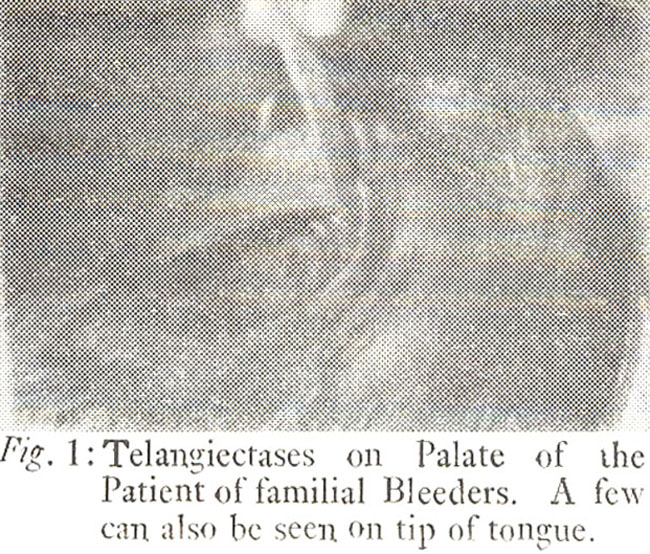
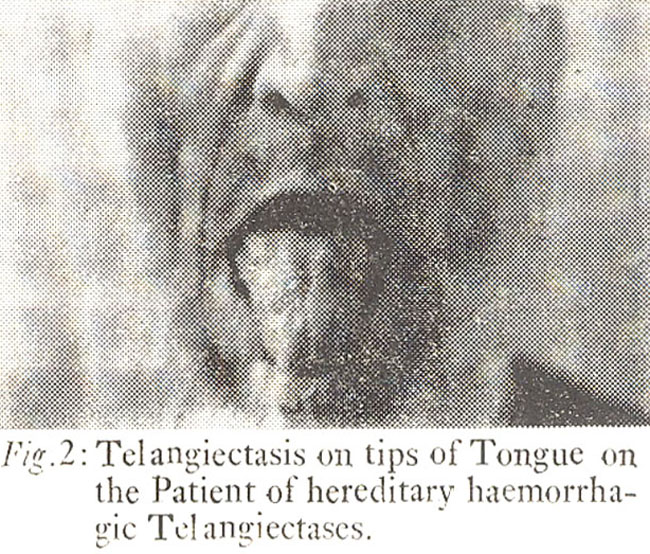
Similar lesions were also noted on the finger nails. These telangiectasia faded away on the application of pressure and re-appeared as the pressure was released. The haematological profile yielded a Hb of 7.5 G% with a normal platelet count, bleeding time, clotting time, prothrombin time and activated partial thromboplastin time.
There was a strong family history of nasal bleeding involving the son, sister and father of the patient. The father had died due to massive uncontrollable epistaxis in Abbottabad.
The diagnosis was supported by the family history and treatment was started with Oestrogen 0. 25 mg (Ethinyloestradicl) daily. Bleeding was controlled in a period of 21 days. Anaemia was combated with four units of blood transfusion. The medication was continued for six months during which the patient was called for check-ups. He did have occasional oozing but there was no profuse bleeding. He returned to Abbottabad in a satisfactory condition at the end of six months.
Discussion
Three hundred families suffering from this crippling disease have been described in the world literature. This is the first case report of its kind from Pakistan. Nose bleeds secondary to Telangiectasia usually starts at puberty and gets worse with advancing age. Severe anaemia develops due to the continuous loss of blood. Septal perforation is a common finding in these patients who are usually missed and treated with cautery. It is postulated that telangiectasia elsewhere in the body do not bleed so frequently because they are covered by a thick squamous epithelium. The nasal mucosa being thin gives way to the slightest trauma causing profuse bleeding. Patients have been described to have haematemesis and malaena due to G.I.T. telangiectasia.
Various treatment regimes have been suggested for this form of epistaxis. Septal dermoplasty (Saunders, 1963) where split thicknessskin is used in the anterior part of the nose and amniotic graft for the nasal mucosa (Laurian et al., 1979), is a favourable procedure. In this case we preferred therapy with Ocstrogen as described by Koch et al. (1952) due to the advanced age of the patient. No untoward side effects were noted.
A careful history and thorough examination in cases of recurrent epistaxis gives a definite diagnosis and makes the management simple.
References
1. Harrison, D.F. (1957) Familial haemorrhagic telangiectases; a survey of a series. J. Laryngol. Otol., 71:577.
2. Koch, U.J. Jr., Escher, G.C. and Lewis, j.S. (1952) Hormonal management of hereditary hemorrhagic telangiectasis. JAMA., 149:1376.
3. Laurian, N., Kalmanovitch, M. and Shimberg, R. (1979) Amniotic graft in the management of severe epistaxis due to hereditary haemorrhagic telangiectasia. J. Laryngol. Otol., 93 :589.
4. Mccaffrey, V., Kern, E.B. and Lake, O.F. (1977) Management of epistaxis in hereditary hemorrhagic telangiectasia. Arch. Otolaryngol., 103:627.
5. Osler, W. (1901) On a family form of epistaxis, associated with multiple telangiectases of the skin and Mucous Membranes. Bull. Johns. Hopkins Hospital, 12:333.
6. Saunders, W.H. (1963) Septal dermoplasty; a new operative procedure for control of Nosebleeds in patients with hereditary haemorrhagic telangiectasia. journal of Laryng. Otol., 77:69.
Journal of the Pakistan Medical Association has agreed to receive and publish manuscripts in accordance with the principles of the following committees:


