

Altaf Bashir ( Department of Gynaecology and Obstetrics, Punjab Medical College, Faisalabad. )
July 1982, Volume 32, Issue 7
A Survey Of Traditional Practices

Abstract
Refresher courses for traditional birth attendants both trained and untrained were organised at the District Headquarters Hospital, Faisalabad in 178. Similar training was arranged in the rural areas in 1979. Care of the pregnant woman and the child, registration of the births and family planning advice were included in the demonstrations. The results of these short courses were found to be encouraging (JPMA 32:168, 1982).
Introduction
Primary healthcare is a basic requirement of Pakistan just like any other developing country of the world. This includes erradication of infectious diseases, control of Tuberculosis, elimination of malnutrition and most important of all reducing of maternal and infant mortality. “Simplified Medicine” is a widely used international term which was conceived as realistic, practical and unsophisticated approach to meet the basic needs of the population. Dr. Boldo of Venezuela (1961) suggested the services of a health worker called a “Feldesher” in the rural areas. The Kampering Bidens in Malaysia have been successfully utilized for teaching family planning.
A survey of maternal and infant mortality carried out in the rural and urban areas of Faisalabad revealed figures found to be the highest in the world. The maternal mortality was 10 in every 1000 cases and infant mortality being 180 in 1000 (Bashir, 1979). To improve the health care for pregnant women, refresher courses for the traditional birth attendants TBAs-Dais, both trained and untrained were organised. These TBAs and Dais are usually illiterate and carry out the duties of a mid-wife because there is an acute shortage of trained personnel.
Material and Methods
Faisalabad city was divided into 15 zones for training purposes. The venue for the training programme was District Headquarters Hospital, Faisalabad. The period of training was three days a week for fifteen weeks. The TBAs were motivated through LHVs, news media, Municipal Authorities and local influential people. The refresher courses included antenatal care, conducting child birth, post natal care and recognition of the cases needing hospitalization to save fatality. The common causes of maternal and infant deaths were discussed and the importance of family planning Was stressed. Obstetric instruments and their use was demonstrated. Emphasis was laid on registration of births. The necessary forms were shown and it was clarified that this fulifilment was a part of their duty. Facilities provided to the trainees were light refreshment during the working hours, travelling allowance which was usually rejected and delivery kits from the UNICEFto trained TBAs. The untrained TBAs were given an opportunity to conduct ten delivery cases under the supervision of L.H.Vs.
A total of 720 TBAs were trained under this programme which included 552 trained and 168 untrained personnel. The training period extended from March 1978 to July 1978.
The refresher courses in rural areas commenced in March 1979 and the duration was 19 weeks. Difficulties in collecting the TBAs was a major problem which was overcome through the co-operation of medical students. The venue for the courses were the 19 Health Centres in the various districts of Faisalabad and the training session was held every Friday lasting the whole day. A total number of 1250 TBAs were trained through this programme of whom 707 were trained and 543 untrained.
Comments
This initial step to pave the way for reducing maternal and infant mortality and advancing family planning has given encouraging resuls.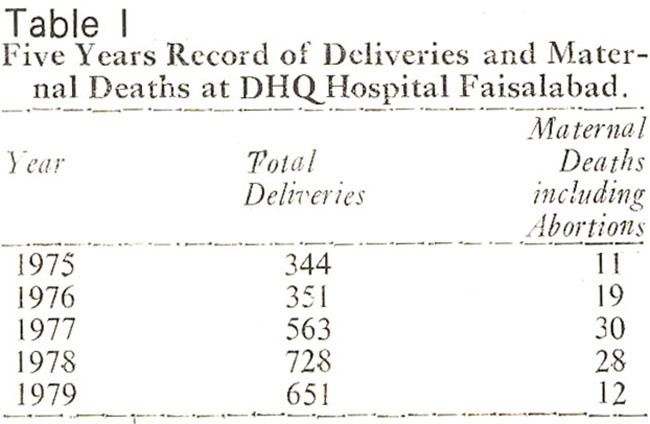
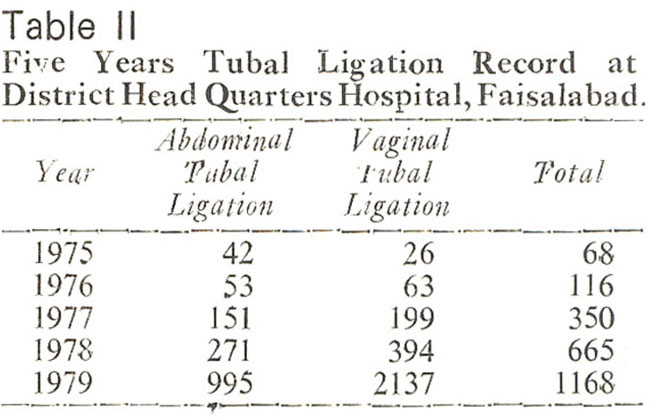
The following tables show the decrease in the maternal deaths and increase in tubal ligation cases in the Commencing years.
A further improvement can be made by proceeding with the training for the TBAs and keeping a follow up of their performance. Help from the general practitioners and undergraduate medical students in the form of public health education and prevention of infection would further propagate the programme. Provision of ambulance services for transport of seriously ill patients to hospitals would reduce mortality rates. Utilization of news media as Tele is:on, Radio and News-papers and voluntary Social Work Organisation for educating the public would also be helpful in raising the general health standards of the country.
References
1. Bashir, A. (1979) Survey of maternal mortality a retro-spective study. The Bulletin, 12:21.
2. Boldo, J.I. (1961) El Problems de Ia medicine on elmedio rural. Rev. Vennez. Sainid., 26:20.
Journal of the Pakistan Medical Association has agreed to receive and publish manuscripts in accordance with the principles of the following committees:


