

Mohammad Iqbal Khadim ( Assistant Professor, Dentistry Department, Khyber Medical College, Peshawar. )
May 1982, Volume 32, Issue 5
Original Article

Abstract
Sera from 80 blood donors and 60 apparently normal medical students were screened for HB5 Ag. Among the blood donors 11.3% were HB5 Ag. positive and in the students group 11.7% showed a positive result. The high frequency of HB5 Ag. positive results indicates that hepatitis-B antigenemia is quite common. If all these 140 individuals are taken as donors, than it is evident that 16 donors will act as a potential source of transmission of hepatitis to the recepients. It is, therefore, suggested that the test for detection of HB5 Ag in the donor blood should be done as a routine, along with the blood group and Rh factor (JPMA 32:122, 1982).
Introduction
Hepatitis type B generally is transmitted by inoculation of human blood or blood products containing hepatitis-B antigen (HB5Ag) or materials contaminated with the antigen (Barker et al., 1970; Gocke and Howe, 1970; Gocke, 1972). The detection of HB5Ag in faeces (Grob and Jemclka, 1971), bile (Akdamar et al., 1971), urine (Tripatzis and Horst, 1971) and saliva suggests that transmission may occur by faecal-oral route but the most common route of infection is parenteral, mainly by transfusion of infected blood (Kattamis et al., 1974). Pooling of blood products increases the risk (Allen et al., 1950) and blood fibrinogen carries a particularly-higher possibility of transmitting hepatitis type B (Boeve et al., 1968). Since the transfusion of blood, containing HB5Ag is followed by on increased incidence of post transfusion hepatitis (Gocke et al., 1970) the study was undertaken to determine the prevalence of HB5Ag in the donor population belonging to the North West Frontier Province (NWFP) of Pakistan.
Material and Methods
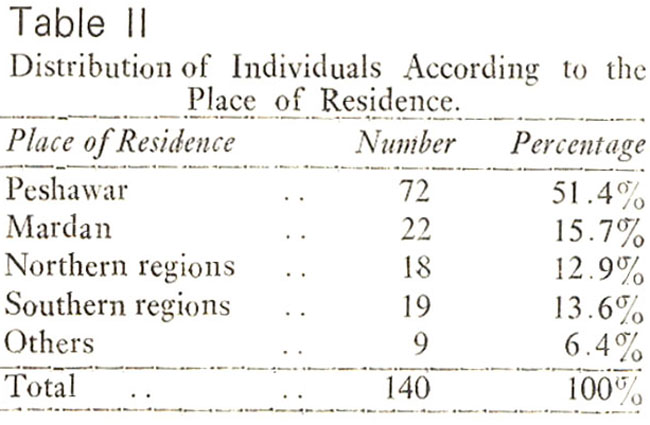
Studies were conducted on sera obtained from 80 blood donors (Khyber Teaching Hospital and Lady Reading Hospital, Peshawar) and 60 apparently healthy medical students. The reverse Passive Hemagglutination test was used for the detection of HB5Ag .All the blood donors were healthy and there was no history of hepatitis or parenteral exposure. The distribution of these individuals according to their age group and place of residence is shown in Table I and II respectively.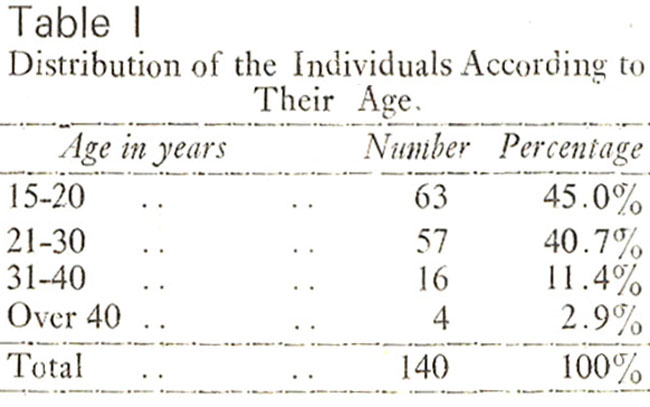
Results
The overall frequency of HB5Ag is shown in Table III.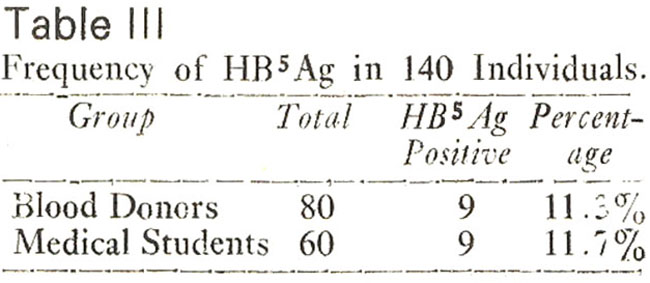
Among the blood donors 9 (11.3%) subjects were HB5Ag positive and in the student group 7(11.7%) individuals showed a positive response.
Discussion
The incidence of hepatitis-B antigenemia detected in 11.3% blood donors and 11.7% apparently healthy individuals in this study is much higher than that of other investigators in Pakistan (Zuberi and Lodi, 1974; Zuberi et al., 1978; Qureshi et al., 1978), but lesser than that described in other countries (Watson et al., 1973). This may be due partly to variation in the sensitivity of the techniques used for detection of the antigen and partly to a small number of individuals tested in this study. The exposure rate to HB5Ag is high in lower socio-econonrc groups (Chcrubin et al., 1972). Since the socioeconomic status in Pakistan in general and in N.W.F.P. in particular is very low, the high frequency of HB antigenemia in blood donors may be related to repeated exposure to HB5Ag due to low standard of living. The unusually high frequency of HB5Ag among medical students may be related to close person to person contacts (Sutnic et al., 1968). Lack of history of hepatitis or parenteral exposure to blood products in these individuals indicate non-parenteral mode of infection, a mode generally favoured by poor sanitation, unhygienic habits and overcrowding (Sama et al., 1973).
The above mentioned observations indicate that hepatitis antigenemia is quite common. The findings also reveal that the incidence among the blood donors is almost similar to that of the other group. If all these 140 individuals are accepted as donors then it is evident that almost 11.4% form a potential source of transmission of hepatitis. In view of this situation, it is of utmost importance that the blood of every donor should be Hepatites 5 screened for the presence or absence of hepatitis-B antigen. This procedure will be an effective safeguard against the transmission of hepatitis in recepients.
Acknowledgement
I am grateful to Doctor A. Qayum, P.CS.I.R. for his technical advice, Dr. Taslim Akhtar PMRC for providing the necessary facilities and Mr. Zahoorullah for his technical assistance.
References
1. Akdamar, K.A., Maumus, L., Epps, A., Leach, R. and Warren, S. (1971) S.H. antigen in bile. Lancet, 1:909.
2. Allen, J.G., Sykes, C, Enerson, D.M., Moulder, P.V. Elghammer, R.M., Grossman, D.J., McKeen, C.L. and Galluzzi, N.J. (1950) Homologous serum jaundice and its relation to methods of plasma storage. JAMA., 144:1069.
3. Barker, L.F., Shulman, N.R., Murray, R., Hirschman, R.J., Ratner, F., Diefenbach, W.C.L. and Geller, H.M. (1970) Transmission of serum hepatitis. JAMA., 21:1509.
4. Boeve, N.R., Winterscheid, L.C. and Merendino, K.A. (1969) Fibrinogen transmitted hepatitis in surgical patient. Ann. Surg., 170:833.
5. Cherubin, C.E., Purcell, R.H., Lander, J.J., McGinn, T.J. and Cone, L.A. (1972) Acquisition of antibody to hepatitis B antigen in three socioeconomically different medical populations. Lancet, 1:149.
6. Gocke, D.J. and Howe, C (1970) Rapid detection of Australia antigen by counterimmunoelectrophoresis. J. Immunol., 104:1031.
7. Gocke, D.J. (1972) A perspective study of post transfusion hepatitis; the role of Australia antigen. JAMA., 219:1165.
8. Grob, P.J. and Jemelka, H. (1971) Fecal S.H. (Australia) antigen in acute hepatitis. Lancet, 1:206.
9. Kattamis, C, Syriopoulou, V., Davri-Karaunouzi, Y., Demetriou, D. and Matsaniotis, N. (1974) Prevalence of Au-Ag and Au-Ab in transfused children with thalassemia in Greece. Arch. Dis. Child., 49:450.
10. Qureshi, M.S., Zuberi, S.J. and Ahmed, M. (1978) Hepatitis Bs antigenemia-incidence in apparently healthy adult males. JPMA., 28:56.
11. Sama, S.K., Saria, P.K. and Gera, K.L. (1973) Hepatitis associated antigen amongst blood donors in Delhi by counter electrophoresis. Indian J. Med. Res., 61:406.
12. Sutnic, A.I., London, W.T., Gerstley, B.J., Cronluno, M.M. and Blumberg, B.S. (1968) Anicteric hepatitis associated with Australia antigen. Occurrence in patients with Down\'s syndrome. JAMA., 205:670.
13. Tripatzis, I. and Hoist, H.G. (1971) Detection of Australia-SH-antigen in urine. Nature, 231:266.
14. Watson, D., Langley, D.J., Chrystie, I.L. et al (1973) Hepatitis-B antigen and safety in pathology laboratories. Lancet, 1:985.
15. Zuberi, S.J. and Lodi, T.Z. (1974) Hepatitis B antigen in blood donors in Karachi. JPMA., 24:126.
16. Zuberi, S.J., Lodi, T.Z. and Siddiqui, M. (1978) Intra-familial spread of hepatitis Bs antigen. JPMA., 28:61.
Journal of the Pakistan Medical Association has agreed to receive and publish manuscripts in accordance with the principles of the following committees:


