

Muhammad Shafique ( Department of Biochemistry, Quaid-e-Azam Medical College, Bahawalpur. )
Iqbal Ahmed Khan ( Department of Pathology, Quaid-e-Azam Medical College, Bahawalpur. )
Anjum Mirza ( Department of Biochemistry, Quaid-e-Azam Medical College, Bahawalpur. )
October 1986, Volume 36, Issue 10
Original Article

Abstract
Low density and high density lipoproteins (LDL) were measured in 50 women taking oral contraceptives and 40 women taking injectable contraceptives for the period of 2-12 months regularly. Compared with control group of 20 women, oral contraceptive users were found to have significantly higher serum levels of total LDL, LDL - cholesterol and significantly lower levels of HDL-cholesterol. However, the mean values of these parameters in group of women on injectable contraceptive, were almost identical with the controls (JPMA 36 : 267, 1986).
INTRODUCTION
The use of oral contraceptives has been shown to be associated with increased levels of serum lipids1,2,3 Fayyaz et al.4 documented increased but non-significant levels of serum cholesterol and triglycerides while Shafique and Majeed reported significantly raised levels of serum cholesterol, triglycerides and blood pressure in women on oral contraceptives. Oral contraceptives also appeared to increase LDL-cholesterol and decrease HDL-cholesterol6,7 Some studies reported unchanged LDL-cholesterol8 and low HDL-cholesterol7 while Gustafson and Svanborg9 showed a rise in both LDL-cholesterol and HDL cholesterol in oral contraceptive users.
The survey of available literature regarding the effects of oral contraceptives on lipoproteins, has revealed conflicting reports in various countries. Also serum lipoproteins in women receiving injectable contraceptives have not been reported. Our study aims to evaluate appropriate lipoprotein fractions (LDL & HDL) in women taking oral as well as injectable contraceptives, because LDL and HDL are the subject of increasing interest mainly due to the finding that hypercholesteremia commonly present in coronary heart disease, is correlated with an increased LDL-cholesterol and decreased HDL-cholesterol concentrations.
MATERIALS AND METHODS
Healthy women for the study were randomly selected from those attending the Family Plannin Unit of Bahawal Victoria Hospital, Bahawalpur. They comprised of 50 women receiving oral contraceptives (group A) and 40 women receiving injectable contraceptive (group B) for a period of 2-12 months regularly. The group A was further divided into group A-i (20 women), group A-2 (18 women) and group A-3 (12 women). Groups A-i and A-2 received ‘Norinyl’ and ‘Ovral’ pills respectively for 2-6 months. The group A-3 received either of these pills for 6-12 months. Group B was also further divided into group B-i (20 women) and group B-2 (20 women). Both these groups received medroxyprogesterone acetate 150 mg/ml intramuscularly at 3 months interval for 2-6 months and 6-12 months respectively.
All the subjects were married and multipara, ranged between 25 and 45 years. Control group consisting of 20 women was age-matched and comparable. Blood samples were collected from all these cases after an overnight fast. The serum was separated and analysed for the Samaille’s method10 and HDL- cholesterol by Lopes - Virella technique11. Statistical significance of results was assessed by student’s t test.
RESULTS
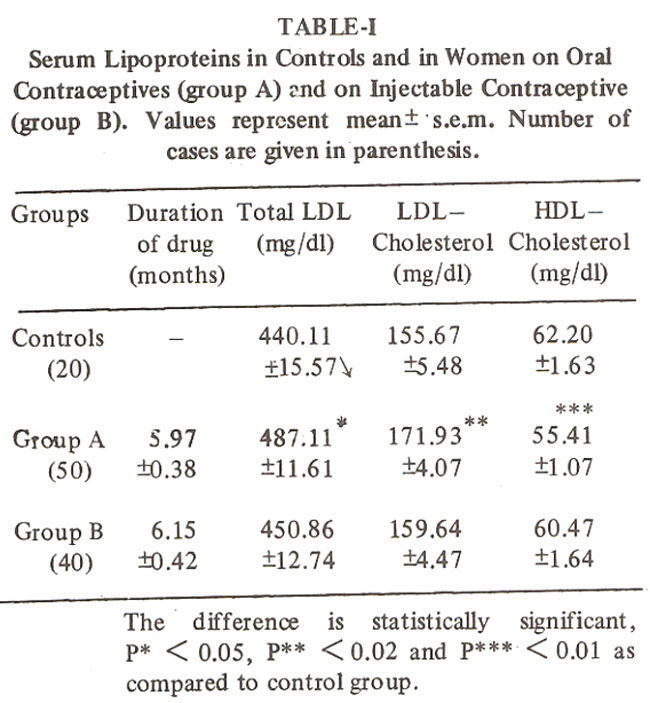
Table I indicates that the group of women using oral contraceptives (group A), was found to have significantly higher levels of total LDL (P < 0.02), LDL-cholesterol (P < 0.05) and significantly lower levels of HDL.cholesterol (P <0.01) than that of controls. On the contrary, no significant difference in these values, was observed in women on injectable contraceptive (group-B).
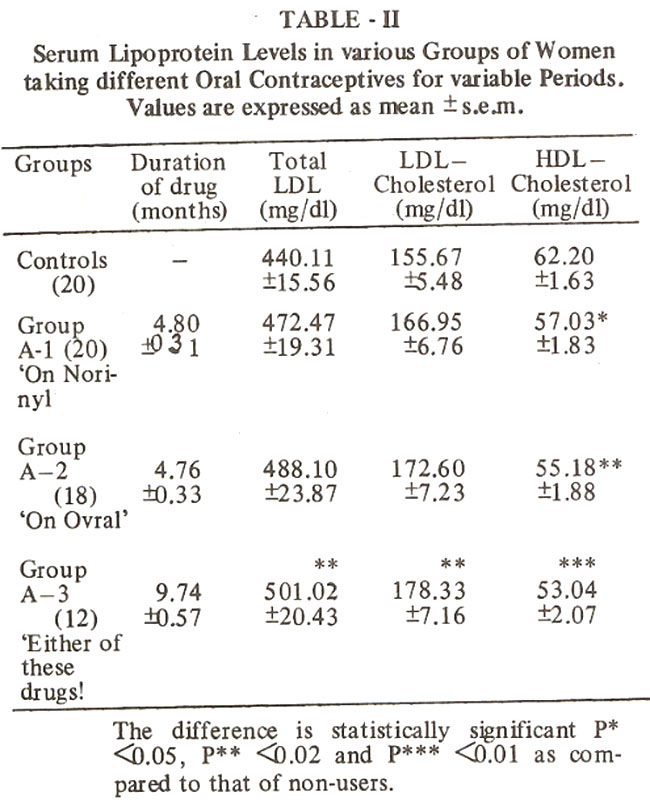
Table II shows the serum lipoprotein alterations associated with the use of different oral contraceptives for a variable period of time. The group of women on ‘Norinyl’ pills (group A-i) and on ‘Ovral’ pills (group A-2) revealed a significant decrease in HDL-Cholesterol (P< 0.05 & P <0.02 respectively) but total LDL and LDL cholesterol did not change significantly in these groups as compared to that of controls. Long- term use of these contraceptive pills by women (group A-3) however, resulted in a significant elevation of total LDL, LDL-cholesterol and a significant fall in HDL-cholesterol (P <0.01) as compared to that of non-users.
Results shown in Table - III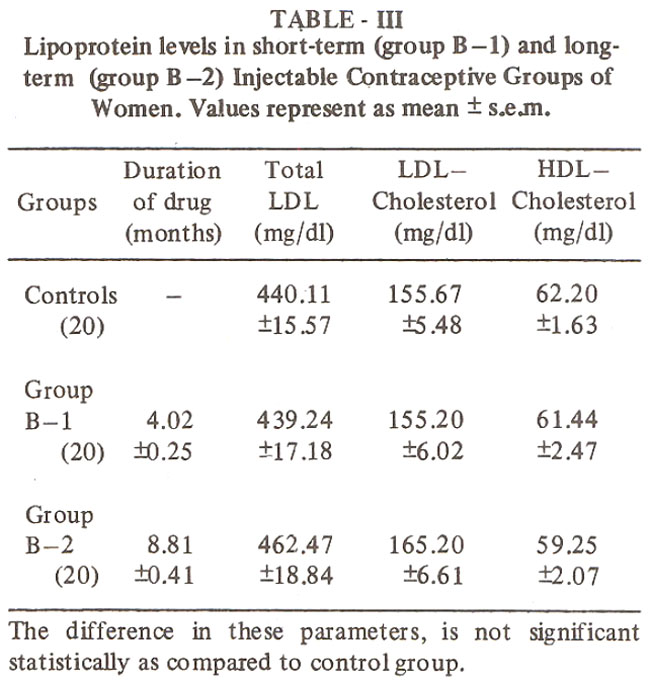
indicate no significant disturbances in low density and high density lipoprotein levels in both the groups of women (groups B-i and B-2) receiving injectable contraceptive for variable durations as compared to controls.
DISCUSSION
Metabolic alterations and side effects of oral and injectable contraceptives are only begin-fling to be studied in Pakistan. In this study, changes of low density and high density lipoprotein levels found in women taking oral contraceptives, are in conformity with the reported values of Wynn et al.6 and Wallace et al.7 This study has also demonstrated that the levels were more affected in women on long-term oral contraceptive therapy than in women on short-term therapy. So far it has not been possible to identify those women who are likely to develop lipoprotein abnormalities or clinical diseases like hypertension and coronary heart disease. Long-term prospective studies are likely to be more informative, though such studies will encounter numerous problems in long-term follow up.
The administration of injectable contraceptive in women, was not found to be associated with significant changes in serum lipoproteins. This data is the first of its kind to be available in our country. Comments and comparison about the difference can not be made with the result of others because the study. of serum lipoproteins in women receiving injectable contraceptives, has not been reported by any other research worker.
ACKNOWLEDGEMENT
We are grateful to Prof. Altaf Hussain Rathore and Prof. Waheed Baig Mirza for their proper guidance and co.operation in the preparation of this paper.
REFERENCES
1. Barton, G.M., Freeman, P.R. and Lawson, J.P. Oral contraceptives and serum lipids. J. Obstet. Gynaec. Brit. Comm., 1970;77:551.
2. Wallace, R.B., Hoover, J, Sandler, D., RifKind, B.M. and Tyrola, H.A. Altered plasma lipids associated with oral contraceptive or estrogen consumption. Lancet, 1977; 2: 11.
3. Knopp, R.H., Walden, C.E., WaN, P.W. and Hoover, J.J. Effect of oral contraceptives on lipoprotein triglyceride and cholesterol; relationsbips to estrogen and progectin potency. Am. J. Obstet. Gynecol., 1982; 142: 725. l.A.Blood lipids and coagulation studies In females taking oral contraceptives. Pakistan 3.
4. Fayyaz, A., Fayyaz-ud-Din, Haider, Z. and Rana, Med. Ret, 1980; 19: 31.
5. Shalique, M. and Majeed, T. Effect of oral and inj ectable contraceptives on weight, blood pressure and serum lipids. J. Pure Applied Sd., 1984; 3:37.
6. Wynn, V., Doar, J.W.H., Mills, G.L. and Stokes, T. Fasting serum triglycerides, cholesterol, and lipoprotein levels during oral contraceptive therapy. Lancet, 1969;2: 756.
7. Wallace, R.B., Hoover, J., Barret-Connor, E., RifKind, B.M., Hunninghake, D.B., Mackenthun, A. and Heiss, G. Altered plasma lipid and lipoprotein levels associated with oral contraceptive and estrogen use. Lancet, 1979; 2: 111.
8. Dyerbery, J. and Home, H. Study of lipoproteins In women on oral contraceptives. Acta. Med. Scand., 1972; 191: 413.
9. Gustafson, A. and Svanborg, A. Gonadal steroid effects on plasma lipoprotein and indMdual phospholipids. J.clin. Endocrinol. Metab., 1972; 35: 203.
10. Burstein, M. and Samaille, 3. Colorimetric methods for the determination of low density lipoproteins. La. Press Med., 1958; 66: 974.
11. Lopes-Virella, M.F., Stone, P., Ellis, S. and Colwell, J.A. Cholesterol determination in high-density Lipoprotein separated by three different methods. Clin. them., 1977; 23: 882.
Journal of the Pakistan Medical Association has agreed to receive and publish manuscripts in accordance with the principles of the following committees:


