

Arshad Hussain Faruqi ( Department of Microbiology, University of Karachi. )
A. Farid Khan ( Department of Microbiology, University of Karachi. )
Khursheed Mi Khan ( Department of Microbiology, University of Karachi. )
Tahir Saeed Haroon ( Department of Dermatology, Jinnah Post-graduate Medical Centre, Karachi. )
November 1987, Volume 37, Issue 11
Original Article

Abstract
The study was aimed initially to find out the prevalence of dermatomycoses in Karachi and its correlation with prevailing climatic conditions and humidity. The results indicated a direct relationship between dermatomycoses and climatic conditions. With the rise in temperature and humidity a corresponding rise in prevalence of dermatomycoses was recorded. The incidence increases in summer and comes down in winter. More persons are exposed during May to August and then a gradual decline occurs. High temperature and humidity are the factors conducive for increased incidence (JPMA 37: 293, 1987.
INTRODUCTION
Climatic conditions and seasonal variations have a direct influence on the incidence of certain mycotic infections, incidence of coccidioidomycoses in California reaches its peak during the dry, dusty, fall months and ebbs during the wet winter months1,2. In Uruguay, Mackinnon3 reported that sporotrichosis occurs mainly during the fall and early winter months.
Mycotic infections are more common in tropical and sub-tropical regions on account of high temperature and humidity and it is universally established that dermatophytic infections are primarily concentrated in hot and humid areas of the tropics4 Alongwith these climatic conditions, congregation of a large number of people and their poor standards of hygiene give impetus to high prevalence of infections.
Pakistan’ is located between 22° and 37° north of equator. Its coastal regions experience high temperatures coupled with high humidity due to moisture laden winds blowing from the sea.
The present study deals mainly with dermatomycoses in relation to climatic conditions and seasonal variation. Karachi experiences continental type of climate in the northern portion of the city and a coastal type of climate nearer the sea. This accounts for high incidence of dermatomycoses in Karachi during May to August.
MATERAL AND METHODS
The present work includes the studies of dermatomycoses carried out during November, 1979 to July, 1982. Data regarding the normals of temperature, relative humidity and rainfall for this period was procured from Meteorological Department (Table I).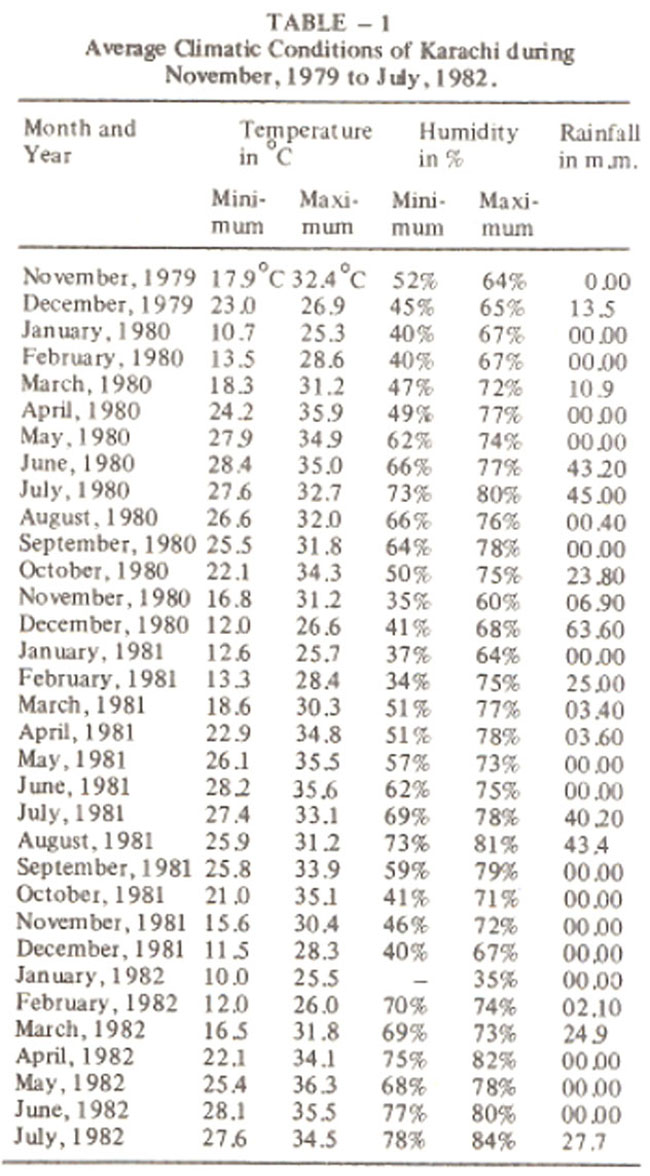
1324 cases of various types of dermatomycoses were diagnosed clinically and confirmed by isolation and identification of the etiologic agents5.
RESULTS AND DISCUSSION
The present work suggests that the incidence of dermatomycoses has significant relationship with climatic conditions and seasonal variations.
According to data (Table II)
the incidence of dermatomycoses increases with the increase in temperature and humidity in Karachi. From January to April the incidence of different types of dermatomycoses was 31.5% in 1980 and 19.25% in 1981 and 32.25% in 1982. Similarly the occurrence of dermatomycoses during September to December in 1980 was 31.75% and in 1981 31.75%. However, during the period May to August in all the years, the incidence of infections almost doubled. During these months the average incidence was 62.75% in 1980, 60% in 1981 and 71.66% in 1982 (Figure )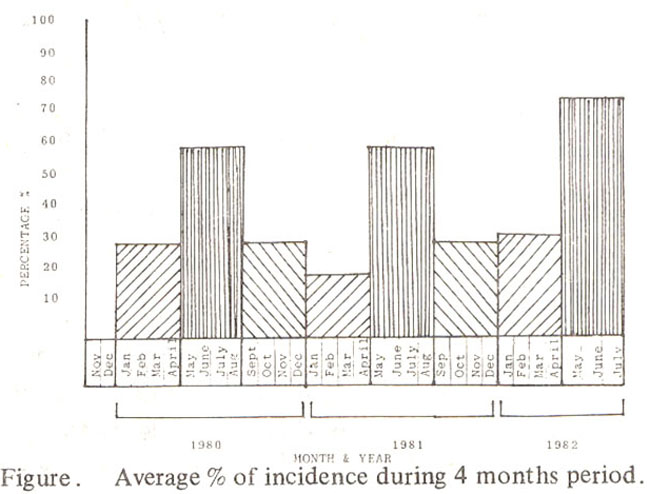
obviously attributable to the rise in temperature and humidity. Rainfall during this period also adds to the increase in infection due to further increase in humidity (Table 1). Similar observations have been reported by Ajeilo.4
REFERENCES
1. Smith, C.E. Epidemiology of acute coccidioidomycosis with erythema nodosum (“San Joaquin” or “valley fever”). Am. J. Public Health, 1940; 30:600.
2. Smith, C.E., Beard, R.R., Rosenberger, H.G. and Whiting, E.G. Effect of season and dust control of coccidioidomycoses. JAMA., 1946: 132:833.
3. Faruqi, A.H., Khan, K.A., Haxoon, TS., Khan, A.F. (1984). Study of 1324 cases of Dermatomy coses. Indian j. Dermatol.,29 No.3, 7-16.
4. Ajello, L. Natural history of the Dermatophytes and related fungi. Mycopathologia, Mycologia, Applicata, 53: 93-110.
Journal of the Pakistan Medical Association has agreed to receive and publish manuscripts in accordance with the principles of the following committees:


