

Saadia Rashid ( Department of Anatomy, FUMC. Fauji Foundation Medical College, Islamabad. )
January 2014, Volume 64, Issue 1
Original Article

Abstract
Objective: To evaluate the effects of alphatocopherol supplement on proximal convoluted tubular diameter of kidney in diabetic mice.
Methods: The randomised controlled trials was conducted partly at the National Institute of Health (NIH), Islamabad, and partly in Army Medical College, Rawalpindi, from November 2009 to November 2010. Thirty adult female mice BALB/C were randomly divided into three equal groups. Group A served as the control group. Group B was made diabetic by the intraperitoneal injection of streptozotocin. Group C received injection streptozotocin and was fed with alphatocopherol (vitamin E) supplemented diet. After 12 weeks, the animals were sacrificed and their kidneys were removed for histomorphological study.
Results: Diabetes caused significant changes in the diameter of proximal tubule of Experimental Group B (diabetic) compared to the controls in Group A, but these changes were prevented in alphatocopherol treated Group C. Tubular diameter in Group B was significantly reduced compared to the Control Group A (p <0.05), but there was no statistical difference in tubular diameter of Group C and Group A (p > 0.05).
Conclusion: Significant difference in proximal tubular diameter of kidneys between diabetic and alphatocopherol treated diabetic mice confirm that vitamin E does extend a protective role in improving diabetic nephropathy.
Keywords: Alphatocopherol, Proximal tubular diameter, Army Medical College, Rawalpindi. (JPMA 64: 46; 2014).
Introduction
Diabetes mellitus (DM) is a complex syndrome which may be due to decrease in the synthesis of insulin (Type-I diabetes) or due to decrease in the secretion of insulin from b-cells of islets of Langerhans of pancreas (Type-II diabetes). Severe insulin deficiency results in gross abnormalities in glucose homeostasis and lipid metabolism.1 The prevalence of diabetes in the world among adults (aged 20-79 years) was 6.4% affecting 285 million adults in 2010, and it may increase to 7.7% affecting 439 million adults by 2030. Between 2010 and 2030, there may be 69% increase in the number of adults with diabetes in developing countries and 20% increase in the developed countries.2
Indeed, there is widespread acceptance of the possible role of reactive oxygen species (ROS) generated as a result of hyperglycaemia in causing many of the secondary complications of diabetes such as retinopathy, neuropathy, cardiomyopathy and nephropathy.3 Diabetics have 20-fold increase in the risk of renal failure.4 Since numerous studies demonstrated that oxidative stress, mediated mainly by hyperglycaemia-induced generation of free radicals, it has become clear that reducing oxidative stress through treatment with antioxidants might be an effective strategy for reducing diabetic complications.5 Vitamin E has been reported to protect against diabetic renal injury. For this reason, there has been an increased interest in the use of dietary antioxidant supplementation as an intervention to attenuate diabetic complications.6 Vitamin E is a generic term used for tocopherol and tocotrienols. It is a membrane bound lipid soluble and naturally occurring antioxidant that has been shown to protect animal tissue against oxidative damage such as lipid peroxidation both in vitro and in vivo.7 This study was undertaken to evaluate the effects of alpha tocopherol on the proximal convoluted tubules diameter of kidney in diabetic mice.
Subjects and Methods
The study was conducted partly at the National Institute of Health (NIH), Islamabad, and partly at the Army Medical College, (AMC), Rawalpindi. Thirty adult female mice BALB/C (weight 25-40g) were obtained from the animal house of NIH. The mice were kept under standard laboratory conditions and were maintained on palleted form of laboratory diet which was prepared at the animal house and water ad libitum. Animals were divided into 3 equal groups. Group A (Negative Control) was maintained on routine NIH diet for 12 weeks; Group B (Positive Control) was made diabetic by giving single injection of streptozotocin 120mg/kg body weight per animal intraperitoneally. The group was maintained on routine NIH diet for 12 weeks; and Group C which received single injection of streptozotocin and was fed with routine NIH diet enriched with alphatocopherol (500 mg/kg of diet) for 12 weeks.
The animals were sacrificed after 12 weeks and their kidneys were removed for histomorphological analysis.
Results
The diabetic Group B mice were sluggish throughout the trial, while Group C mice were sluggish initially but later became apparently healthy and active. No death was observed in any group.
Tubular diametres of 20 randomly selected rounded proximal tubules were measured from the basement membrane of cells on one side to the basement membrane of cells on the opposite side in five fields at 40X by using ocular micrometre. Three observations were noted and their average was taken as the final reading.
Proximal and distal convoluted tubules could be easily differentiated in Haematoxylin and Eosin (H & E) stain. Proximal tubules were more in number and of larger diameter having low columnar cells with brush border, while distal tubules were smaller in diameter, less in number, having cuboidal epithelium without brush border. The basement membrane of tubular epithelium was strongly Periodic acid schiff stain (PAS) positive. Brush border were also strongly stained with PAS stain while distal convoluted tubule (DCT) stained lighter than proximal convoluted tubule (PCT) (Figure-1a).
Mean tubular diameter of PCT in kidney of control Group A were 44+2.415µm and 43.375+2.433µm respectively (Table).
Mean tubular diameter of PCT in kidneys of experimental Group B were 30+2.635µm and 29.625+2.639µm (Figure-1b)
respectively which was statistically significant from control Group A (p<0.05) (Figure-2).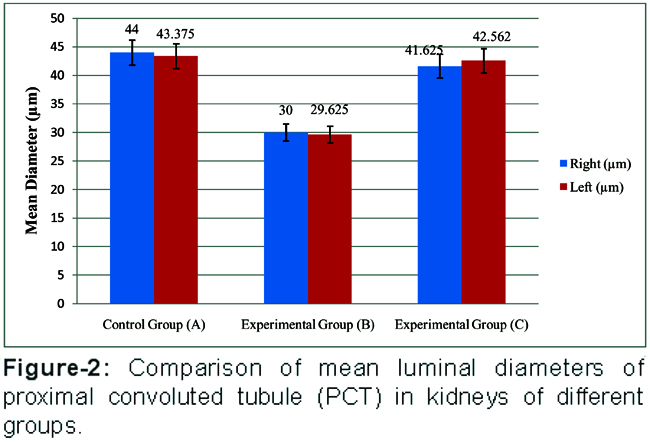
Mean tubular diameter of right and left kidney in Group C were 41.625±2.129µm and 42.562±1.762µm respectively which was significantly different from Group B with (p<0.05). There was no statistically significant difference in mean tubular diameter between Group A and Group C (p>0.05).
Discussion
Diabetic nephropathy is the most common cause of chronic renal disease and is the foremost indication for dialysis and transplantation. Various studies have reported protective effects of antioxidants such as groundnuts oil,8 soyabean oil9 and vitamin E10 against the oxidative damage of diabetes. Prakasam11 observed that levels of alphatocopherol, chain-breaking antioxidant was significantly decreased in liver and kidney of streptozotocin diabetic rats. There is also evidence that increase in glucose concentration depresses the natural antioxidant defence system of the body. The imbalance between oxygen-free radicals and antioxidants defence system results in DNA damage and, hence, tissue damage.
This suggests that demand for antioxidants like vitamin E is increased due to activation of free radical related metabolism in diabetes. Impaired generation of antioxidants results in increase in oxidative injury due to the failure of protective mechanism. So any compound with rich antioxidant properties might contribute towards partial or complete alleviation of organ damage.12
The current study used alphatocopherol as an antioxidant and found that it had blood glucose-lowering effects on streptozotocin-induced diabetic mice. It was further indicated that structural changes in tissue taken from PCT of the kidneys of diabetic group were near to normal in those diabetic animal which were fed with alphatocopherol supplemented diet.13 Considering our results, significant difference in blood glucose level as well as other diabetic nephropathic parameters between the diabetic and alphatocopherol-treated diabetic mice confirm that vitamin E does extend a clear protective action against streptozotocin-induced diabetic nephropathy.
Regarding tubular diameter, our study showed that there was a remarkable difference between the luminal diameter of PCT when compared between diabetic and diabetic mice treated with vitamin E (p<0.05). Tubular atrophy in diabetic nephropathy (DN) ultimately leads to end-stage renal disease.14
Hyperglycaemia can induce deoxyribonucleic acid (DNA) fragmentation and stimulate apoptosis in PCT because of increased oxidative stress. It causes tubular atrophy which may contribute to development of DN. Antioxidants might inhibit the development of DN by suppressing apoptosis.15 Kumar16 observed apoptosis of tubular cells of cortex and medulla in streptozotocin induced diabetic rats at 2 and 12 weeks of experimentation and its reversal by insulin. DN is not only a glomerular disease, but is also characterised by impaired tubular function as well. Injury to the proximal tubules has been suggested by the urinary excretion of low molecular weight proteins and tubular enzymes.17
The finding of tubular diameter in experimental Group C after treatment with vitamin was strongly supported by Anjaneyulu18 who showed that catechin administration, which is antioxidant, helps in the prevention of tubular atrophy in cyclosporine induced nephrotoxicity. Some researchers have proved that vitamin E improved the glomerular function, but did not have effect on tubular function.19
In this study the general morphology of PCT of alphatocopherol-treated mice compared with diabetic mice was much improved and seemed quite normal in appearance compared to those in diabetic mice.
Conclusion
Considering our results, significant difference in proximal tubular diameter of kidney between the diabetic and alphatocopherol treated diabetic mice confirm that vitamin E does extend a clear protective action against streptozotocin induced diabetic nephropathy. However exact mechanism of action of this protective effect is not known.
References
1. Sreemantula S, Kilari EK, Vardhan VA, Jaladi R. Influence of antioxidant (L- ascorbic acid) on tolbutamide induced hypoglycaemia/antihyperglycaemia in normal and diabetic rats. BMC Endocrine Disorders 2005; 5: 2.
2. Shaw JA, Sicree RA, Zimmet PZ. Global estimates of the prevalence of diabetes for 2010 and 2030. Diabetes Resear Clinil Pract 2010; 87: 4-14.
3. Bhandari U, Jain N, Pillai KK. Further Studies on Antioxidant Potential and Protection of Pancreatic ?-Cells by Embelia ribes in Experimental Diabetes. Exp Diabet Resear 2007; 2007: 1580.
4. SathshsekarI D, Subramanian S. Beneficial Effects of Momordica charantia Seeds in the treatment of STZ-Induced Diabetes in Experimental Rats. Biological Pharmaceutical Bull 2005; 28: 978-83.
5. Johansen JS, Harris AK, Rychly DJ, Ergul A. Oxidative stress and use of antioxidants in diabetes linking basic science to clinical practice. Cardiovas Diabetol 2005 ; 4: 5.
6. Melhem M.F, Craven PA, Derubertis FR. Effects of Dietary Supplementation of -Lipoic Acid on Early Glomerular Injury in Diabetes Mellitus. J Am Soc Nephrol 2001; 12: 124-33.
7. Nader MM, Eissa LA, Gramil NM, Ammar SM. Effect of nitric oxide, vitamin E and selenium on streptozotocin induced diabetic rats. Saudi Pharmaceutical J 2007; 15 ; 1, 23, 32.
8. Ramesh B, Saravanan R, Pugalendi KV. Effect of dietary substitution of Groundnut oil on blood glucose, lipid profile, and redox status in streptozotocin-diabetic rats. Yale J Biol Med 2006; 79: 9-17.
9. Sena CM, Proenca T, Nunes E, Santos MS, Seica RM. The effect of soybean oil on glycaemic control in Goto-Kakizaki rats, an animal model of type 2 diabetes. J Med Chem 2008; 4: 293-7.
10. Ruperez FJ, Garcia-Martinez D, Baera B, Maeso N, Cifuentes A,Barbas C, et al. Evolution of oxidative stress parameters and response to oral vitamins E and C in streptozotocin-induced diabetic rats. J Pharm Pharmacol 2008; 60: 871-8.
11. Prakasam A, Sethipathy S, Pugalendi KV. Antiperoxidative and antioxidant effects of Laseana Esculenta Root extract in streptozotocin induced diabetic rats. Yale J Biol Med 2005; 78: 15-23.
12. Wu JH, Ward NC, Indrawan AP, Almeida CA, Hodgson JM, Porudfoot JM, et al. Effect of _tocopherol and mixed tocopherol supplementation on markers of oxidative stress and inflammation in type 2 diabetes. Clin Chem 2007; 53: 511-9.
13. Harding AH, Wareham NJ, Bingham SA, Khaw K, Luben R, Welch A, et al. Plasma vitamin C level, fruit and vegetable consumption and the risk of new-onset type 2 diabetes mellitus: The European prospective investigation of Cancer - Norfolk prospective study. Arch Intern Med 2008; 168: 1493-9.
14. Najafian B, Kin Y, Crosson JT, Mauer M. Atubular glomeruli and glomerulotubular junction abnormities is diabetic nephropathy. J Am Soc Nephrol 2003; 14: 908-17.
15. Lee EY, Lee MY, Hong SW, Chung CH, Hong SY. Blockage of oxidative stress by vitamin C ameliorates albuminun and renal sclerosis in experiemtnal diabetic rats. Yonsei Med J 2007; 48: 847-55.
16. Kumar D, Zimpelmann J, Robertson S, Burns KD. Tubular and interstitial cell apoptosis in the streptozotocin-diabetic rat kidney. Nephron Exp Nephrol 2004; 96: 77-88.
17. Choi YE, Ahn SK, Lee WT, Lee JE, Park SH, Yoon BB, et al. Soyabean ameliorate diabetic nephropathy in rats. Evid Based Complement Alternat Med 2010; 7: 433-40.
18. Anjaneyulu M, Tirkey N, Chopra K. Attenuation of cyclosporine induced renal dysfunction by catechin: possible antioxidant mechanism. Ren Fail 2003; 25: 691-707.
19. Farvid MS, Jalali M, Siassi F, Hosseini M. Comparison of the effects of vitamins and/or mineral supplementation on glomerular and tubular dysfunction in type 2 diabetes. Diabetes Care 2006; 29: 747-8.
Journal of the Pakistan Medical Association has agreed to receive and publish manuscripts in accordance with the principles of the following committees:


