

Abdul Jabbar ( Entomological Research Labs, National Agricultural Research Centre, Islamabad. )
Shaheena Akhtar Khawaja ( Department of Biology, Quaid-i-Azam University, Islamabad. )
Aftab Iqbal ( Department of Biology, Quaid-i-Azam University, Islamabad. )
Salman Akbar Malik ( Department of Biology, Quaid-i-Azam University, Islamabad. )
November 1990, Volume 40, Issue 11
Original Article

ABSTRACT
The effect of sub-lethal doses of Malathion and Methyl-parathion was studied on the rat liver enzymes. Intravenous administration of both insecticides at weekly interval for four weeks resulted in increase in heart and spleen weight. Short term (24 hr.) and long term (4 weeks) treatment with insecticides resulted in increased specific activities of liver enzymes, Acid, phosphatase, Alkaline phosphatase, Glutamate dehydrogenase, Glutamate oxaloacetate transaminase and Glutamate pyruvate transaminase. The increase in enzyme activity was not as profound when the insecticide administration was spread over 4 weeks. Malathion had greater effect than Methyl-parathion on the biochemical parameters studied (JPMA 40 : 266, 1990).
INTRODUCTION
Pesticides are of benefit to mankind as they protect crops and increase the yield, but they can create serious problems when used, handled and stored improperly. In addition to their ability to destroy the environment, humans can also be poisoned by pesticides, if proper precautionary measures are not adopted. In Pakistan pesticide usage first started in 1954 with the import of 254 m. tons of formulated products which in 1987 increased to 4388m. tons active ingredients1. Of the organophosphates, Malathion and Methyl-parathion are among the most widely used insecticides. Degree of toxicity of organophosphate insecticides varies widely. These compounds are absorbed in humans through all the routes including skin, lungs and gastrointestinal tract2. Long term exposure to residues of insecticides in food or water causes liver damage, vein thrombosis, carcinomas, sarcomas and depressed growth3,4. Marked effects on nervous system and other body tissues of cconsumers have been reported5. In the present investigation the short and long term effects of Malathion and Methyl-parathion on the general development of the animals and specifically on the activities of the liver enzymes were studied.
MATERIALS AND METHODS
Animals
Mature male albino rats, 8-10 weeks old were obtained from Department of Biological Sciences, Quaid-iAzam University, Islamabad. The rats were maintained in controlled environment. Food and water were available adlib.
Chemicals
The chemicals used in this study were of analytical grade. The kits used for the assays of Glutamate Oxaloacetate Transaminase (GOT) and Glutamate Pyruvate Transaminase (GPT) enzymes were supplied by the Wakopure Chemical Industries Ltd. Japan. Insecticides, Malathion (96% active ingredient) and Methyl- parathion (99% active ingredient) were obtained from National Institute of Health, Islamabad.
Experimental Design Short term treatment
The animals were divided into three groups, one serving as control (carrier solution only), to the other group Malathion 0.96 mg/kg body weight, dissolved in corn oil was injected intravenously while the third group received Methyl-parathion 0.04 mg/kg body weight. The animals were killed after 24 hours by cervical dislocation and dissected. The liver removed from each animal was immediately weighed and processed further after washing with ice cold saline solution.
Long term treatment
The procedure was the same as that for short term except that the dose of insecticides was divided in 4 equal parts and each part injected at weekly interval. The animals were killed after 4 weeks and tissue further processed for analysis.
Preparation of liver tissue for enzyme assays
Liver tissues were minced with fine pair of scissors and homogenized in (1:10 v/v) ice cold 50mM phosphate buffer (pH 7) using a mechanized homogenizer. An aliquot of this homogenate was used for the estimation of total protein. Another aliquot of the homogenate was centrifugcd, at 10,000 rpm for 20 minutes at 4°C, in Kokusan modelH 251 centrifuge. The supernatant was decanted and analysed.
In vitro treatment
The supernatant from untreated rat liver preparations was assayed for enzyme activities with and without Malathion and Methyl- parathion dissolved in corn oil. The concentrations of insecticides were equivalent to those used for in vivo experiments.
Analytical procedures
(i) Protein concentrations
Protein in liver samples (homogenates and supernatants) was determined according to themethod of Lowry et al6, using Folin Phenol reagent. Protein concentration was calculated from calibration curve based on Bovine Serum Albumin as standard.
(ii) Acid Phosphatase (E.C. No. 3.1.3.2.)andAlkaline Phosphatase (B.C. No. 3.1.3.1.)
Acid phosphatase and alkaline phosphatase activity was determined according to the method described by Walter and Schmitt7, using para-nitrophenol phosphate (p-NPP) as substrate.
(iii) SorbitolDehydrogenase (B.C. No. 1.1.1.14.)
The sorbitol dehydrogenase activity was measured by the method of Berdgmeyer8 ,using fructose as substrate.
(iv)Glutamate Dehydrogenase (B.C. No. 1.4.1.3.)
Glutamate dehydrogenase activity was assayed by the method of Carlson et al9.
(v) Glutamate Oxaloacetate Transaminase (B.C. No. 2.6.1.1.) and Glutamate Pyruvate (B.C. No. 2.6.1.2.).
Glutamate oxaloacetate transaminase and glutamate pyruvate transaminase were assayed by the methods of Reitman and Frankel10.
(vi) Statistical analysis
The results were analysed statistically by complete block design. Two way analysis of variance and Duncan’s Multiple Range Test were applied to test the significance at P=0.05.
RESULTS
The treated groups of rats receiving Malathion and Methyl- parathion for 4 weeks continued to grow normally with almost equal body weight as in the control rats and showed no visible toxic symptoms. The weight of various organs were recorded after 4 weeks treatment with insecticides (Table I).
The ratio of organ weight to body weight indicated that the weight of heart and spleen increased in the treated animals; whereas there was no difference in weight of liver, kidney and lungs of the control and the treated animal.
Effect on total protein in liver
Total protein concentration was estimated both in control and treated animals. After long term treatment with insecticides a decline in the level of protein content in the liver of animals was observed, the corresponding values for Malathion and Methyl-parathion were 29.6 and 37.5 mg/kg respectively. It was observed that decrease in protein contents was significantly greater in liver extracts of animals treated with Malathion than those treated with Methyl-parathion. Treatment with Malathion resulted in a decrease parathion. Treatment with Malathion resulted in a decrease of 33.6% whereas a decrease of 16.8% was observed in Methy-parathion treated animals as compared to control (Table II).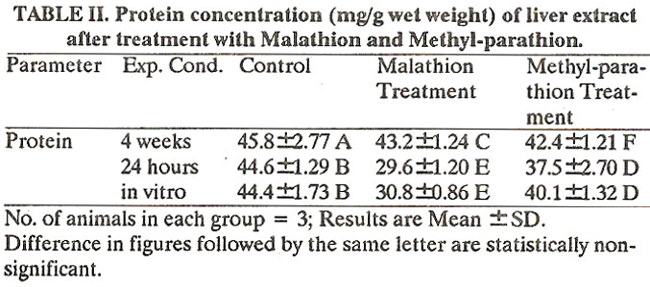
Short term treatment with Malathion and Methyl-parathion also resulted in a decrease of protein concentration of liver. In invitro experiment, decline in the level of protein was less but non-significant than for in vivo experiment for both insecticides.
Effect of insecticides on liver enzyme d’ctivities
The activities of vatious liver enzymes as affected by insecticides are presented in Table III.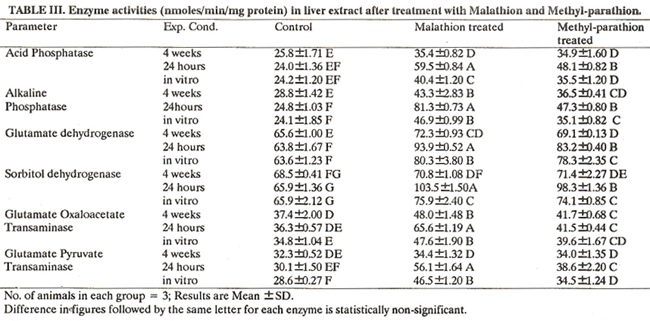
(1) Acid phosphatase: Specific activity of acid phosphatase in liver extract of animals treat&d with Malathion and Methyl- parathion showed a significant increase as compared to the control under all the experimental conditions. The increase in specific activity after short term treatment was significantly higher than after long term treatment. However, the administration of Malathion resulted in a greater enzyme activity than Methyl-parathion after short term treatment but the effect of the long term treatment with both insecticides for four weeks did not differ from each other.
(2) Alkaline phosphatase: The administration of Malathion and Methyl-parathion to animals for short term in vivo and in vitro and for long term in vivo resulted in significant increase in the specific activity of this enzyme. In short term treatment with Malathion and Methyl-parathion, the specific activity of the enzyme increased by about 3 and 2 folds respectively than controls. After long term treatment the increase was 1.5 and 1.2 times respectively compared to corresponding controls. Malathion had a greater effect on specific activity of this enzyme as compared to Methyl-parathion.
(3) Glutamate dehydrogenase: The rate of increase in the activity of GDH varied under different conditions. The maximum increase (47.3%) in specific activity was observed in liver of animals treated with Malathion for 24 hours. While in animals treated with Methyl-parathion it was 30.5% higher than controls. The treatment of liver extracts with insecticides in vitro had the same effect on specific activity but it was significantly less than in vivo conditions. In in vitro conditions the increase in specific activity was 26.3% and 22.6% with Malathion and Methyl-parathion respeeLively. The long term treatment with insecticides had almost the same ecfect on the specific activity of GLDH but the activity was significantly higher as compared to control.
(4) Sorbitol dehydrogenase: The short term treatment, with Malathion in vivo had more prominent effect on the specific activity of SDH than in in vitro and long term treatment. The specific activity of SDH increased from 65.91 nmoles/min/mg protein in the control to 103.5 nmoles/min/mg protein with Malathion treatment. Short term treatment in vivo and in vitro with Methyl-parathion also significantly increased the specific activity of SDH. Its specific activity increased by 48.7% in in vivo and 8.1% in vitro as compared to the control. Administration of Methyl-parathion in multiple doses had little effect on the activity of SDH.
(5) Glutamate oxaloacetate transaminase: In short term treatment with Malathion in vivo 80.6% and in vitro 36.7% increase in specific activity of GOT was observed while there was only 28.2% increase in specific activity of GOT in liver of animals receiving multiple dose of Malathion over a longer period. Short and long term effects of Methyl-parathion on the specific activity of GOT revealed no statistical difference. The increase in specific activity was 14.3% as compared to control after short term administration of insecticide in vivo, whereas after long term treatment, this increase was only 11.4%.
(6) Glutamate pyruvate transaminase: The short term effect of Malathion on specific activity of GPT resulted in 86.3% increase in in vivo and 27.9% increase in vitro, while the administration of Methyl-parathion in vivo and in vitro did not differ significantly. It was observed that there was statistically no change in the specific activity of the enzyme when both the insecticides were given to the animals for a longer period. To conclude, it was observed that if the insecticides were given in smaller doses for a longer period, the animals adjusted by probably detoxifying these toxicants. However, if the insecticides are given as a single dose and samples analysed 24 hours after administration all the enzymes studied showed enhanced specific activities.
DISCUSSION
The average body weight of the animals after insecticide treatment for 4 weeks showed no variation than the controls. However, the loss of weight has earlier been observed in rats treated with Malathion11 and also in rabbits treated with Methyl-parathion13. The ratio of organ weight to body weight increased to some extent in all the organs studied, but it was more prominent in heart and spleen, after the administration of Malathion and Methyl-parathion. Similar results have been reported when rats were treated with organophosphates11,13,14. The post-treatment analysis revealed loss in protein concentration after both short and long term exposure to Malathion and Methyl-parathion. Earlier reports have also shown the reduction in protein concentration in liver of rats and fish by the administration of Malathion and other organophosphates14,15. Reduction in protein may be due to inhibition of amino-acid metabolizing enzymes with subsequent inhibition of translation. Organophosphate induced alteration in enzyme activities in liver tissues16. In the present investigation the activity of acid phosphatase was increased with the treatment of Malathion and Methyl-parathion. This agrees with the fmdings for fish ovary17 and in brain tissues of hens treated with Parathion18. Although a decline was observed in the total protein, the increase in AcP may be the reflection that most of the decrease occurred in the non-enzymic protein, therefore changing the ratio in the favour of enzymic protein. Alkaline phosphatase activity was also increased by the administration of the insecticides as compared to the control animals. Similar observations have been made in rat liver and fish liver after treatment with Parathion, EPN, Dichlorvos (DDVP) and Malathion17,19. The increase in the enzyme activity maybe due to liver cell damage. Glutamate dehydrogenase activitywas observed tobe enhanced under all the experimental conditions. These results are in agreement with the earlier findings which show elevation in GLDH activity in various tissues of fish with the treatment of Methyl-parathion and other organophosphates20. Sorbitol dehydrogenase (SDH) activity was also observed to increase after the administration of Malathion and Methyl-parathion. The increase in the activity of SDH in liver, brain and muscle was also found after treating the Indian cat and fish with organophosphate insecticides21. Similarly, increase in the activity of GOT was observed after administration of Malathion and Methyl-parathion. These findings are in agreement with the previous findings on the influence of chiorpyrifos and diazinon on the GOT activity in rat liver22. The activity of GPT was increased with the treatment of Malathion and Methyl-parathion. Similar kinds of results have been re?orted when the insecticides were administered to the rats21 . Malathion and Methyl-parathion had more profound effect on the liver enzymes in in vivo (short term) rather than in vitro treatment. This maybe attributed to the fact that Malathion and Methyl-parathion are converted to their metabolic derivatives in liver whose toxicity is several times greater than that of the original compounds23. In a similar study Jabeen22 has reported increase in various rat liver enzymes under the effect of organophosphate insecticides, chlorpyrifos and diazinon. Most of the enzymes tested in liver tissues showed increased specific activities suggesting intra and extra hepatocellular release by necrosis of the hepatocytes. Since both cytoplasmic (SGPT) and particular mitochondrial (SGOT) and lysosomal enzymes (Ac + Al P) are elevated suggests generalized toxic effects within the hepatocytes. Finally, it may be emphasized that the results of our study using sub-lethal doses may create some awareness among the users to the fact that these insecticides, even if taken in only small quantities, are dangerous to health hence proper precautionary measures should always be applied while handling these insecticides.
REFERENCES
1. Jabbar, A., Inayatullah, C., Alishah, A. and Bajwa, M.I. Environmental considerations of pesticide production and usage in Pakistan. Country paper, UNIDO/UNDP seminar, Jakarta, Indonesia, Nov. 28-Dec. 2, 1988.
2. Namba, T., Nolte, C.T., Jakrel, J. and Grob, D. Poisoning due to organophosphate insecticides. Acute and chronic manifestation. Am. J. Med., 1971; 50 : 475.
3. Reubar, M.D. Hepatic vein thrombosis in mice ingesting chlorinated hydrocarbans. Arch. Toxicol., 1977; 58: 163.
4. Reuber, M.D. Carcinomas, sarcomas and other lesions in osbornmended rats ingesting endrin. Exp. Cell Biol., 1978; 3: 129.
5. Morgan, D.P. and Roan, C.C. Absorption, storage, and metabolic conversion of ingested DDT and DDT metabolites in man. Arch. Environ. Health, 1971; 22: 301.
6. Lowry, O.H., Rosebrough, NJ., Farr, A.L. and Randall, R.J. Protein measurement with the Folin phenol reagent. J. Biol. Chem., 1951; 193: 265.
7. Walter, K. and Schmitt, C. Acid and alkaline phosphatase in serum (two point method). Methods Enzyme Anal., 1974; 2: 856.
8. Berdgmeyer, H.U. ed. Methods of Enzymatic analysis, 2nd ed. New York. Academic Press, 1965, p. 8.
9. Carlson, A.S., Siegelman, A. M. and Roberthon, T. Glutamic dehydrogenase II. Activity in human serums, contrasted with that of lactic dehydrogenase and glutamic oxaloacetic transaminase. Am. J. Clin. Pathol., 1962;38: 268.
10. Reitman, S. and Frankel, S. A colorimetric method for the determination of serum glutamic oxalacetic and glutamic pyruvic transarninases. Am. 3. Clin. Pathol., 1957; 28: 56.
11. Ilahi, A. Studies on the level of insecticide residues in food and feed stuffs. Final Tech. Ret. (198t.84), Faisalabad, Univ. of Agri. Pakistan, 1985.
12. Abbosov, T.G. Effect of chlorofos phosphamid, trichiorophos and methyl-nitrophos on rabbit following long term feeding Tr. Vses. Nauchno-Issled Inst. Vet. Scn., 1971; 39 : 220.
13. Meena, K., Gupta, P.K. and Bawa, S.R. Endrine induced toxicity in normal and irradiated rats. Environ. Res., 1978;16: 373.
14. Varshenyer, C. and Sharma, L.C. Effect of dietary malathion on hepatic microsomal drug metabolic system of Callus domestians. Toxicol. (AIMS), 1986; 31: 107.
15. Akhtar, N. Studies on selected developing stages of mice. Islamabad, Quaid-i-Azam University, 1985, p. 1. (Thesis).
16. Koshal, H. Effect of cholinesterase inhibitor on acetyicholine and insulin induced glucose uptake and certain hepatic enzymes in pigeon liver: an in vitro study. Indian J. Physiol. Pharmacol., 1987; 31: 159.
17. Ansari, B.A. and Kumar, K. Malathion Toxicity: effect on the ovary of Zebra fish Brachydanio rerio (Cyprinidae). Int. Rev. Gesamten. Hydrobiol., 1987; 72 : 517.
18. Mohammad, B., Abou, D., Kurnar, M. and Timmon, S.R. Brain acetyicholinesterase, acid phosphatase and plasma butyiyl cholinesterase activities in hens treated with single derma! dose, S, S, S, tributyl phosphorotrithioate. Toxicol. App!. Pharmacol., 1986; 82:461.
19. Kim, LG., Koo, K.H. and Mann, L.J. An experimental Study on the influence of organophosphorus pesticides upon the liver. Hanyang Uidae Hoksulchi (in Korean), 1985; 5 : 65.
20. Reddy, B.K, Kisswam, and Citta, C.S. Effect of sub-lethal dose of methyl-parathion and organophosphate on nitrogen metabolism of fish. Proc. Ind. Nat!. Sci. Acad. Part-B, 1986; 5 : 555.
21. Gosh, T.K. and Kalyani, K. Effect of 3 important organophosphates on carbohydrate metabolism in fresh water muscle. Proc. Ind. Nat!. Sci. Acad. Part B Biol. Sci., 1987; 53: 135.
22. Jabeen, S. Hepatotoxic effects of insecticides chlorpyrifos and diazinon. Islamabad, Quaid-i-Azam University, 1988, p. 26. (Thesis).
23. Heath, D.F. Organophosphorus poisons: anticholinesterases and related compounds. New York, Pergammon Press, 1961.
Journal of the Pakistan Medical Association has agreed to receive and publish manuscripts in accordance with the principles of the following committees:


