

Suhaib Haider Naqvi ( Department of Medicine, King Edward Medical University, Lahore, Pakistan. )
Fizza Mobasher ( Department of Medicine, King Edward Medical University, Lahore, Pakistan. )
Muhammad Abdul Rehman Afzal ( Department of Medicine, King Edward Medical University, Lahore, Pakistan. )
Muhammad Umair ( Department of Medicine, King Edward Medical University, Lahore, Pakistan. )
Arooj Naeem Kohli ( Department of Medicine, King Edward Medical University, Lahore, Pakistan. )
Mulazim Hussain Bukhari ( Department of Pathology, King Edward Medical University, Lahore, Pakistan. )
July 2013, Volume 63, Issue 7
Original Article

Abstract
Objectives: To discover the most effective mode of teaching from the perspective of medical students and to analyse their preferences for various pedagogical aids.
Methods: The qualitative, descriptive survey designed as a cross-sectional study was conducted at the King Edward Medical University, Lahore, from April to June 2011. A 25-item questionnaire regarding perceptions towards teaching aids was handed out to 500 undergraduate medical students and the answers were analysed using SPSS 17.
Results: Of the 500 questionnaires, 8 (1.6%) were left out for being incomplete. The study sample size, as such, was 492 with a response rate of 98.4%. Out of the 492 students, 325 (66%) disagreed that the whole lecture should be delivered via PowerPoint slides. To understand complex concepts, 246 (50%) approved of animation based learning. For retaining and recalling facts, the combination of PowerPoint slides and animations was considered by 157 (32%) as most effective, while transparencies were considered to be the least effective (n=5; 1%). Regarding their attention span 357 (76%) students said they experienced the lowest attention span during Overhead Projector lectures. Irrespective of the method used, 225 (46%) students responded that visual aids of any sort increased their concentration \\\'a lot\\\'. For small groups, 283 (58%) students considered blackboards optimal, while for a large group, 243 (49%) students considered animations to be optimal. As far as combinations went, 291 (59%) preferred blackboard plus animations, 148 (30%) preferred blackboard plus PowerPoint.
Conclusion: The combination of animations alongside blackboard was preferred over other combinations. The subjects wanted animations to be incorporated frequently into medical pedagogy, while overhead projectors were clearly disliked by them.
Keywords: PowerPoint slides, Overhead projector, Transparencies, Animation-based learning, Video animation, Multimedia projector, Blackboard. (JPMA 63: 859; 2013).
Introduction
John Dewey stated once that if we teach today as we taught yesterday, we rob our children of the tomorrow. Technological advancements of this era have revolutionised every field of life. Teaching is no exception. Instructional technology has noticeably paved its way into the profession of pedagogy, proof of which is the basic instructor-computer workstation that is often, if not always, found in our university lecture rooms. Different professional institutes differ in their gross structure, teaching aids utilized and their study design. In the medical institutions of Pakistan, we observe the use of both conventional and non-conventional methods. The former encompasses blackboard and chalk with oral demonstrations and verbal dictations, while the latter consists of more modern teaching aids, like overhead projectors (OPs), PowerPoint (PP) slides, Medical videos and animation clips.1 The traditional chalk-talk methodology provides strong student-teacher interaction, but its effectiveness declines as the number of students in the class increases. Furthermore, maintenance of discipline and pupil attention may get hampered by it.2
Introduced in the 1960s, OPs are the mainstay of teaching in Pakistani medical institutions. Despite their popular use by instructors, students in general seem less than warm towards them. OPs lack the ability to display moving images, have dim visibility and poor optical focus. Writing style and font size are also issues that govern the readability of a transparency.3
Microsoft PP slides, accompanied with multimedia projectors, have remarkably revolutionised teaching. Texts as well as audiovisual clips can be easily played on PP slides.4 Text colour, font and size may be modified with ease, and the visibility made catchy with contrasting slide backgrounds. Quality creation of a slide though lies in the hand of its maker, and heavy slides that basically comprise texts become tedious.2
Animations refer to 3D video clips that can be played on a multimedia projector (MP). They provide a visual simulation that is particularly handy in sustaining interest and understanding complex medical concepts. But an entire lecture cannot solely rely on animations. To incorporate animations into the lecture, the lecturer searches for them on the internet. As he does not create them on their own, the availability of a needed video clip is dependent upon chance.5,6
A study titled \\\'PowerPoint or chalk-and-talk\\\' in India concluded that medical students preferred the use of PP presentations significantly over other methods.2
On the other hand, another study concluded that students had the most positive take on animation-based lectures and viewed PP slides and transparencies as reasons for creating a passive unsuitable learning environment.6 A different conclusion was reached by another study in which students rated both unconventional computer presentations and conventional blackboard methodologies as equal.7 Discussing the effectiveness of learning strategies, a Spanish research concluded that medical students learned more when blended methods of traditional and non-traditional were used, and favoured employing new technologies in teaching.8 Another intriguing conclusion was reported by a study that students preferred PP teaching when asked, while objectively their performance peaked when traditional chalkboard teaching and PP presentations were used.
A mixture of results and conclusions has been drawn from the various studies conducted previously. A study of this nature was not carried out in Pakistan, especially with regard to medical institutions. The current study was planned to fill the gap and to convey the opinion of students to their teachers. The feedback was expected to act as a guide to educationalists in developing better, more efficient teaching designs. The study\\\'s impacts were foreseen in terms of future decision-making for academic performances by the medical academia.9
Subjects and Methods
The cross-sectional, observational non-analytical study was conducted at the King Edward Medical University (KEMU), Lahore, from April to June 2011. It contained a questionnaire consisting of 25 questions, pertaining to the comparison, benefits and drawbacks of four teaching modalities: blackboard, PowerPoint, overhead projectors and video animation. The questions were styled in multiple-choice format, with two based on the 5 point Likert Scale. The forms were distributed to 500 undergraduate medical students. The sample size was based on convenience sampling, and responses were taken from the students of 2nd, 3rd and 4th years present in the class on the day of the survey.
The consent of the students was taken beforehand. The questionnaire also contained a feedback and suggestion panel, enquiring the reasons for disliking each modality (if any) and (any) suggestions for improvement. The response was analysed using SPSS 17.0 for data entry, calculating frequencies and percentages, and making graphs and pie-charts.
Results
Out of the 500 forms, 199 (39.8%) were from 2nd Year; 207 (41.4%) from 3rd Year, and 94 (18.8%) from 4th Year. The returned forms were counted and 8 (1.6%) were found incomplete; and, hence, rejected. Out of the selected 492 (98.4%) responses, 197 (40%) were from 2nd Year; 203 (41.26%) were from 3rd Year and 94 (19.10%) were from 4th Year.
Of the participants, 276 (56%) had no previous exposure to audio-visual and multimedia teaching compared to 215 (44%) who had previous experience during their higher or higher secondary learning. At the KEMU, which represented the study location, the most commonly encountered teaching modality for students was PP slides (48.58%), followed by OPs, blackboard teaching, animation-based lectures and the rest (Figure-1).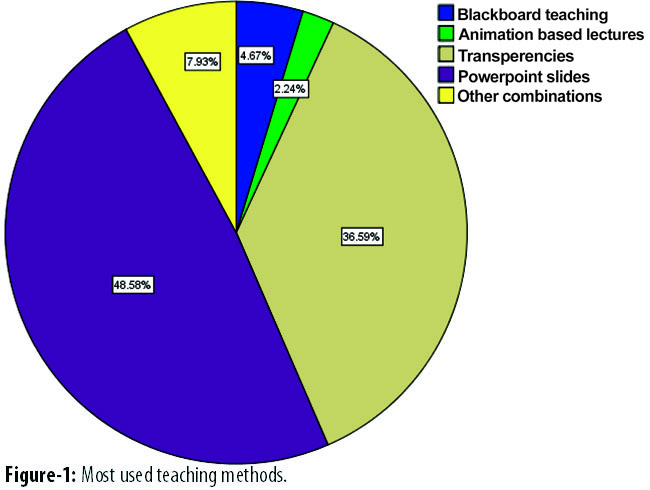
Majority of the students (n=325; 71.5%) disagreed 247 (50%) disagreeing and 78 (16%) strongly disagreeing) with the idea that the whole lecture should be delivered via PP slides.
As far as understanding complex concepts went, 246 (50%) participants approved of the utilisation of animation-based learning. Amongst the remaining half, 115 (23%) preferred blackboard teaching. For retaining and recalling facts, a combination of PP slides and animations was considered by 157 (32%) as most effective while OPs were considered to be the least effective (n=5; 1%). Regarding their attention span and ability to concentrate on a lecture, 374 (76%) students said they experienced the lowest attention span during OP lectures; 221 (45%) believed teachers using transparencies showed the least disciplinary control; 290 (59%) students responded to be attentive during the entirety of an animation-based lecture; while only 84 (17%) participants retained their concentration throughout PP lectures (Figure-2).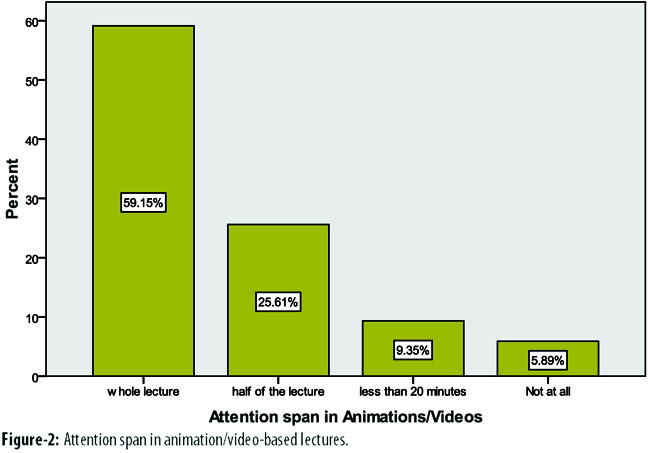
Irrespective of the method used, 226 (46%) students said visual aids of any sort increased their concentration \\\'a lot\\\' (Figure-3).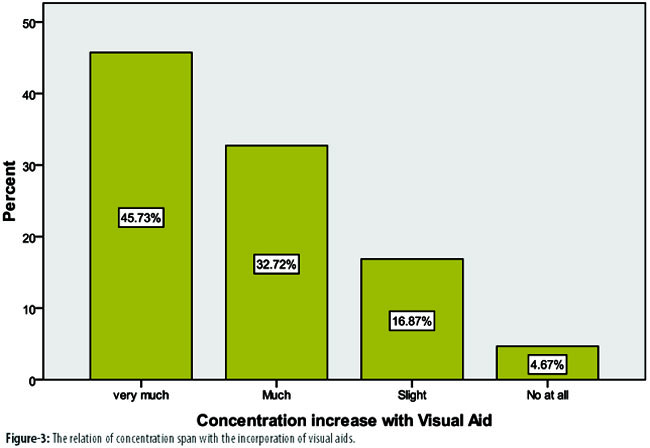
In the case of OP transparencies, 178 (36%) declared handwriting the most modifying factor for a slide\\\'s quality. In the case of PP 184 (37%) preferred \\\'moderate slides\\\'. For small groups, 283 (58%) students considered the blackboard method to be optimal for the delivery of a lecture, while for a large group, 243 (49%) students considered animations to be optimal.
Overall, 291 (59%) preferred blackboard + animations, 148 (30%) preferred blackboard + PowerPoint; 26 (5%) preferred blackboard + transparencies and a few other combinations which were least responded to by the students.
In the survey, students commented on their reasons for disliking each mode. The Blackboard method was deemed "outdated", "unsuitable for large groups" and that the "squeaks of chalks were loathsome". Transparencies were commented upon as having "a lot of clutter with no essence", being "monotonous", "non attractive", having "erased words", being "illegible" and that "teachers just read them and didn\\\'t explain them". Regarding PP slides, students said they were the "best way to hide the teachers\\\' incompetency", "got boring when the teacher just read them", caused a "concentration deficiency", that they were "Google copies" and that a "text-packed slide equalled a dull transparency". Animations were rarely disliked in the comments. Students also stated that "Any method should be used properly and the teacher should be able to conduct orally", that "explanation is very important" and that "oral lectures delivered should be strong".
Discussion
The current study was undertaken to analyse the preferences of KEMU students to various pedagogical modalities and determine their opinions regarding the effectiveness of each mode. It is an obvious observation that gradually "the use of electronic media has become common in medical colleges."9 Conservative teaching methods that utilised blackboards have been progressively replaced by electronic, more visually attractive teaching aids.
Both conventional and non-conventional teaching aids were in use for undergraduate medical teaching, and the students expressed familiarity with blackboard, PP, transparency and animation forms of learning.
Historically, the phenomenon of teaching and instruction has always been associated with a blackboard. For centuries, a blackboard remained the mediator between the instructor and the pupil, formulating a context for discussion and learning between them. "The blackboard is a very powerful tool for instruction - it allows information to be displayed in a persistent manner, and can give the audience a consistent view of far more information than can be held in short- term memory."10
Black or whiteboards encourage note-taking and student-teacher interaction. The presenter is not dependent on a device, and the effectiveness of the lecture is solely displayed by the competency of the speaker. The chalkboard promotes a sense of naturalness, suppleness and cohesiveness in the instructor.9 Taking down the simply-drawn diagrams is easy, the teacher makes natural pauses and power breaks do not interfere with the lecture.2 The cons of this mode include that information-rich content like complex tables and graphs and vivid images cannot be displayed. Further, the organisation of the presentation may not be as well as electronic slides offer.
According to the KEMU students, blackboard-based lectures were not common, and existed well behind the ones delivered by other modern modalities like PP slides and transparencies. It was something of a discovery that the students preferred blackboard-oriented learning for understanding complex mechanisms. Thus the effectiveness of this modality of teaching has not been totally compromised. The results did not conform to previous studies that repeatedly stated a student preference for PP slides over blackboards.2,9,11
Students\\\' ability to focus on the lecture delivered via chalkboard was still encouraging, despite the various innovative teaching methods being employed these days. A blackboard-based teaching modality was favourable when the learning group was small. Adding to that, 59% of students leaned towards a blackboard + animation combo for teaching, thus highlighting the worth this chalk-talk procedure still had for them.
PP slides have become an oft-used pedagogical aid. They possess the unique ability to exhibit both text and pictorial content together; a feature that other modalities lack. "A good PP presentation can enliven a lecture by offering imagery to support key points."12 The results of our survey indicated that the most widely used teaching aid was PP slides. Students cited a decrease in their attention span while attending PP lectures. This fact conforms to a study\\\'s observation that although PP presentations can arouse the audience, the material is so stimulating, it begins to hamper further information processing (of the student), hence be taxing.13
The nature of the slide also exerts an influence on the addressees.14 A slide may be \\\'light\\\' and may be as simple as having only a few bullet points. Or it may be \\\'heavy\\\' and comprise copious sentences. These features solely depend on the instructor who creates the slides. Unrelated text and irrelevant pictures cause reduced comprehension.15 Electronic slides also tend to script a lecture, leaving the audience in a dreary mood, a feature that may dim the atmosphere of the classroom.10 This phenomenon was described frequently by students in the comments section of the survey.
Overhead projectors have been employed as a pedagogical tool in universities the world over, for many years.16 From the teachers\\\' perspective, transparencies are easy to make and can be repeatedly used. Presentations using an OP have the advantage of allowing the instructor to face the audience while pointing out features on the transparency.17 Diagrams can easily be drawn and presenters can modify the slide order according to their will. But with the technological boom of the era, recent times have witnessed the availability of more visually eye-catching teaching aids, like the PP slides. Consequently, transparencies are progressively being replaced.2,16
Contrary to the global decline in OP use, transparencies still stand as a frequently used teaching aid to KEMU students. But the students\\\' response declared it as the least effective method. The results conform to previous studies2,9,18 that have proven student dislike for this particular mode of pedagogy. Our results indicated that students regarded handwriting as a major factor in determining the quality of transparencies. Light-coloured markers, a small font, too much text and the phenomenon of key-stoning (the top of the projected image being wider than its bottom) all add to the confirmed distaste for transparencies. Furthermore, with the widespread possession of colourful screens and monitors that students are used to viewing, the dull presentation of transparencies utterly fail to magnetise the eyesight. This explains the minimal attention span of students in transparency-based lectures. The comments of the students in the survey form indicated mass unanimous dislike for this mode. Overall, transparencies have nominal popularity amongst learners and studies have shown marked improved examination results when PP slides replaced transparencies.18 There is no concrete reason to continue using them.
The advent of animations has not only revolutionised the entertainment industry, but has also produced marvels in many areas. Amongst the recent most applications of these animations is their utilisation in many educational institutions for teaching purposes.19 Animations, with their unique three-dimensional presentation, have been accredited with simultaneously being able" to increase interest and motivation, to direct attention, to illustrate procedures and to explain how things work."19 Since the start of their application, numerous studies have been conducted for their efficacy and unique role in education, with many agreeing to their effectiveness in deep learning6 while some have differed.20
The least commonly used method of teaching at the KEMU proved to be animations. However, it was discovered that animations, though used very rarely, were also incorporated into lectures delivered by other methods, especially PP and blackboard. It is noteworthy that while considering the different combinations of teaching methods, animations were preferred by many students in combination with the blackboard method. The perception of audiovisual aids augmenting the understanding of the complex concepts was strongly proved by the study. Students believed their concepts, attention span, concentration and retention were all positively reinforced by the use of animations in lectures. This conforms to the conclusion that animation-based learning boosts long-term retention.21
One of the other factors considered in the study was the comparison of different teaching modalities in a large group of students compared to a small one. The ability of videos to draw and engage individuals may be why students hailed animation-based lectures preferable for a large group of pupils. Considering all these favourable statistics, lectures supported with interactive audiovisual aids should be entertaining much more than they currently are.
Animation-based learning is not without its drawbacks. Animations, having too small time per frame or those containing a lot of extra and irrelevant details in them, may lead to poor understanding.22 The picturesque presentation of animations must be facilitated with a verbal narration by the teacher.23 Also making animations and multimedia videos is a tough task as they take a lot of time to create which can be frustrating.24 Many teachers lack the skill in developing their own animations and only rely on web-based ones that can cover limited topics.
The study also revealed that most students believed effective teaching to depend on factors other than the teaching aids used. This enforces the fact that the individual capability of the teacher in conceptually teaching and clarifying a topic is also vital, irrespective of the medium of instruction used.25 Therefore, whatever mode of instruction the teacher is using, his/her own personal abilities of verbal oration and oral teaching play a pivotal role in educating the audience and transferring the essence of a topic to them.
Conclusion
The medical students preferred an \\\'old meets new\\\' combination of blackboard and animation significantly over other combinations. To understand complex concepts and to retain facts, the participants desired animations to be incorporated frequently into medical pedagogy, while transparencies were repeatedly ostracised and were clearly disliked by them. PP slides can be effective, provided they are moderate in their construction and should not contain comprise too much text.
Acknowledgements
We grateful to Ms. Hafiza Ummara Rashid of the Punjab Institute of Preventive Ophthalmology for her guidance regarding statistics, and to the Department of Pathology, Department of Physiology and Department of Pharmacology of KEMU for allowing the survey to take place.
References
1. Baxi SN, Shah CJ, Parmar RD, Parmar D, Tripathi CB. Students perception towards different teaching aids in a medical college. AJHPE 2009; 1: 15. (Online) (Cited 2011 April 28). Available from URL: http://www.ajol.info/index.php/ajhpe/article/view/49723.
2. Seth V, Upadhyaya P, Ahmad M, Moghe V. PowerPoint or chalk and talk: perceptions of medical students versus dental students in a medical college in India. Adv Med Educ Pract 2010; 1: 11-16.
3. Moscoe FK. Overhead Projectors and LCD Panels. In: Gayeski DM (ed.). Designing Communication and Learning Environments. New Jersey: Educational Technology Publications. 1995.
4. Mayer RE, Anderson RB. The instructive animation: helping students build connections between words and pictures in multimedia learning. J Educ Psychol 1992; 84: 444-452.
5. Rieber LP. Animation in computer-based instruction. Educ Technol Res Dev 1990; 38: 77-86.
6. Singh S, Singh S, Gautam S. Teaching styles and approaches: medical student\\\'s perceptions of animation-based lectures as a pedagogical innovation. Pak J Physiol 2009; 5: 16-19.
7. Ricer RE, Filak AT, Short J. Does a high tech (computerized, animated, PowerPoint) presentation increase retention of material compared to a low tech (black on clear overheads) presentation? Teach Learn Med 2005; 17: 107-111
8. Pereira JA, Pleguezuelos E, Merí A, Molina Ros A, Molina-Tomás MC, Masdeu C. Effectiveness of using blended learning strategies for teaching and learning human anatomy. Med Educ 2007; 41: 189-95.
9. Seth V, Upadhyaya P, Ahmad M, Kumar V. Impact of various lecture delivery methods in pharmacology. EXCLI J 2010; 9: 96-101.
10. Anderson R. Beyond PowerPoint: building a new classroom presenter. Syllabus 2004; 17: 31-3.
11. Apperson JM, Laws EL, Scepansky JA. The impact of presentation graphics on students\\\' experience in the classroom. Comput Educ 2006; 47: 116-26.
12. Young JR. When good technology means bad teaching: giving professors gadgets without training can do more harm than good in the classroom, students say. The Chronicle of Higher Education. November 12, 2004; 51: A31-A37.
13. Levasseur DG, Sawyer JK. Pedagogy meets powerpoint: a research review of the effects of computer-generated slides in the classroom. Review of Communication 2006; 6: 101-23. doi:10.1080/15358590600763383.
14. Apperson JM, Laws EL, Scepansky JA. An assessment of student preferences for PowerPoint presentation structure in undergraduate courses. Comput Educ 2008; 50: 148-53.
15. Mayer RE. Multimedia learning. Psychol Learn Motiv 2002; 41: 85-139.
16. Ho B. From using transparencies to using PowerPoint slides in the classroom. In: Jeffery PL (ed.). AARE 2001 Conference Papers. Fremantle: Australian Association for Research in Education; 2001.
17. Farrow R. ABC of learning and teaching in medicine: creating teaching materials. BMJ 2003; 326: 921-23.
18. Lowry RB. Electronic presentation of lectures - effect upon student performance. University Chemistry Education 1999; 3: 18-21.
19. Lowe R, Schnotz W (eds.). Learning with animation: research implications for design. UK: Cambridge University Press. 2008.
20. Morrison JB, Tversky B, Betrancourt M. Animation: does it facilitate learning. AAAI Spring Symposium on Smart Graphics 2000; 53-59.
21. O\\\'Day DH. The value of animations in biology teaching: a study of long-term memory retention. CBE Life Sci Educ 2007; 6: 217-23.
22. Tversky B, Morrison JB, Betrancourt M. Animation: can it facilitate? Int J Hum Comput Stud 2002; 57: 247-62.
23. Mayer RE. The promise of multimedia learning: using the same instructional design methods across different media. Learn Instr 2003; 13: 125-39.
24. Heyden RJ. Approaches to cell biology: developing educational multimedia. Cell Biol Educ 2004; 3: 93-8.
25. Shallcross DE, Harrison TG. Lectures: electronic presentations versus chalk and talk — a chemist\\\'s view. Chem Educ Res Pract 2007; 8: 73-9.
Journal of the Pakistan Medical Association has agreed to receive and publish manuscripts in accordance with the principles of the following committees:


