

Charu Mohan Marya ( Department of Public Health Dentistry, Faridabad, Haryana, India. )
Kirti Mohan Marya ( Department of Orthopaedic Surgery, Aster Hospital & Aster Medical Centre, Dubai, United Arab Emirates. )
Vandana Dahiya ( PG Student, Department of Conservative Dentistry and Endodontics, Faridabad, Haryana, India. )
Vishal Juneja ( Department of Dental Anatomy/Dental Histology, Sudha Rustagi College of Dental Sciences & Research, Faridabad, Haryana, India. )
Puneet Gupta ( Department of Community Dentistry, Government College of Dentistry, Indore, Madhya Pradesh, India. )
May 2013, Volume 63, Issue 5
Short Reports

Abstract
The study was conducted to investigate the extent to which students of two dental schools in northern India make use of internet during their undergraduate course and to assess their attitude towards the internet in general. All undergraduate students were assessed using a specially designed, self-administered questionnaire. Overall, 470 (88.84%) students used the internet. Among the internet users, only 207 (44%) accessed it for academic purposes. Also, 356 (75.7%) found information about dentistry easily accessible, whereas 114 (24.3%) reported difficulty in doing so. The study showed that a good number of Indian dental students are using internet, but they are lagging behind their counterparts in the western world.
Keywords: Internet, Dentistry, Undergraduate students.
Introduction
Usage of computer technology has expanded manifold in recent times. The number of internet users is likely to pass the billion mark.1,2 Today is the age of computer-mediated learning and internet-mediated education.3
Internet is used for various reasons in the field of medicine and research, including teaching, diagnosis and the conduct of medical examination. Students can have the opportunity to undertake research and it helps them to go into the details of controversial topics by accessing expertise of specialists all over the world.4 Effective communication is established using chat rooms, video conferencing and interactive learning environment using animation and simulation methods.
One estimate suggests that by 2010 more than 30% of a physician\\\'s time was to be spent using information technology (IT) tools.4 But these developments are usually occurring in Europe and North America. Literature shows that global prevalence of internet use among dental and medical students varies from 60% to 80% for academic and non-academic purposes.5-7 Developing countries are found to lag behind the developed countries in this regard.
An important advantage of the internet is that the students in developing countries can access a large pool of data, which could help reduce the information gap resulting from the disadvantages of educational systems and opportunities in those countries. But a major concern of many academicians is that the spread of IT in the developed countries is leaving the rest of the world behind.
Hence, the present study was conducted to investigate the extent to which students of two dental schools in northern India make use of internet during their undergraduate course and to assess their attitude towards the internet in general.
Methods and Results
The cross-sectional survey was carried out among the 680 dental undergraduate students from two dental schools in Punjab and Haryana in India. The study was conducted during the beginning of the 2011-12 academic year. Ethical clearance was obtained from the Institutional Review Board, while informed consent was also obtained from the subjects and their identities were kept anonymous.
A pre-tested questionnaire was distributed among the students attending lectures and it was collected back once the students had finished filling in the response. A total 529 (77.8%) students responded to the questionnaire, which addressed different internet related variables associated with its usage, reason, place, frequency and factors restraining the students from using the internet.
Data was analysed using SPSS 18.0. Frequencies and percentages were calculated. The chi square test was used to analyse the differences among dental classes according to the year of dental education.
Of the 529 students, 137 (25.89%) were males and 292 (74.11%) were females. Overall, 470 (88.84%) students were found to be internet users. Of them, 207 (44%) used it for academic purposes; and 358 (76.17%) found pictures on the internet more useful than the text (Table-1).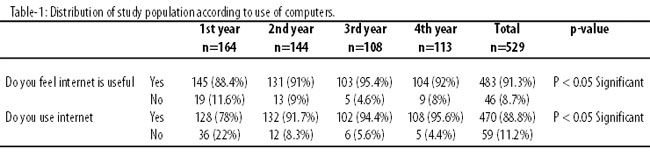
Of the total users, 386 (82.12%) students spent 1 hour or less at every internet usage session, while only 19 (4.1%) spent more than 2 hours (Table-2).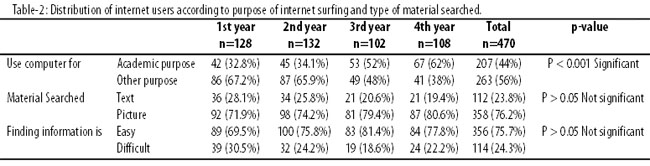
Only 38 (8%) students reported that they did not know how to use internet for academic purposes. Of the 470 internet users, 356 (75.7%) found information about dentistry easily accessible, while 114 (24.3%) reported difficulty in doing so.
Conclusion
Although the internet is an important source of information, dental students in the study were not fully utilising these facilities. The curriculum of dental services should include the education of computer, internet and allied technologies to improve students proficiency in the use of internet for academic purposes. Campus-wide networking with browsing facility should also be provided in the teachers\\\' rooms as well as the hostels. The dental colleges should subscribe to more e-journals and e-databases, and qualified IT staff should be appointed to provide guidance to students about e-resources.
References
1. Larkin M. Non US web use rising fast. Lancet 2000; 356: 1451.
2. Young K. Clinical Assessment of Internet Addicted Clients. In: Young K, Nabuco de Abreu C (eds). Internet Addiction: A Handbook and Guide to Evaluation and Treatment. Haboken, NJ: Wiley; 2011; pp 19-34.
3. Komerik N. Use of the Internet among dental students in Turkey. J Dent Educ 2005; 69: 470-5.
4. Rajab LD, Baqain ZH. Use of information and communication technology among dental students at the University of Jordan. J Dent Educ 2005; 69: 387-98.
5. Walmsley AD, White DA, Eynon R, Somerfield L. The use of the Internet within a dental school. Eur J Dent Educ 2003; 7: 27-33.
6. Uribe S, Mariño RJ. Internet and information technology use by dental students in Chile. Eur J Dent Educ 2006; 10: 162-8.
7. Arora R. Computer and information technology skills of first year medical and dental students at CMC Ludhiana. Health Administrator 2005; 17: 54-8.
Journal of the Pakistan Medical Association has agreed to receive and publish manuscripts in accordance with the principles of the following committees:


