

Ayesha Saba Naz ( Department of Anatomy, Bahria University Medical and Dental College, Karachi. )
Rehana Rehman ( Department of Physiology, Bahria University Medical and Dental College, Karachi. )
Mehwish Hussain ( Department of Biostatistics, Dow University of Health Sciences, Karachi. )
May 2013, Volume 63, Issue 5
Original Article

Abstract
Objective: To identify and compare awareness of intellectual wellness in male and female medical students of Karachi.
Methods: The cross-sectional questionnaire-based survey comprised randomly selected 800 medical students of both gender. It was conducted from January to December 2010 in 8 medical colleges of Karachi. Responses - never, sometimes, mostly and always (numbered 0-4) - were analysed in terms of frequency, proportion and percentages by Predictive Analysis Software version 18. Chi square test was applied for comparison of intellectual wellness in both genders. Results were considered significant at p <0.05.
Results: Of the 800 questionnaires distributed, 736 (92%) were received fully completed; 526 (71.5% of them from females. Intellectual wellness was significantly higher in females due to an increasing aptitude towards book reading (p <0.0001), selection of movies (p <0.03) and analytical thinking (p <0.002). Male students derived help from mentors (p <0.03)
Conclusion: Females were found to be better in terms of intellectual wellness compared to the males. However, males used mentorship support to acquire intellectual wellness.
Keywords: Wellness wheel, Intellectual wellness, Mentors. (JPMA 63: 568; 2013).
Introduction
A magnitude of people think "intellectual wellness (IW)" to be dull or boring, but its spectrum, which inculcates learning by reading, creative hobbies, exercise etc, prove this assumption false. Reading is a great, but not the lone, way to learn new things; one can make use of other avenues like print and electronic media to promote an intellectual aspect of wellness. Creativity is a complex1 multicomponent process which one can exercise to improve intellectual abilities. It makes use of three key domains; first is the divergent thinking which affects the cognitive flexibility, second is the convergent thinking for the evaluation of new ideas, and the last one is the analogical thinking which trains the mind to get familiar to problem-solving tasks.
In the world of medical education, students from different educational and cultural backgrounds get exposed to a stressful, demanding and voluminous curriculum.2 According to the National Institute of Health, 80% of all diseases are caused by accumulated, unmanaged stress. Lack of creative, recreational activities worsens the scenario.3,4 This proves hazardous to the physical and mental (psychological) wellbeing of students which may impair their behaviour, diminish learning, destroy personal relationships, negatively affect scholastic performance5,6 as well as the psychosocial makeup of a medical student that can have depressive outcomes. The knowledge, attitude and practice (KAP) to enhance intellectual wellbeing at this moment may help the individual to withstand hazards of stress and think of coping strategies.
IW can be applied by medical students in a number of ways; reading, listening, observing, learning new skills, taking part in hobbies, and becoming creative. A piece of advice by a senior regarding selection of books, exploration of internet and any other associated problem might turn out to be the defining moment. That senior could be a mentor who guides another (usually younger) individual (mentee) in learning and growth in his profession.7 We keep talking about wellness, but such programmes cannot be offered unless a theoretical assessment model is available. At the same time, the biological differences between men and women with a wide range of distinct metabolic and hormonal factors have to be considered.8 The objective of the current study was to assess and compare awareness of IW in both the genders, and to find its association with mentoring help. The information gained may then be incorporated to design a compatible curriculum accordingly and to incorporate changes along the wa.
Subjects and Methods
The cross-sectional questionnaire-based survey was conducted from January to December 2010 at Bahria University Medical and Dental College, Karachi, after approval from the Research and Ethical Committee and acceptance by the selected medical colleges of Karachi. A total of 800 students from First Year MBBS were randomly selected from three government and five private medical colleges. Students from both genders, aged 18-24 years, belonging to all ethnic groups who gave consent were included. Students with acute or chronic illnesses were excluded. The close-ended questionnaire, tailored from the Wellness wheel,9 evaluated aspects of IW on four points ranked never, sometimes, mostly, always (annexure); numbering 0-4 from the lowest to the highest ranks). The subjects were enquired about any help from mentors in this regards on the same scale. Computation of frequency, proportion and percentages were executed for categorical variables with the help of Predictive Analysis Software (PASW) version 18. Sample size was based on a population of 3,000 with e (margin of error) of 5% and z (confidence interval) of 95%. Mean and standard deviation were computed for continuous variables. For measuring consistency among the responses, the reliability of scores was measured using Cronbach\\\'s Alpha. For the comparison of categorical variables of intellectual wellness, chi-square test was used. P value less than 0.05 was considered significant.
Results
A total of 800 questionnaires were distributed out of which 736 (92%) completed forms were included for analysis. Among them, 526 (71.5%) were females and the rest were males. The mean age of the subjects was 18±2 years, and they belonged to various ethnic backgrounds. The reliability of the responses was 85.3%. Awareness of IW was found to be different in the two genders (M vs F: 11.22±3.39 vs 11.88±3.26; p <0.012). Almost half of the participants (n= 365; 49.5%) had taken part in class intellectual discussions actively, and females were significantly involved in such discussions more than the males (p <0.0004).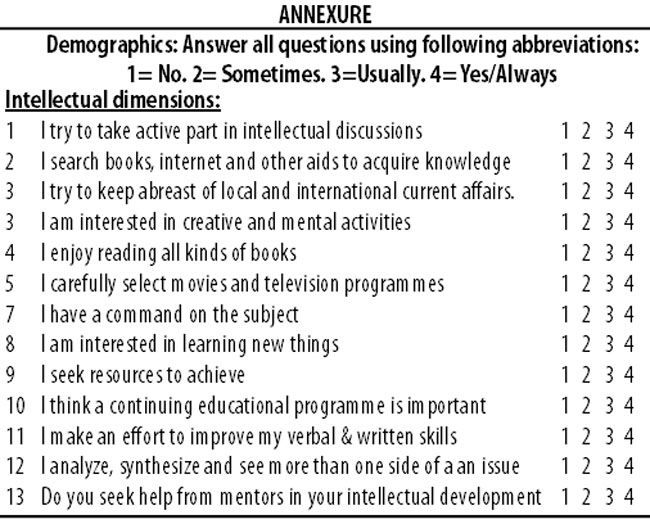
Girls searched other aids to acquire knowledge more than the boys (p <0.053). Nearly one quarter of the participants (n= 170; 23%) always tried to keep abreast of local and international affairs. About half of the participants (n= 382; 52%) were interested in creative and mental activities. Females significantly enjoyed reading books and carefully selected movies and television programmes than the males (Table).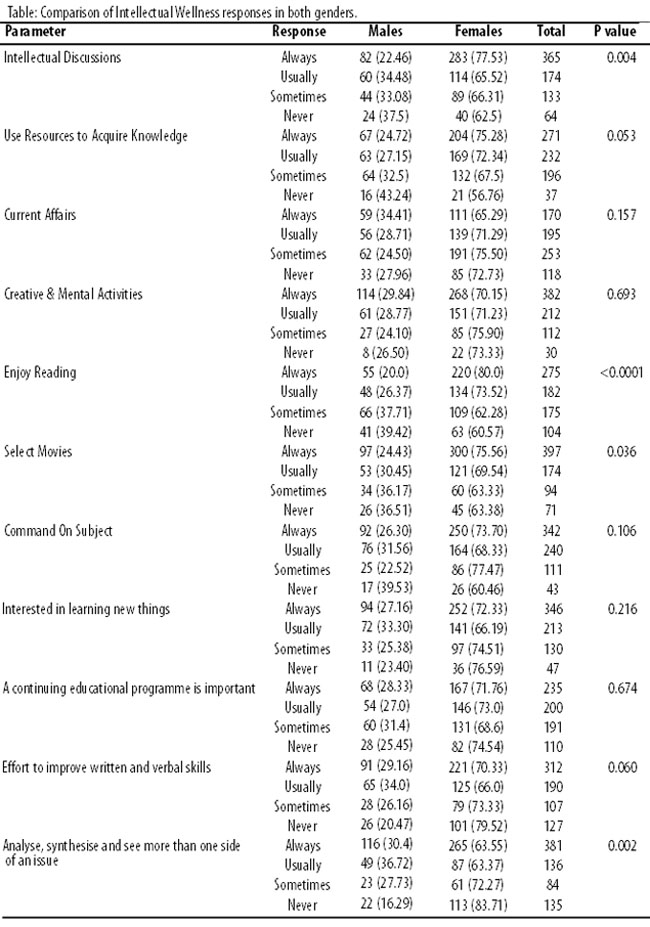
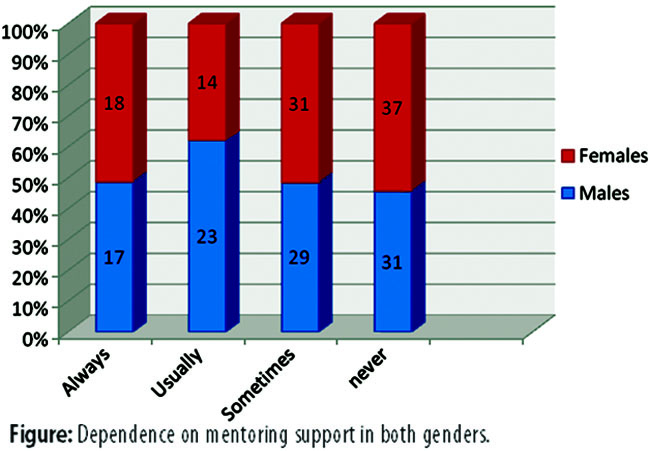
The attempt to acquire IW (Figure) in males was attributed to help from mentors (p <0.03).
Discussion
As the results showed, reading was one of the popular ways among the subjects in terms of acquiring IW. There is a positive correlation between reading for fun with the development of higher intelligence, better grades, and a negative relation between depression and reading habits.10 A study suggested that by encouraging students to develop reading habits, one can reduce stress with a lower subsequent risk of incident dementia.11 It is thus recommended to spend in at least half-an-hour for reading every day. In our study we wanted to enquire whether our subjects applied the habit to refresh and relax their minds and stay in touch with contemporary writers. Females were found to have a significantly high level of IW acquired through reading. However, there was no gender difference when it came to the domain of current and international affairs in both genders as there was a general reluctance among the subjects to be aware of the happenings.
It has been proven that movie-watching is an effective strategy to enhance students\\\' awareness about psychosocial and health-related issues. Selection of movies alters intellectual component of wellness and changes behaviour of the individual accordingly.12 It is important that individuals should carefully select movies according to their own perspectives. Girls were good at selection of movies, while boys did not focus on their assortment in our study. There are no other studies authenticating our finding, but since movie-watching has positive influence on learning, so it can be said that it could promote IW more in females through creative learning.13
Evidence suggests endorsement of long-term memorisation of facts, better understanding, analytical thinking, growth of affirming outlooks, improvement in insightful practice and hence IW through group discussions.14 Females in our study were more enthusiastic about acquiring knowledge by generation of group discussions on selected topics.
While taking a stroll through the path of IW, medical students face many impediments in the form of comprehension of lectures, performance in laboratory sessions, submission of assignments, hostel accommodation or even transportation. The only way to overcome these obstacles is by way of tackling through procurement of knowledge via various sources like reading, watching news, net surfing and group discussions. Students can then assimilate new knowledge into a conceptual framework which creates expertise in analytical thinking. This forms basis of evidence-based reasoning with the incorporation of higher-order cognitive skills15 and helps to solve a problem by separating into its elemental parts. Females were aware of the need to analyse, synthesise and see more than one side of any issue.
Critical thinking, an essential element of problem-solving,16 can be applied for ingenuity which is a higher-order cognitive skill as defined in Bloom\\\'s taxonomy. Our subjects did not respond well to creative and mental activities, emphasising the need to introduce revised teaching methodologies to construct and develop IW by creativity.
Mentoring is well recognized to be a cornerstone for the multi-faceted growth of medical students in their professional, personal and career planning.17 It contributes to professionalism, performance, and increases overall wellbeing in the formative years of medical schooling. The role of mentors for career and professional development has been well established7 but in our study, another perspective of mentors has been found which is inclination of males towards mentorship as compared to the females. Our result emphasizes that males sought help from mentors for improvement in learning capabilities. In another study, the male gender preference was found to be three times more for mentorship.18
Since it was a questionnaire-based KAP study, we did not measure IW of genders with respect to any standard scale, which is a limitation of the study.
Conclusion
Females were fond to be more inclined towards using reading skills, selecting movies, and trying to be analytical for IW, whereas the males opted to consult mentors to promote their intellectual capabilities. Students should be invigorated to make an IW map with activities and priorities, keeping in view information and knowledge with the help of creativity, analytical thinking and problem-solving capabilities.
References
1. Dehaan R L. Teaching Creativity and Inventive Problem Solving in Science. CBE Life Sci Educ 2009; 8: 172-81.
2. Singh S, Singh S, Gautam S. Teaching styles and approaches: medical student\\\'s perceptions of animation-based lectures as a pedagogical innovation. Pak J Physiol 2009; 5: 16-9.
3. Wolf TM, Elaston RC, Kissling GE. Relationship of hassles, uplifts and life events to psychosocial well-being of freshman medical students. J Behav Med 1989; 15: 37-45.
4. Jungkwon L, Graham AV. Students\\\' perception of medical school stress and their evaluation of a wellness elective. Med Edu 2001; 35: 652-9.
5. Mohsin S, Hasan S,Malik S, Sreeramareddy CT. Perceived stress, sources and severity of stress among medical undergraduates in a Pakistani Medical School. BMC Med Educ 2010; 10: 2.
6. Shaikh BT, Kahloon A, Kazmi M, Khalid H, Nawa K, Khan N, et al. Students stress and coping strategies :a case of Pakistani medical school. Educ Health (Abingdon) 2004; 17: 346-53.
7. Frei E, Stamm M, Buddeberg F B. Mentoring programs for medical students - a review of the PubMed literature 2000 - 2008. BMC Med Educ 2010; 10: 32.
8. Emslie C, Hunt K. The weaker sex? Exploring lay understandings of gender differences in life expectancy: A qualitative study Soc Sci Med 2008; 67: 808-16.
9. Vander Bilt University. Wellness Resource Centre. (Online) (Cited 2009 November 4). Available from URL: www.vanderbilt.edu/ wellnesscenter/ wellnesswheel.html.
10. Bahrami S, Rajaeepour S, Rizi H A, Zahmatkesh M, Nematolahi Z. The relationship between students\\\' study habits, happiness and depression. Iran J Nurs Midwifery Res 2011; 16: 217-21.
11. Wells JB, Christiansen MH, Race DS, Acheson DJ. Experience and sentence processing: Statistical learning and relative clause comprehension. Cogn Psychol 2009; 58: 250-71.
12. Hastings EC, Karas TL, Winsler A, Way E, Madigan A, Tyler S. Young Children\\\'s Video/Computer Game Use: Relations with School Performance and Behavior. Issues Ment Health Nurs 2009; 30: 638-49.
13. Gallagher P, Wilson N, Edwards R, Cowie R, Baker M G. A pilot study of medical student attitudes to, and use of, commercial movies that address public health issues. BMC Res Notes 2011; 4: 111.
14. Kitchen M. Facilitating small groups: how to encourage student learning. Clin Teach 2012; 9: 3-8.
15. West D C, Pomeroy J R, Park J K, Gerstenberger E A, Sandoval J. Critical Thinking in Graduate Medical Education. A Role for Concept Mapping Assessment? JAMA 2000; 284: 1105-10.
16. Mumford MD, Waples EP, Antes AL, Brown RP, Connelly S, Murphy ST, et al. Creativity and Ethics: The Relationship of Creative and Ethical Problem-Solving. Creat Res J 2010; 22: 74-89.
17. Sambunjak D, Straus SE, Marušic A. Mentoring in Academic Medicine: A systematic review. JAMA 2006; 296: 1103-15.
18. Osborn EH, Ernster VL, Martin JB. Women\\\'s attitudes toward careers in academic medicine at the University of California, San Francisco. Acad Med 1992; 67: 59-62.
Related Articles
Journal of the Pakistan Medical Association has agreed to receive and publish manuscripts in accordance with the principles of the following committees:


