

October 2012, Volume 62, Issue 10
Letter to the Editor

Madam, road rage comprises of verbal abuse, threats, and acts of physical harm while travelling or driving on the road.1 It could lead to injuries, death and psychiatric morbidity.2 A study of 318 rickshaw drivers in Rawalpindi reported that 261 (78.9%) drivers had experienced being shouted at and having experienced rude gestures from other drivers (78.9%).1 While a study of 156 bus drivers in Islamabad and Rawalpindi reported that 138 (88.6%) of drivers had experienced rude gestures as the most common type of road rage.3 Road safety is a major global public health problem; a study in Rawalpindi General Hospital reported that 1,244 cases were recorded in the emergency room for road traffic injuries in 2005.4,5 A cross-sectional survey with convenience sampling was conducted among taxi, rickshaw, wagon and bus drivers in Faisalabad; to study their behaviours/experiences regarding road rage and involvement in road traffic accidents, from March to July 2010. Injuries resulting from road traffic accidents were also inquired about; with injury defined as one requiring either self-treatment or visit to a physician and requiring treatment. An interviewer-administered, pre-tested, structured questionnaire with both open and close-ended questions was used. Only those commercial vehicle drivers who had been driving for at least one year were interviewed by a trained interviewer, after obtaining verbal consent. Results were analyzed using open source statistical analysis software package R version 2.14, applying chi-squared and Fisher\'s Exact tests.
Cumulatively, 1021 drivers were approached, and 956 agreed to be interviewed i.e. a response rate of 93.6%. Most respondents had 5 or less years of schooling or no formal education i.e. 715 (74.8%); had been driving commercially for a mean of 10.4 ± 5.9 years, and their mean age was 42.8 ± 7 years.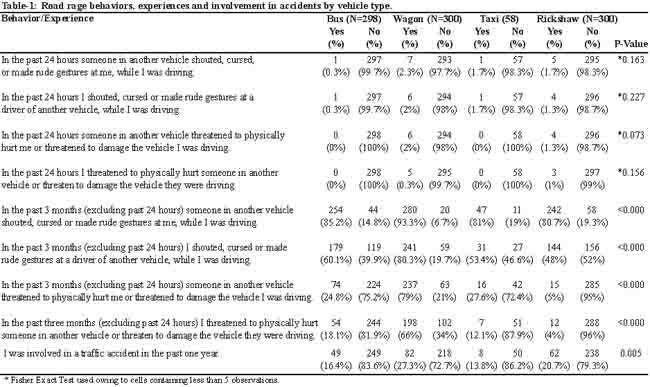
Table-1 lists the road rage behaviours, experiences and involvement in accidents by type of commercial vehicle driven; additionally statistically significant associations found between road rage experiences/behaviours and the type of commercial vehicle driven using Pearson chi-square and Fisher\'s Exact tests of difference between four groups of drivers. Wagon drivers reported more road rage experiences, behaviours, and involvement in accidents compared to three other types of commercial vehicle drivers. Cumulatively 201 (21%) respondents were involved in a road traffic accident in the past one year, and association between drivers of four commercial vehicles was statistically different. The most common types of road rage experience reported in the past 24 hours as well as in the past three months - excluding past 24 hours — was someone in another vehicle having shouted, cursed, or made rude gestures; however this experience was statistically significantly different among the four types of commercial vehicle drivers in the past three months only. Out of the 201 respondents who reported being involved in a road traffic accident in the past one year, 190 (94.5%) reporting one such accident; while 10 reported two and one reported 3. Only 129 (64.2%) accidents were recorded (challan) by the traffic police. In these accidents 134 (40.2%) drivers reportedly sustained injuries themselves and 108 reported injuries to passengers of their own vehicles or passengers or drivers of another vehicle. Out of 108 drivers who reported injuries in other passengers, 66 stated that one to three persons were injured, while rest reported 4-8 persons were injured. Injury was defined as one requiring self or physician prescribed treatment. The results of this study are comparable to the few studies conducted on road rage in Islamabad and Rawalpindi i.e. shouting, cursing or rude gestures are common form of road rage expression and experience in Pakistani commercial vehicle drivers.1,3 An interesting finding in this study was that traffic police did not record all the traffic accidents. This suggests that non-recorded accidents might be of a minor nature but some respondents volunteered additional information and stated that \'both\' parties involved in the accident decided to deal the matter among themselves rather than involve police! Self-reporting of road rage experiences, behaviours and involvement in accidents was the major limitation of this study; however, trying to independently determine this phenomenon would be very difficult. Results of this study underscore the need for better commercial vehicle driver training, and health education campaigns to improve road safety in Faisalabad.
Masood Ali Shaikh,1 Zulfiqar Siddiqui2
Apartment No. 32, Building No. 3, Group No. 71, Al Rehab, Cairo, Egypt,1268-B, Kamal Road, Cantt. Rawalpindi.2
Corresponding Author: Masood Ali Shaikh. Email: masoodali1@yahoo.com
References
1. Shaikh MA, Shaikh IA, Siddiqui Z. Road rage behaviour and experiences of rickshaw drivers in Rawalpindi, Pakistan. East Mediterr Health J 2011; 17: 719-21.
2. Sansone RA, Lam C, Wiederman MW. Road rage: relationships with borderline personality and driving citations. Int J Psychiatry Med 2010; 40: 21-9.
3. Shaikh IA, Shaikh MA, Siddiqui Z. Road rage behavior and experiences of bus and wagon drivers in Islamabad and Rawalpindi. J Pak Med Assoc 2008; 58: 220-1.
4. Toroyan T, Peden M. How safe are the worlds\\\'s roads? Bull World Health Organ 2009; 87: 736.
5. Bhatti MA, Ajaib MK, Masud TI, Ali M. Road traffic injuries in Pakistan: challenges in estimation through routine hospital data. J Ayub Med Coll Abbottabad 2008; 20: 108-11.
Journal of the Pakistan Medical Association has agreed to receive and publish manuscripts in accordance with the principles of the following committees:


