

Farhat Hussain Mirza ( Department of Forensic Medicine, Sindh Medical College, Karachi. )
Perwaiz Ahmed Makhdoom ( Department of Forensic Medicine, Sindh Medical College, Karachi. )
February 1998, Volume 48, Issue 2
Short Reports

Abstract
Purpose: To study whether various injuries labelled as antemortem are in fact postmortem artifacts.
Study subjects: 780 postmortems conducted in mortuary of S.M.C. Karachi from 1-1-95 to 20-9 -95.
Main Findings: Out of 78O autopsies, 229 showed postmortem artifacts which included decomposition in 78, animal and insects producing changes in 45, injuries due to rough handling in 40, breaking of rigor mortis and shifting of postmortem lividity during transportation in 37, iatrogenic fracture of skull during opening in 15, fractured ribs during resuscitation after death in Sand exhumation producing fractures of bones in 6 bodies.
Introduction
Postmortem artifact is defined as “any change caused or afeature introduced into abody after death, that is likely to lead to misinterpretation of medically significant antemortem findings”. In the context of Forensic Pathology an artifact can be defined as a spurious postmortem presentation which stimulates a finding which would be significant in the course of antemortem events1. Artifacts can be broadly divided into two groups i.e., those introduced in the period between Death and Autopsy2 and those introduced during autopsy2 (Table).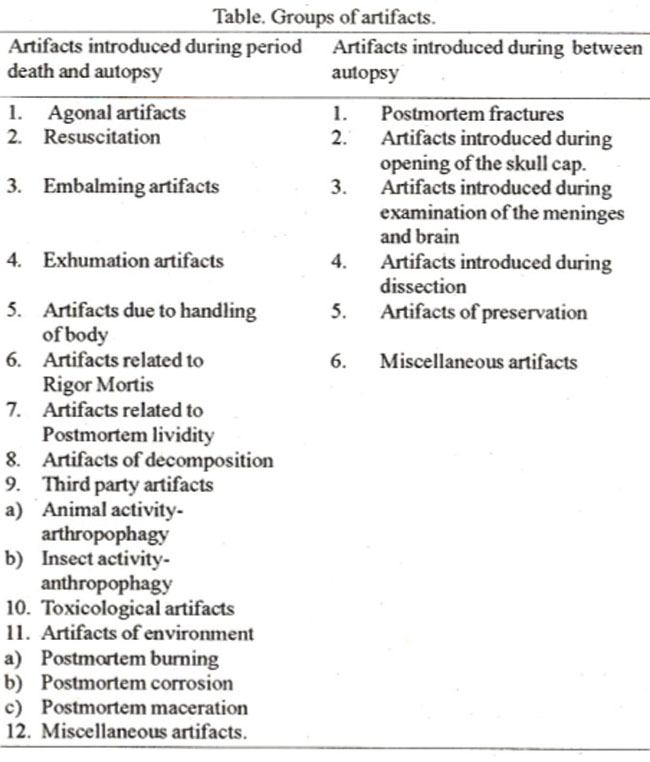
Material, Methods and Results
A study was carried out on 780 dead bodies which were brought to the mortuary of Sind Medical College from 1-9-95 to 20-9-95 where both authors were present as experts. The study included: detailed examination of the dead bodies sçon after they were received, postmortem examination, review of the injuries included inpolice report and theircomparisonwiih present findings, radiography of the skull so as to rule out the extension of the existing fractures ordistu.thances of fractured fragments during examination and histopathology of tissues when there was doubt of the injury being antemortem or postmortem. Dissection techniques were used according to the nature of the case.
Ethics
Names, initials and hospital numbers of deceased persons are not used. A total of 780 postmortems were done of which 229 (29.3%) showed artifacts. Of 229 cases which decomposition, 45 had changes due to animal and insect activity, 40 showed injuries due to rough handling, 37 showed breaking of rigor mortis and shifting of postmortem lividity during transportation. In 15 bodies iatrogenic fracture of the skull occurred during opening of the skull, 8 bodies showed fractured ribs (resuscitation measures after death) and 6 had fractured limbs during exhumation
Seventy-eight decomposed bodies were brought to the mortuaiy, most of which were of firearm injuries in which differentiation between entry and exit-wound was difficult due to change in the shape of margins of wounds due to gases of putrefaction escaping from these wounds. However, entry wound was identified by cherry red discolouration due to the formation of Carboxy-Haemoglobin. Identification of 8 bodies was not possible due to advanced stage of decomposition.In 10 decomposed bodies deep grooves were seen around the neck due to tight collars simulating ligature marks as seen in strangulation and hanging. In 12 decomposed bodies fissures and splits were seen in the skin due to decomposition which could easily have been mistaken for lacerated or incised wounds. Handling of the body during transportation led to the presence of abrasions overthe back of the body as they were dragged; this has been noticed previously3. Dislocationof shoulderjoints was seen in3 cases. In few cases there was congestion of conjunctiva with reddish patches on the face, front of the chest and flanks with postpartumlividity onthe dependentpartsofthebodylyingon its back in the mortuary. These findings created confusion; later it was found that the bodies had been found by the police with face towards the grounds; later on in the mortuary they
were placed on their backs which caused shifting of the postmortem lividity. Breaking of rigor mortis was seen in 37 cases which were brought to mortuary, 6- 12 hours afterdeath, giving a wrong impression that rigor mortis had passed away. This caused difficulty in assessment of time since death. Six bodies were exhumed for the reconfirmation of cause of death all suffered fractures due to impact of digging tools, these fractures were not mentioned in the previous reports. In 8 autopsies fractures of ribs were noted due to aggressive resuscitation carried out prior to death. Most common problem facedby Medico Legal Officers was opening of the skull by chisel and hammer whichled to either iatrngenic fractures orenlargement of pre-existmg hair line fractures of the skull. Intestines were also out in some cases while dissectionof the abdornea.
Comments
It is important to differentiate between antemortem injuries and postmortem artifacts, keeping in mind changes taking place after death, such as exudation of white blood cells, prdliferation of fixed tissue cells, growth of hair or nails, penetration of foreign particulate matter into the pulmonary alveoli (drowning), formation of significant carboxy-haemoglobin and significant degree of propulsion of food along gastrointestinal tract4. After conducting this study, it was concluded that lack of differentiation between ante and postmortem artifacts can lead to incorrect assessment of time since death, wrong cause of death, miscarriage of justice and wastage of time and sources as result of misleading fmdings. All these are avoidable with the availabilities of well equipped mortuary with Chemical and Histopathological labs., provision of a cold storage plant to prevent decomposition of body, well trained staff with arrange ment of special workshopsand refresher courses for doctors involved in medicolegal work, provision of propersafety measures to stop entry of animals, birds, rodents etc into the mortuary, proper training of law enforcing personnel and mortuary attendants in handling of dead bodies to avoid infliction of postmortem artifacts, anangement for taking photographs of the dead bodies on arrival which must be handed over to the medicolegal officer along with the body and the accompanying police report and close coordination between the medicolegal section, forensic experts and the pathologists to minimize errors durig autopsies.
Acknowledgements
I acknowledge the cooperation of the Assistant Police Surgeon, Jinnah Postgraduate Medical Centre and the MLOs of the Medicolegal section of Jinnah Postgraduate Medical Centre, Karachi for conducting this study.
References
1. Abdullah, F. Artifacts in Forensic Pathology. Hand Book of Forensic Pathology. J.B Lippincott Company, 1973, pp. 235-253.
2. Mason, J,K. and McCall, K.A. Smith. Artifact, Butterworths Medicolegal Encyclopedia, London, Butterworths and Company, 1987. p.4 1.
3. Bernard, K. Postmortem bruising and other artifacts. Forensic Pathology, London, Melbourne, Auckland, Edward Arnold, 1991, p. 136.
4. Russel, S. and Charles. S. Postmortem changes and artifacts, Forensic Pathology, London, Castle House Publications Limited, 1980,p.58.
Journal of the Pakistan Medical Association has agreed to receive and publish manuscripts in accordance with the principles of the following committees:


