

Ashfaq A. Razzaq ( Department of Surgery, Jinnah Post-graduate Medical Center, Karachi. )
August 2000, Volume 50, Issue 8
Original Article

Abstract
Objective: To evaluate and quantify the correlation between surface wounds and internal injuries.
Methods: The medical records of 55 patients, admitted over a two year period with a diagnosis of gunshot wound of abdomen, were reviewed retrospectively. Imaginary trajectories of each bullet track were re¬constructed on real scale abdominal anatomy models, and data regarding expected injuries was obtained. This data was then matched with the laparotomy findings for each patient and the percent correlation between observed and expected injuries was calculated.
Results: The mean correlation between expected and observed injuries was found to be 31 %. Most of the wounds were in the upper abdomen, and the correlation was strongest for fixed organs such as liver and lowest for mobile viscera like small intestine.
Conclusions: The assessment of internal injuries on the basis of entrance and exit wounds is hazardous, due to cavitation and ricochet effects of bullets. The chances of visceral injuries remote from the trajectory are greater than 50% (JPMA 50:259, 2000).
Introduction
A continuing debate among trauma surgeons is the evaluation of internal injuries in Gunshot Wounds of Abdomen (GSWA) 1. With the ever-increasing accuracy of diagnostic techniques such as diagnostic peritoneal lavage, cavitary endosçopy and radiologic studies such as computerized tomography, the role of physical examination in guiding surgical decisions may stand in question2. Once the decision for surgical intervention is made, most Surgeons regard the location of entrance and exit wounds as ir
relevant in operative planning. However, in hemodynamically stable patients without clear evidence of internal injury, the location of wounds may supplement other diagnostic data in formulating the management strategy. The aim of this study was to evaluate and quantify the ability of surface wounds to predict the location and type of internal injuries.
Methods
Patients
The medical records of all patients admitted with a diagnosis of abdominal gunshot wounds between January 1, 1996 to December 31, 1997 were reviewed retrospectively. The Jinnah Post-Graduate Medical Center is a major referral center for trauma victims. Patients with either entrance or exit wounds on the chest were excluded. Fifty five patient records were identified for analysis during this period.
Data Collection and Analysis
Information regarding the location of entrance and exit wounds and the type and location of visceral damage found at laparotomy, was transcribed onto specially designed proformas. The next step was the re-construction of imaginary trajectories of each bullet track on real scale abdom inal anatomy models. The viscera lying in the path of these trajectories were presumed to be injured and were findings for each patient. It should be noted that these expected injuries were based on the assumption that viscera were not displaced by cavitation effects. This data was then matched with the laparotomy findings for each patient and the percent co-relation between the two was calculated. A correlation value was thus derived for each patient. Only those expected injuries which matched the laparotomy findings were considered in the calculation.
Results
The medical records of fifty five patients admitted with abdominal gunshot wounds were found eligible for this study, using the criteria described in the methods section. The surface distribution of entrance wounds showed 76.3% (n=42) to have occurred on the anterior aspect and 23.7% (n=13) posteriorly. Among the anterior injuries 38% (n=21) were in the upper abdomen, 23.6% (n]3) in the mid abdomen and the remaining 38% (n=21) in the lower abdomen. The exact location of anterior and posterior wounds and the co-relation of expected injuries with laparotomy findings for individual viscera, are presented in Table 1.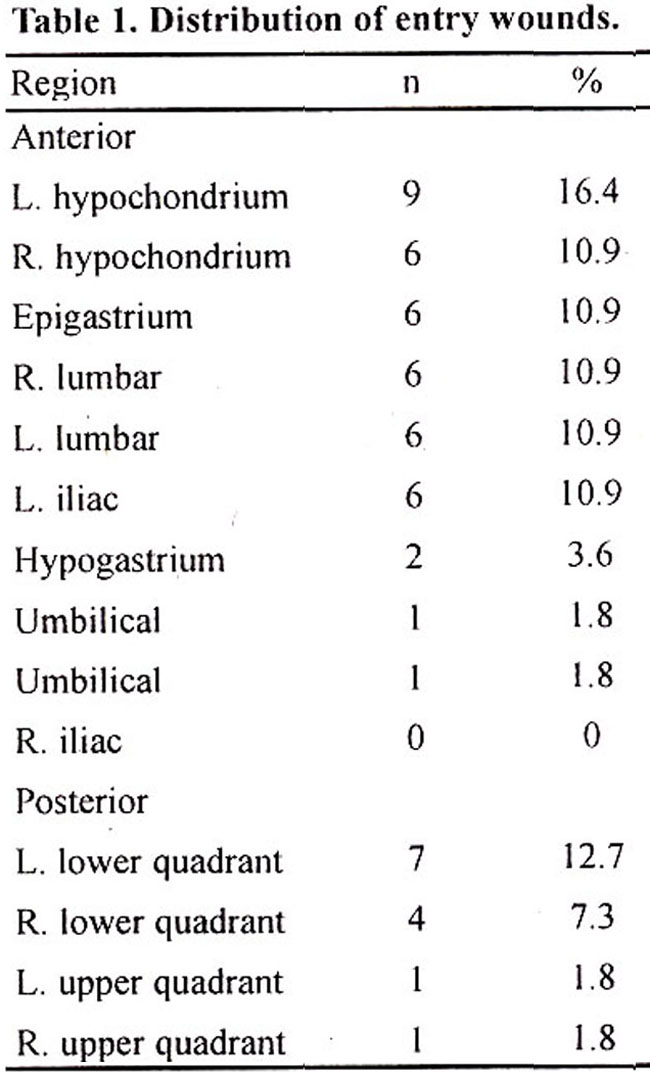
It is evident that the highest co-relation was for the relatively fixed organs of the tipper abdomen i.e., diaphragm, stomach, liver and spleen.
The co-relation of expected and observed injuries was quantified for each patient by calculating the co-relation value. The mean of these 55 co-relation values was found to be 31%.
Discussion
The authors did not find any study in the English literature addressing the issue of surface wound relation to internal injuries. The low overall co-relation (31%) between the expected and observed injuries may be explained on the basis of data relating to gunshot wound ballistics. The effects of bullets on soft tissues have been simulated using models wherein bullets were fired into gelatin and pig muscle2. Thus wound profiles of different types of bullets have been produced, which represent the bullet track and areas of surrounding tissue disruption. These investigations have proved that tissue disruption by firearms can be attributed to two distinct mechanisms3. One of these is the permanent cavity produced by the mass of the bullet itself (the bullet track4). The other mechanism, which is relevant to this study is the “temporary cavity” effect, which is produced when the tissue accelerates radially away from the point of projectile contact. The temporary cavity surrounds the permanent cavity “like a sleeve5, but occupies a much larger volume. In these experiments, the temporary cavity physically moved the tissue, and could be a significant wounding mechanism, depending on its size and the characteristics of the tissue dislodged6. The velocity of the bullet was not found to significantly influence the amount of tissue destruction in these studies7,8. In elastic tissues such as liver were found to be more susceptible to disruption by the temporary cavity than the more flexible body tissues such as muscle, bowel wall and lung2,9,10.
Mobile viscera like bowel tend to be easily displaced rather then disrupted and may account for the low co-relation value of 31 % between expected and observed injuries in this study. This hypothesis is further supported by the differences in co-relation found for solid organs such as liver (52.3%) vs. small intestine (9%) (Table 2).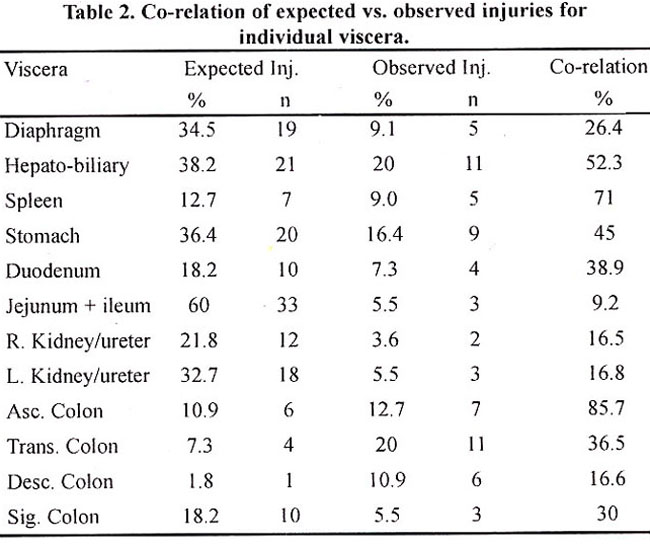
In conclusion, the findings of this pilot investigation confirm the hazards of predicting internal injuries on the basis of surface wounds. Even in hemodynamically stable patients considered for non-operative management, entrance and exit wounds have no co-relation with the presence or location of visceral injuries. The value of entrance and exit wounds in guiding the management of abdominal gunshot wounds is therefore questionable.
References
1.Fackler ML, Surinchak JS, Malinowski JA, et at. Bullet fragmentation: A major cause of tissue disruption. J. Trauma, 1984;24:35-39.
2.Fackler ML, Breteau JPL, Sandowski ICP, et al. Perforating wounds in the abdomen by the modern assault rifle. Chungking, China: Proceedings of the Sixth International Wound Ballistics Symposium. J Trauma, (China) 1990;6(suppl): 192-99.
3.Fackler ML. Gunshot Wound Review. Ann. Emerg. Med., 1996;28:194-203.
4.McCarthy MC, Lowderrnilk GA, Canal DF et al. Prediction of injury caused by penetrating injury to the abdomen, flank and back. Arch.Surg., 1991;126:962-66.
5.Harvey EN, Koitt IM, Osler G. Secondary damage in wounding due to pressure changes accompanying the passage of high velocity missiles. Surgery. 1947;21:218-39.
6.Houdelette P. The dynamics of projectile wounding. Concepts in ballistic injuries (editorial). Ann. Chir. Plast. Esthet., 1998;43: 109-16.
7.Mendelson JA. The relationship between mechanisms of wounding and principles of treatment of missile wounds. J. Trauma, 1991;31:1181-302.
8.Swan KG, Swan RC. Principles of ballistics applicable to the treatment of gunshot wounds. Surg. Clin. North. Am., 1991 ;7 1:221-39,
9.FacklerMi. Ballistic Injury. Ann. Emerg. Med., 1986;15:1451-55.
10.Fackler ML, Malinowski JA. The wound profile: a visual method for quantifying gunshot wound components. J. Trauma, 1985;25:522-29.
Related Articles
Journal of the Pakistan Medical Association has agreed to receive and publish manuscripts in accordance with the principles of the following committees:


