

B. I. Avan ( The Human Development Programme, The Aga Khan University, Karachi. )
F. White ( Department of Community Health Sciences, The Aga Khan University, Karachi. )
October 2001, Volume 51, Issue 10
Research Concepts

Abstract
There is no such concept as “the ideal research method”. Most study types are understood and taught in a relative vacuum without appreciating their philosophical context. However, to achieve an optimal approach is more a matter of resolving the congruence between research purpose and method. Proper location of research methods within a theoretical framework is therefore important, otherwise the resulting over-simplification will eventually lead to inappropriate use of study types. Designing any type of study encompasses the process of identification, exploration and explanation, and utilizes concepts such as manipulation, sampling, replication and time dimensions. Medical research has borrowed study types both from Epidemiology and Social Sciences and practiced as observational and experimental inquiries, and we offer in the present review a framework within which these various types may be understood.
Forthcoming articles on research concepts will review the pertinent study types in greater detail (JPMA 51:362,2001).
A group of medical students captivated by the word “research” wanted to be the part of the research bandwagon. They juggled with several ideas. Finally they decided to discuss their thoughts with the campus epidemiologist. “Sir we want to do a case control study on growth patterns among children”. Faculty often become confused with such assertions, and might ask in response:
“What is the purpose of your project? Do you want to conduct a case control study, or do you want to know about growth pattern?”
Every research project has a specific purpose. The nature, content and context of that purpose determines how that purpose should be achieved. Many medical professionals feel like doing research at some time in their careers. In this pursuit, they soon realize that it is not an easy task to align research purpose and methodological concepts and practices, especially study types.
Medical research is full of glossaries, techniques and descriptions. Certain study types are glamorized to such an extent that sometime their advocacy and usage even precedes the research purpose. The analogy is similar to the world of “fashion”, where trends are copied and followed blindly, irrespective of logic and rationality of individual suitability. The same may happen when study types are adopted without considering the philosophy and conceptual requirements of the study purpose.
In research, in-vogue jargon, techniques and study types usually create dilemmas both at personal and political levels. At a personal level, an individual may think that a particular technique is superior because it is in vogue. At political level, a researcher surrenders to such followings because it will earn him a more favorable response from the scientific community (especially review committees which drive the funding decisions). Such attitudes and influences can be harmful in medical research as they distract the investigator from the fundamental task of unbiased and optimal empirical inquiry. A fuller understanding within the research community regarding the relationship between the purpose of research and the choice of methods would lead to better communication, comprehension and acceptance of research findings.
Moral: Science commits a suicide when it adopts a creed_Thomas Henry Huxley.
If we consider the study purpose as our primary focus, we may then consider a system of study types in which each study type has its own significance, vitality and specific purpose to perform. Metaphorically, one can debate that the pen is mightier than the sword, but practically each one has its own specific contextual utility and would be meaningless in another context. In medical research, any genuinely raised question requires a systematic approach regarding the selection of study types. Literally every question regarding prevalence, incidence, mortality rates, antibiotic sensitivity patterns evaluation of clinical performance, cost-effectiveness of a new preventive or therapeutic regimen, or study of etiology of emerging conditions, requires its own unique response in the selection of study type. For example, one cannot estimate parameters of the disease occurrence, by utilizing study types meant for testing a causal hypothesis or vice versa.
The inter-linked exercise of inter-relating problem statement, study purpose and hypothesis formulation forms the basis of any research. A research purpose is somewhat like a silk worm, which spins its own cocoon around itself to achieve its survival. Nobody except the silkworm itself has a valid judgment about what kind of silkworm cocoon is more suitable for it. Similarly, the basis for every research project is its purpose; so it would be beneficial first to discuss the categories of study purpose, which ultimately determines the development of study type according to its needs.
Research methodology specialists have proposed numerous classifications of study purpose, although the underlying concepts are more or less similar. For this article, to provide explicit relationships of practical value to the reader, the classification is harmonized with the prevalent study type in medical research. Research purpose can be differentiated into three stages of “curiosity”: identification, exploration and explanation.
Identjflcation purpose
The components and context of phenomenon of interest are labeled, characterized and described as factors.
There were more than 50,000 peripheral nerve repair procedures performed in the US during 1995. This would underestimate the frequency of nerve injury because not every traumatic nerve injury is repaired. In addition, intra abdominal procedures and other traumas may add to neurological injuries especially of autonomic nervous system1.
Exploratory Purpose
The links between various factors of phenomenon of interest are explored.
A random sample survey of 354 medical consultants was conducted in Karachi for thefr prescribing practices. Liberal use of antimicrobials, vitamins and injections were observed. The prescribing practices of the consultants in Karachi were considered irrational2.
Explanatory purpose
In scientific enquiry, the phenomenon of interest is explained on the basis of hypothesis testing. Associations may be correlational without being causal (ie., two or more variables may vary together by chance in their natural setting, or non-causal) or causal; the latter may be tested by manipulating the natural setting and/or the factors.
To test the hypothesis, whether a relationship exists between normal amniotic fluid (AFI) and birth weight (BW) in term-patients presentingfor labor, a study was conducted in a hospital setting. It was found that AFI and BW were correlated linearly [p<0.0001]3.
The first two types have the effect of broadening the sphere of research activities, as their perspective is more discovery-oriented so that study types for these purposes should have a greater margin for wider spectrum information collection. By their nature, relatively less stringent and flexible study types better suit these research purposes. By contrast, the explanatory purpose actually narrows the sphere of research: the perspective is more towards establishing a specific fact. It requires exclusion of spurious associations, minimization of bias and maximum validity of a research finding. Consequently, study for this purpose requires precise and accurate measurements; relatively more stringent and controlled study types better suit this type of research purpose.
Moral: We...repeatedly enlarge our instrumentalities without improving our purpose_Will Durant.
To achieve study purposes, study types are classified mainly on the basis of the following three concepts: manipulation, sampling vs. replication, and time dimension.
Manipulation
Manipulation refers to management of study subjects for a specific research purpose. The researcher has control over the independent variable and purposefully varies it to observe its effect on the outcome variable.
To compare the effectiveness of 2 urinary drainage systems, ICU patients during the first 6 months underwent Two-chamber open Drainage System (TCOS) and Complex Closed Drainage System (CCDS) in the next 6 months. During this period patient care and diagnostic criteria were kept constant. The cost of the CCDS was $3 higher than TCOS. In the end, no difference was noted between the 2 systems for nosocomial urinary tract infection4.
Sampling vs Replication
Sampling is a strategy in which a subset of a study population is selected in a manner assumed to be representative of the population. The information obtained from a sample would be considered valid for the population. Sampling assumptions underlie most forms of statistical analysis, and applied whenever research deals with estimation of phenomena in populations having specific health-related states and in the conduct of tests of statistical inference in the assessment of factors associated with such phenomena.
For evaluation of breast-feeding practices, 1601 mothers were randomly selected as representatives of monthly deliveries in 20 major districts of Italy5.
In order to assess the impact of a World Bankass istedAgricult ure Development Project (ADP) in Nigeria, a sample of 50 households was selected from an ADP area and 125 from a non-ADP area. Signiflcant differences were observed for nutrition, housing and state of health among the 2 sample categories6.
On the other hand, requirement of certain types of research are not congruent with the sampling strategies or assumptions of statistical analysis. In replication, the research considers èertain sets of phenomena in which each individual experience is considered as a complete and whole phenomenon in its context. If multiple individual experiences are studied as individual experiments or phenomenon, this is known as replication, not sampling. Consequently quantitative analysis relies on non- statistical strategies.
In Order to investigate about the mild Guillain Barre syndrome (GBS), only 12 of 254 patients of GBS were admitted with the diagnosis of mild severity in the community teaching hospital from 1992-2000. There were no age, sex or seasonal differences found in comparison of mild GBS with a case series of all severity7.
Replication is a process of repeating the same experience, treatment or observation on more than one research unit, and helps to reduce errors in assessment and to increase the confidence in findings. In non-statistical analysis, individual experience is a research unit, so it follows that experience of multiple units is possible. While the statistical sample is also considered a research unit, repeated sampling is generally not feasible. Statistical methods in either instance are employed primarily to build confidence in research findings (e.g. confidence intervals), in order to assess the likelihood that particular observations may or may not be due to chance.
Thne dimension
The time dimension is another concept utilized in classification of study types. The time of a measurement is an important consideration in research because health related states and associated factors have may have specific configurations/conglomerations at certain instances or may evolve over time. Furthermore, sequencing of factors on a time axis is fundamental to the criterion of establishing temporal relationships, which may be essential to the assessment of causality. Time may be considered either as a cross-sectional or longitudinal characteristic of particular study types.
Cross sectional
The measurement of health related state (outcome) and proposed exposure factors are assessed simultaneously on research participants.
For comparison of quality of care by specialist and general ist physicians for asthmatic children, a survey was conducted on 260 parents of asthmatic children. Parents were asked for the type of physician and quality of care. Then quality care was compared with National Asthma Guidelines. It was concluded that asthma treatment of children was more likely to be consistent with national guidelines, when a specialist was the primary care provider8.
Retrospective (ex post facto)
The measurement of proposed exposure factors are done after the determination and measurement of the outcome on research participants.
A study was conducted in an urban emergency department setting offood consumption patterns of patients suffering from suspected food poisoning. It was concluded that food poisoning patients are about twice as likely to have recently eaten out as compared to other mobile patients attending the emergency rooms [OR=2.4 95%CI 1.3-4.5]9.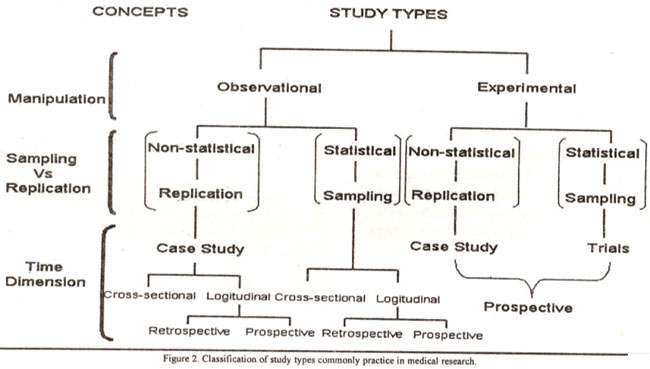
Prospective
Measurement of proposed exposure factors is done prior to determination and measurement of the outcome in research participants.
In Honolulu Heart Program, elderly people were followed for 20 years. It was concluded that lowering of cholesterol (<4.65 m mol/L.) is associated with a significantIy high mortality as compared to all cause mortality10.
In summary, in the cross-sectional approach, data regarding outcome and exposure are assessed at a single point over time. By contrast, in the longitudinal approach, outcome measurements are taken at different points. Consequently data is collected at more than one point over time.
Moral: Research is to see what everybody else has seen, and to think what nobody else has thought Albert Szent-Cyorgi.
Only those activities, which evaluate empirical evidence on the basis of scientific principles, is worthy of the term “medical research”. The classification of study types captures the pertinent research methods practiced in medical disciplines. A majority of them have been developed by epidemiology and inspired by the principles of biostatistics. A few of them have taken their inspiration from social sciences, some of which are also derived from statistical foundations, while others follow the principles of nonstatistical and alternative approaches to analysis.
Types of research, which monitor the natural state and course of events, without intervening, are known as observational studies.
To assess the depression during antenatal and postpartum phases, pregnant worn en were evaluated at different intervals through postal questionnaire of a depression scale. The presence of depression symptoms was not signiflcantly different between these phases11.
The researcher’s role in an observational study is only to observe, record and analyze the collected data.
Types of research, which entail a purposeful of events, are known as experimental studies.
Therapeutic usefulness of surgery in temporal lobe epilepsy is not established In order to investigate, one randomly selected group was treated with an antiepileptic drug and the other group was operated upon surgically. It was concluded that surgery is superior to medical treatment for this condition [P<0.001]12.
Observational and experimental studies are further classified on the basis of techniques utilized in the analysis of the empirical evidence. Case studies are evaluated on the basis of non-statistical approach while epidemiological studies are analyzed on the basis of their biostatistical fundamentals.
Further, studies may be categorized on the basis of timing of measurements: observational studies are either cross-sectional or longitudinal (i.e. prospective and retrospective), while experimental studies have only one time axis i.e. prospective.
Moral: Science seeks generally only the most useful systems of classification: these it regards for the time being, until more useful classification are invented as true — S. I. Haykawa.
These classifications of the concepts may sound some what rigid and mechanical like any other theoretical exercise, especially as the real world in which these concepts are applied is not that organized,calculated or perfect. Consequently, theory and practices can never be completely congruent. Theoretical concepts are ideals, which set the standard for medical research. Though they are extremely difficult to achieve wholly, one should strive nonetheless to achieve the optimal type of study for the given study purpose. Due to heterogeneity of researchable issue and problems in conducting research, there is always demand for good judgment, skill and creativity on the part of the researcher, so that the purpose of the research is achieved with minimum compromise to the principles of sound study design.
Moral: Creativity in science cannot be put into a methodological straightjacket — Leahey.
References
1. Evans GR. Peripheral nerve injury: a review and approach to tissue engineered constructs. Anat Rec. 2001 ;263:396-404.
2. Das N, Khan AN, Badini ZA, et al. Prescribing practices of consultants at Karachi, Pakistan. J. Pak. Med. Assoc., 2001;51:74-7.
3. Myles TD, Nguyen TM. Relationship between normal amniotic fluid index and birth weight in term patients presenting for labor. 1. Reprod. Med., 200 1;46:685-90.
4. Leone M, Gamier F, Dubuc M, et al. Prevention of nosocomial urinary tract infection in ICU patients: comparison of effectiveness of two urinary drainage systems. Chest. 2001;120:220..4.
5. Giovannini M, Banderali G, Agostoni C, et a!. Epidemiology of breastfeeding in Italy. Acta Paediatr (suppi). 1999;88:19-22.
6. Umeh JC. Rural health and labour supplies: empirical evidence from the World Bank Assisted Agricultural Development Project in the Kwara State of Nigeria. Soc. Sci. Med., 1991;32:1351-60.
7. Green DM, Ropper AH. Mild Guillain-Barre syndrome. Arch. Neurol., 2001;58:1098-101.
8. Diette GB, Skinner EA, Nguyen TT, et al. Comparison of quality of care by specialist and generalist physicians as usual source of asthma care for children. Pediatrics. 2001 ;108:432-7.
9. Leman P, Strachan D. A case-control study of food poisoning seen at an accident and emergency department. Lancet., 2001 ;358:387-8.
10. Schatz lJ, Masaki K, Yano K, et al. Cholesterol and all-cause mortality in elderly people from the Honolulu Heart Program: a cohort study. Lancet., 2001 ;358:351-5.
11. Evans 3, Heron 3, Francomb H, et al. Cohort study of depressed mood during pregnancy and after childbirth. Br. Med. J., 2001 ;323:257-60.
12. Wiebe S, Blume WT, Girvin JP, Eliasziw M. A randomized, controlled trial of surgery for temporal-lobe epilepsy. N. EngI. J. Med., 2001;345:311-8.
Journal of the Pakistan Medical Association has agreed to receive and publish manuscripts in accordance with the principles of the following committees:


