

S. W. Khan ( Fourth Year Student. Ziauddin Medical University Hospital. Karachi. )
A. Ahmed ( Fourth Year Student. Ziauddin Medical University Hospital. Karachi. )
February 2001, Volume 51, Issue 2
Student's Corner

Abstract
Objective: To determine the frequency and antibiotic susceptibility pattern of uro-pathogens.
Setting: Department of Pathalogy, Ziauddin Medical Hospital Laboratory, Karachi.
Method: A retrospective analysis was done on all the urine samples sent for culture and sensitivity during a seven months period. Two thousand eight hundred and forty four urine samples were received and inoculated in cysteine lactose electrolyte deficient agar (CLED). Positive samples were identified, processed and antibiotic susceptibility was carried out. Data was analyzed using Microsoft® Excel 97.
Results: E. coli (45.6%) was the leading uropathogen followed by candida spp. (10.5%), enterococcus spp. (10.2%). For E. coli ampicilin, ceftazidime , nitrofurantoin and gentamycin sensitivity was 26%, 20%, 79.5%, 65% respectively. Enterococcus isolates showed 60% resistance to ampicillin.
Conclusion: The resistant pattern of uro-pathogens causing urinary tract infections to common antimicrobial agents is changing and must be taken into account when selecting treatment strategies. Therefore, antibiotic policy should be made according to local surveillance data (JPMA 51:98, 2001).
Introduction
Urinary tract infection (UTI) is one of the most common infections observed in clinical practice among community and hospitalized patients1. Twenty five to 35% of all females suffer from UTI at some stage in their lives2. UTI forms 40-50% of the total of nosocomial infections and is a therapeutic problem3, a cause of morbidity renal scarring and end stage renal disease4. The choice of antibiotics should depend upon the causative organism and their susceptibility pattern to various antibiotics5. Hence, the knowledge on the frequency of the causative organisms and their sensitivity pattern requires reappraisal from time to time for effective treatment6. This retrospective study reports the pattern of uropathogens and their antibiotic resistance in a tertiary care hospital.
Material and Methods
A retrospective analysis of 2844 urine samples collected for culture and sensitivity at Ziauddin Medical University Hospital Laboratory from January Ito July, 31. 1999 was done. All samples were cultured on cysteine lactose electrolyte deficient (CLED) medium. The plates were incubated at 37oC for 24 hours and bacteria were identified by standard methods. .Six hundred sixty-six positive urinary cultures were processed and antibiotic sensitivity was done by Kirby-Bauer disc diffusion method. The data so obtained was recorded and was analyzed using program Microsoft® Fxcel 97.
Results
A total 2844 samples were collected and 666 (23%) gave positive urine culture with various uropathogens.
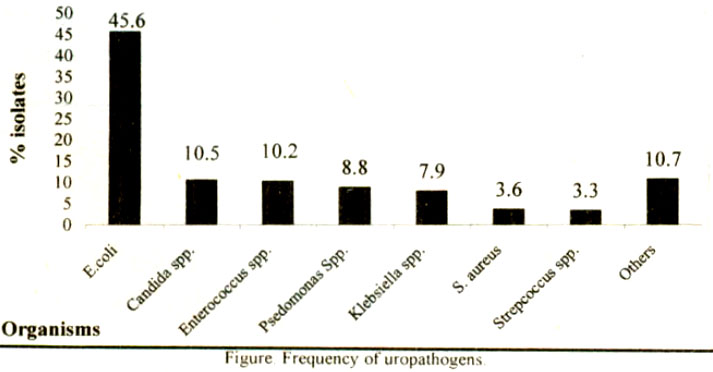
Figure 1 shows E.coli as the common uropathogen followed by Candida species and gram positive Enteroccocus species. Candida species were isolated 78.5% from hospitalized patients. There is a high resistance pattern of E.coli to ampicllin (74%) and ceftazidime (80%) respectively.
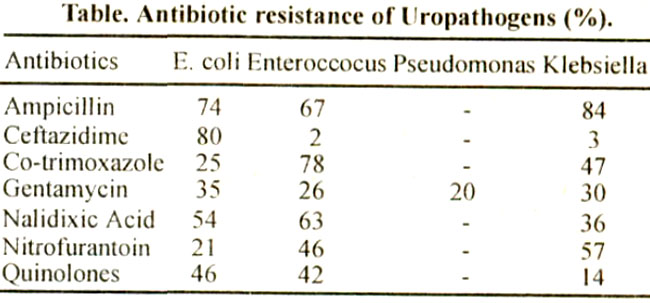
Table 1 refers to antibiotics to which bacteria were resistance. E.coli and Kiebsiella species showed similar resistant pattern to ampicillin (74 and 84% respectively) and to gentamicin (“35 and 30% respectively). Pseudomonas species was 20% resistant to gentamicin. S. aureus showed 12.5% resistance to methicillin.
Discussion
The spectrum of uropathogens isolated from urine in this study is not too different from that reported in literature. Throughout Pakistan various studies7-13 had been conducted for causative agents of UTI, which reports that E.coli is the leading pathogen. Our study shows similar findings. Candida species is the second common payhogency this finding is not comparable with other studies done in Pakistan7-13. Enteroccocus species is the third most common pathogen in our study; similar reporting is done by Nizami et al.7 showing that now gram positive bacteria are becoming one of the main uropathogens of UTI.
The resistant pattern of E.coli against ampicillin had been raised to 20-25% in past decade. Khan et al.8 also report that anipicillin is least effective E.coli strains in 19899 were sensitive to nitrofurantoin, nalidixic acid but after 10 years the resistance rate had increased to almost 50 to 60% and in cases of qiiinotones up to 13 to 25% while that of co-trirnoxazole had been decreased. The decreasing pattern of resistance could be due to abandoning first line of drugs and using new and strong antibiotics in the last few years. The resistant pattern of Ecoli in our study is same as that of past 2-3 years10,11. The resistance pattern of Klebsiella species is more or less the same as that of E. coli.
In our setting where there is no guideline for antibiotic use, unchecked use will increase the resistant strains of previously sensitive bacteria as reported by laboratory reports6,12. Pseudomonas species were least resistant against gentarnicin in last 10 to 15 years6,8,13 but resistance pattern has increased now.
S. aureus was 12.5% methicillin resistant. A study done in 1989~ showed that at that time there were 5% Methicillin resistance Staphylococcus aureus (MRSA) cases, but no definitive actions were taken to reduce their emergence. For MRSA positive patients, proper screening program should be carried out as set by British Society for Anti-Microbial Chemotherapy15.
The study shows that there was not a single antibiotic, which showed zero percent resistance against any one of uropathogens. This points towards the need of making strict antibiotic guidelines for rational use and the need of continuous surveillance of frequency and antibiotic susceptibility pattern of microogranisms for effective empiric therapy. This has now been carried in few tertiary care hospitals in Pakistan to avoid emergence of new resistant strains.
References
1.Topley N, William JD Urinary tract infections in adults Med Interne.. 1991 4:3064-70.
2.Charania S. Siddiqui P. Hayat L. A study of urinary infections in school going female children. J. Pak. Mcd. Assoc., 1980:30:165-7.
3.Turk M, Siamm W. Nosocomial urinan’ tract infection Am. J. Med. 1981,70:651-5.
4.Sanford JP. Urinary Tract Symptoms and infections. Am. Rev, Med., 1975;26:85.
5.Goldstein FW. Antibiotic susceptibility of bacterial strains isolated from patients with community acquired urinary tract infections in France. Multicentre Study Group. Eur. J. Clin Microbial. Infect. Dis.. 2000:19:112.
6.Ahined S I Antibacterial sensitivity pattem in urinary tract infection 1975-79. J. Pak. Med. Assoc., 1982;32:69-71.
7.Nizami, SQ. khan IA, Farooqui Bi. Treatment of UTI in children in Karachi, Pakistan: Which antibiotic to use?. Infect. Dis J. Pak,l997;25-6.
8.Khan AS. Khan H. In vitro antibacterial activity of commonly used antibiotics against urinary tract isolates. J. Pak Med. Assoc.. 1987:37 154.
9.Farooqui BJ, Khurshid M, Alam M, Urinary tract infections. J. Pak. Med. Assoc., 1989; 39:129-31.
10.Abmed A, Zafar A, Rizvi S. et al. Quinolone resistance among common urinary tract pathogens E.coli and Kiebsiella Infect. Dis. J. Pak.. 2000;7:1211, Ahmed M. Mumtaz S. Jarnila I. Urinary Tract Infections: prevalent organisms and their sensitivity pattern in catheterized patients. Pak. J. Med. Res., 1997;36:136-9.
12.Antibiotic pattern of pathology Laboratory. Antibiotic susceptibility Repoil Jan-June 1997. Aga Khan University Hospital J Pak. Med. Assoc., 1998:48:24.
13.Khan FA, Siddiqui SH, Bailey E. Urinary tract infection: a survey of the prevalent strains and their sensitivity. J. Pak, Med. Assoc., 1981:31:259-62.
14.Ashiq B. Tareen AK. Methicillin resistant S.aureus in a teaching hospital in Karachi. J. Pak. Mcd. Assoc., 1989;39:61-2.
15.Ayliffe GA. Guidline for the control of epidemic of MRSA. Report of Hospital Infection Society for Anti microbial Chemotherapy. J. Hosp. Infect., 1986:7:193-96.
Related Articles
Journal of the Pakistan Medical Association has agreed to receive and publish manuscripts in accordance with the principles of the following committees:


