

Mohammad Zafar Rabbani ( Department of ENT, Head and Neck Surgery, Shifa International Hospital,Islamabad. )
Zafar Iqbal ( Department of ENT, Head and Neck Surgery, Shifa International Hospital,Islamabad. )
Muhammad Jawad Zafar ( Shifa College of Medicine, Islamabad. )
October 2009, Volume 59, Issue 10
Original Article

Abstract
Objective: To compare the frequency of haemorrhage after tonsillectomy as a day care procedure versus tonsillectomy as a one day procedure.
Methods: A comparative study was conducted at the Department of ENT and Head and Neck Surgery,
Results: Post tonsillectomy haemorrhage was seen in 10 patients (2.5%), 4 (2%) occurred in day care group while 6 (3%) in one day group. All were secondary haemorrhages. Chi square test showed no significant difference in haemorrhages between the two groups.
Conclusions: Tonsillectomy can safely be done as a daycare procedure as there is no significant difference of post operative haemorrhage between daycare and one day admission (JPMA 59:709; 2009).
Introduction
Tonsillectomy is defined as the surgical excision of the palatine tonsils and is a procedure routinely done in the ENT specialty. The majority of patients are from a younger age group and in these patients tonsillectomy is often combined with adenoidectomy, in which case the procedure is called adenotonsillectomy. Usual indications for tonsillectomy are recurrent attacks of sore throat and obstructive sleep apnoea (OSA), confirmed through sleep studies. Minimum age at which tonsillectomy can be performed is still controversial. Studies have shown that it can be done safely even in children younger than 3 years. The only concern in such a young age is the inability of the child to eat properly after the procedure.1
There is an increasing popularity of day surgery these days in an attempt to decrease the risk of nosocomial infections and economic burden on the patient due to prolonged hospital stay. All over the world different procedures are being done in the day care unit and tonsillectomy has also gained popularity as a day care procedure.2 The primary reservation with choosing day care tonsillectomy over the traditional approach is the risk of post operative haemorrhage, and this is the base on which this study was conducted.
Patients and Methods
The study was conducted at the department of ENT and head and neck surgery
Results
The gender and mean age of the two groups were comparable. (Table-1, Figure). A total of 10 patients 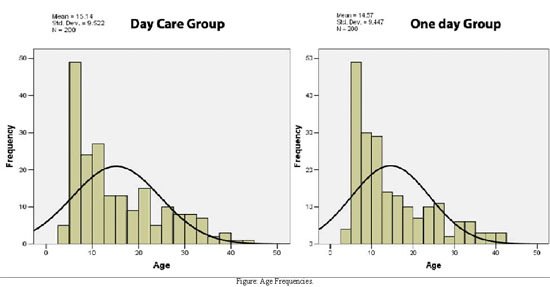
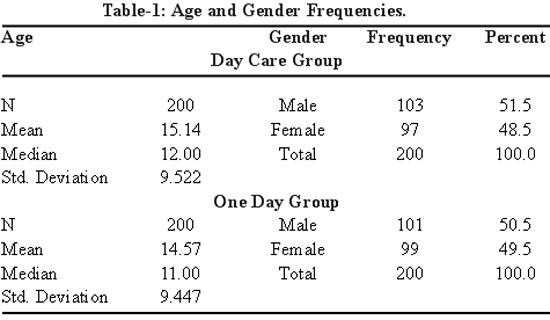
In the daycare group, secondary haemorrhage was seen in 4 patients (2%). One patient presented at 6th post-operative day, one at 10th post-operative day and two patients presented at 8th post-operative day. In this group all haemorrhages occurred in males. In the one day group, 6 patients (3%) presented with secondary haemorrhage, 4 patients presented between 5th-10th post operative day while two at 12th and 14th post-operative days respectively. In this 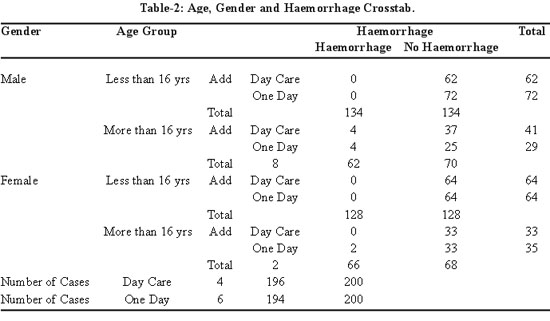
On comparing incidence of haemorrhage in both the groups and applying chi-square test it was noted that there was no significant difference between the two groups.
No significant difference was observed between the two groups on the frequency of post tonsillectomy haemorrhage.
Discussion
Tonsillectomy done either alone or combined with adenoidectomy (adenotonsillectomy) is commonly practiced in the ENT specialty. There is an increasing number of patients with complaints of recurrent attacks of sore throat and most of them are from the younger age group. There are certain indications of tonsillectomy, for example recurrent attacks of acute tonsillitis in the absence of any nasal pathology, enlarged tonsils causing upper airway obstruction, severe dysphagia and sleep disturbances. Peritonsillar abscess is another indication in which tonsillectomy is done after the acute episode has subsided, usually 4-6 weeks after the infection has settled (called as interval tonsillectomy). Streptococcal and diphtheria carriers are relative indications for tonsillectomy. This procedure may also be required in certain malignant conditions like lymphoma in which the tonsil is removed for histopathological examination.
Over the years, surgeons have wanted to keep the patient admitted in hospital after tonsillectomy for one or two days because of the risk of serious complications like haemorrhage. However prolonged stay at the hospital not only increases the risk of hospital acquired infections, but also the cost of medical care to the patient. Our objective was to compare post operative haemorrhage after tonsillectomy done as a daycare and one day procedure.
The concept of daycare surgery, not only decreases the risk of hospital acquired infections but also reduces the cost for the patient.3 When the patient is referred for daycare surgery, it is essential to ensure that the procedure is suitable, the risk of complications (from surgery and anaesthetic) are minimized, admission to in-patient department following the day surgery is prevented and patients are adequately supported after discharge at home.
Daycare procedures are being done in various centers around the world in different specialties. Tonsillectomy has been traditionally performed as an in-patient procedure, but it has also gained popularity as a daycare procedure. Usually, it is the surgeon's decision whether to keep the patient for one day or more post operatively or discharge him on the same day of surgery.4,5 Often, it is the younger children who require careful post operative observation and may need to be admitted overnight.6 Studies have proved that in smaller children a short period of observation is all that is required.7-9 Adults, on the other hand, can be benefited with daycare tonsillectomy10 probably because of better compliance than the younger age group.
In our study all the post operative haemorrhages seen were secondary haemorrhages. The episode of bleeding in patients of both groups occurred at home and hence prolonged admission of the daycare patients for observation purpose would not have given any added benefit over day care protocol. They were kept under observation in hospital for 24 hours with conservative management. No bleeding was seen in any patient during hospital stay and none of them required blood transfusion or return to theater for any intervention.
From our study we concluded that tonsillectomy as a daycare procedure is safe and can be adopted in the routine practice provided there is specialized daycare staff.
No significant difference was found in post-tonsillectomy haemorrhage between day one and one day admission patients.
References
1.Mitchell RB,
2.Riding K, Laird B, O'Connor G,
3.Schloss MD, Tan AK, Schloss B, Tewfik TL. Outpatient tonsillectomy and adenoidectomy: complications and recommendations. Int J Pediatr Otorhinolaryngol 1994; 30: 115-22.
4.Holzmann D, Kaufmann T, Boesch M. On the decision of outpatient adenoidectomy and adenotonsillectomy in children. Int J Pediatr Otorhinolaryngol 2000; 53: 9-16.
5.Guida RA, Mattucci KF. Tonsillectomy and adenoidectomy: an inpatient or outpatient procedure? Laryngoscope 1990; 100: 491-3.
6.Postma DS, Folsom F. The care of an outpatient "approach" for all pediatric tonsillectomies and/or adenoidectomies: a 4-year review of 1419 cases at a community hospital. Otolaryngol Head Neck Surg 2002; 127: 101-8.
7.Mills N, Anderson BJ, Barber C, White J, Mahadevan M, Salkeld L, et al. Day stay paediatric tonsillectomy — a safe procedure. Int J Pediatr Otorhinolaryngol 2004; 68: 1367-73.
8.Lalakea ML, Marquez-Biggs I, Messner AH. Safety of pediatric short-stay tonsillectomy. Arch Otolaryngol Head Neck Surg 1999; 125: 749-52.
9.Kalantar N, Takehana CS, Shapiro NL. Outcomes of reduced postoperative stay following outpatient pediatric tonsillectomy. Int J Pediatr Otorhinolaryngol 2006; 70: 2103-7.
10.Fenton JE, O'Dwyer TP. Adult day case tonsillectomy: a safe and viable option. Clin Otolaryngol Allied Sci 1994; 19: 470-2.
Journal of the Pakistan Medical Association has agreed to receive and publish manuscripts in accordance with the principles of the following committees:


